
Australia Dependent Visa
Reunite with Your Loved Ones in Australia
Australia offers several visa pathways that allow eligible partners, children and other family members to join Australian citizens, permanent residents and temporary visa holders.
The appropriate dependent or family visa depends on your relationship with the primary visa holder, their visa status, your age and dependency status, and whether you are applying from inside or outside Australia.
WorldVisaHelp can help you understand the available family and dependent visa options, prepare supporting documents and navigate the application process.
Australia Dependent Visa Process
Partner Visa Subclass 309
The Partner Visa Subclass 309 is a temporary partner visa for the spouse or de facto partner of an Australian citizen, Australian permanent resident or eligible New Zealand citizen.
It is generally the first stage toward the permanent Partner Visa Subclass 100.
To qualify, the applicant must demonstrate that they are in a genuine and continuing relationship with their Australian partner and satisfy the applicable visa requirements.
Features of Subclass 309
- Temporary partner visa
- Provides a pathway toward the permanent Partner Visa Subclass 100
- Applicant generally applies while outside Australia
- Available to eligible spouses and de facto partners
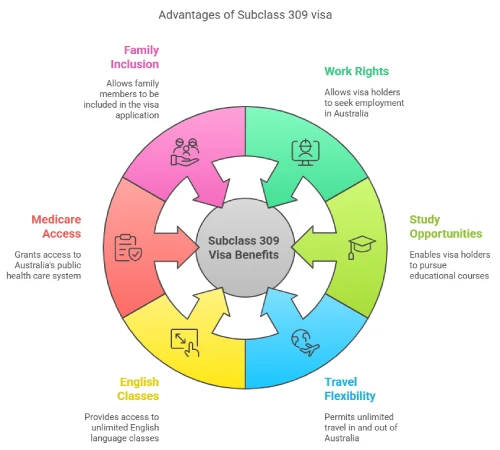
Benefits of Subclass 309
Depending on the visa conditions, a Subclass 309 holder can:
- Live in Australia temporarily
- Work in Australia
- Study in Australia
- Travel to and from Australia
- Access eligible healthcare arrangements
- Include eligible dependent family members in the application
Australia Family & Dependent Visas
Australia offers several visa pathways for partners, children, parents and other eligible family members of Australian citizens, permanent residents and certain eligible New Zealand citizens. The appropriate pathway depends on the relationship, the sponsor's status, where the applicant is located and whether the intended stay is temporary or permanent.
Family visa requirements can differ substantially between subclasses. Applicants should therefore identify the correct pathway before preparing documents or submitting an application.
Australia Partner Visa Subclass 309
The Partner Visa Subclass 309 is a temporary partner visa pathway for eligible spouses and de facto partners of Australian citizens, Australian permanent residents or eligible New Zealand citizens who apply from outside Australia.
The visa is part of the offshore partner visa pathway and is associated with the permanent Partner Visa Subclass 100 stage.
Applicants generally need to demonstrate that their relationship with their Australian partner meets the applicable requirements and provide evidence supporting the relationship.
Duration of Stay
Subclass 309 is a temporary visa. The holder can generally remain in Australia while progressing toward the permanent Partner Visa Subclass 100 stage, subject to the applicable visa conditions.
The transition to the permanent stage is not based on one fixed timeframe for every applicant. Processing can vary according to the application, supporting evidence, relationship circumstances and Department of Home Affairs processing.
Australia Partner Visa Subclass 100
The Partner Visa Subclass 100 is the permanent stage of the offshore partner visa pathway.
Applicants must continue to satisfy the relevant requirements and demonstrate that their relationship with their Australian partner remains genuine and continuing.
Once granted, the Subclass 100 allows the holder to remain in Australia permanently, subject to Australian immigration law.
Permanent residents may subsequently be able to apply for Australian citizenship when they satisfy the separate citizenship requirements.
Partner Visa Processing Time
Partner visa processing times can vary significantly between applications.
Factors that can affect processing may include:
- Completeness of the application
- Quality and quantity of supporting evidence
- Response time to requests for additional information
- Verification of documents and information
- Health examinations
- Character checks
- Circumstances of the applicant
- Circumstances of the sponsor
- Overall application complexity
Applicants should therefore avoid relying on a fixed processing timeframe.
Dependent Visas for International Students
International students studying in Australia may be able to bring eligible family members with them, depending on the conditions of their student visa and the applicable immigration requirements.
Eligible family members can include:
- Spouse
- De facto partner
- Dependent children
A family member may be included in the original student visa application or may be able to apply subsequently, depending on the circumstances and applicable rules.
Applicants should carefully check the requirements that apply to their particular student visa before making arrangements for dependents.
Documents for Student Dependents
Where a dependent applies after the primary student has commenced their course, supporting documents may include:
- Evidence of the student's current visa status
- Evidence of course enrolment
- Evidence of the family relationship
- Marriage certificate or relationship evidence
- Birth certificates for children
- Evidence of financial capacity
- Evidence of health insurance
- School enrolment evidence for school-aged children where applicable
- Identity documents
- Other documents requested by the Department of Home Affairs
The exact documentation can depend on the visa held by the primary applicant and the circumstances of the dependent.
For students considering Australia as their study destination, see Study Australia.
Dependents of Post-Study Work Visa Holders
Eligible family members of Australian temporary visa holders may be able to join the primary visa holder, subject to the conditions of the relevant visa.
A post-study work visa holder may need to provide evidence relating to:
- Current Australian visa status
- Relationship with the dependent
- Financial circumstances
- Health insurance
- Character requirements
- Identity
- Other applicable visa requirements
The available pathway depends on the primary applicant's current visa and whether the relevant visa permits subsequent or additional family members.
Applicants should verify the conditions attached to the primary visa before selecting a dependent pathway.
Dependents of Australian Work Visa Holders
Australia has several temporary and permanent work-related visa pathways that may allow eligible family members to accompany or join the primary visa holder.
Depending on the visa category, eligible family members may include:
- Spouse
- De facto partner
- Dependent children
- Other eligible dependent family members where specifically permitted
The eligibility of family members depends on the primary visa subclass and its applicable conditions.
The primary visa holder and accompanying family members may need to satisfy requirements concerning health, character, relationship evidence, financial circumstances and other applicable criteria.
Applicants considering skilled migration can also explore the Australia Skilled Visa pathway.
Australia Child Visa
Australia provides several child-related visa pathways for eligible children of Australian citizens, permanent residents and eligible New Zealand citizens.
The appropriate visa depends on factors such as:
- Location of the child
- Australian status of the parent
- Whether the child is biological, adopted or a stepchild
- Age of the child
- Dependency circumstances
- Whether the child is applying from inside or outside Australia
Child Visa Subclasses
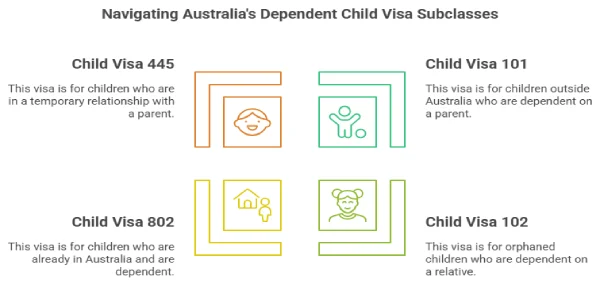
Common child-related pathways include:
- Child Visa Subclass 101 – for eligible children applying from outside Australia
- Adoption Visa Subclass 102 – for eligible children adopted or being adopted from outside Australia
- Child Visa Subclass 802 – for eligible children applying from inside Australia
- Dependent Child Visa Subclass 445 – a temporary pathway for certain dependent children of eligible temporary partner visa holders
The requirements differ between subclasses, so the child's circumstances and the parent's visa status should be assessed before selecting the appropriate pathway.
Australia Subclass 491 Visa
The Skilled Work Regional (Provisional) Visa Subclass 491 is a points-tested regional visa pathway for eligible skilled workers.
It allows eligible visa holders to live, work and study in designated regional areas of Australia, subject to the conditions of the visa.
What Can You Do With a Subclass 491 Visa?
Eligible visa holders can generally:
- Live in designated regional areas of Australia
- Work in regional Australia
- Study in regional Australia
- Travel to and from Australia while the visa is valid
- Potentially progress toward permanent residence after meeting the relevant requirements
The Subclass 491 is a skilled regional pathway rather than a family or dependent visa. Its inclusion is relevant where applicants are considering skilled migration as an alternative or longer-term pathway.
For applicants considering permanent residence through other Australian pathways, see Australia Permanent Resident Visa.
Subclass 491 Application Process
Step 1: Submit an Expression of Interest
Eligible applicants submit an Expression of Interest (EOI) through SkillSelect.
The EOI may contain information concerning:
- Qualifications
- Occupation
- Skills assessment
- Employment history
- English-language ability
- Age
- Other points-tested factors
Step 2: Prepare Supporting Documents
Applicants should prepare documents supporting the information provided in their EOI.
These may include:
- Educational qualifications
- Skills assessment
- Employment evidence
- English-language test results
- Identity documents
- Other documents relevant to the points claimed
Step 3: Receive an Invitation
If an applicant receives an invitation, they can proceed with the visa application within the timeframe specified in the invitation.
An invitation does not itself constitute a visa grant.
Step 4: Lodge the Visa Application
The applicant submits the Subclass 491 application online with the required supporting documents and applicable government charges.
Information provided in the application should correspond with the information previously declared in the EOI.
Step 5: Complete Additional Requirements
Applicants may be required to:
- Complete health examinations
- Provide police certificates
- Provide additional documents
- Respond to requests for further information
Step 6: Receive the Visa Decision
The Department of Home Affairs assesses the application and communicates the outcome to the applicant.
Applicants should monitor their application and respond to requests within the specified timeframe.
Australia Parent Visa
Australia has several parent visa pathways for eligible parents of Australian citizens, Australian permanent residents and eligible New Zealand citizens.
The appropriate pathway depends on the applicant's circumstances, the Australian child's status, location, sponsorship arrangements and whether the applicant is seeking temporary or permanent residence.
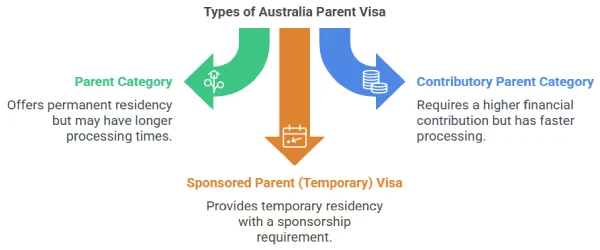
Parent-related pathways can include:
- Parent visa pathways
- Contributory Parent visa pathways
- Sponsored Parent (Temporary) Visa Subclass 870
Parent Category
The Parent visa pathway allows eligible parents to seek migration to Australia where the relevant requirements are satisfied.
Applicants generally need an eligible child who can sponsor them and may need to satisfy requirements relating to:
- Family relationship
- Sponsorship
- Balance of Family Test
- Health
- Character
- Assurance of Support
- Other applicable requirements
Permanent parent visa holders may, subject to the conditions and applicable Australian rules:
- Live permanently in Australia
- Access eligible healthcare services
- Sponsor eligible family members where permitted
- Apply for Australian citizenship when eligible
- Access certain social security benefits subject to applicable waiting periods and rules
Contributory Parent Category
The Contributory Parent visa pathway involves substantially higher application costs than the non-contributory parent pathway and is designed to provide a different processing pathway.
Applicants must meet the applicable eligibility and sponsorship requirements.
Depending on the subclass, applicants may also need to provide an Assurance of Support and associated financial security.
Eligible permanent visa holders may generally be able to:
- Live permanently in Australia
- Access eligible healthcare services
- Travel to and from Australia subject to applicable visa conditions
- Sponsor eligible family members where permitted
- Apply for Australian citizenship when eligible
Applicants should distinguish between temporary parent visas and permanent contributory or non-contributory pathways when planning their migration.
Sponsored Parent (Temporary) Visa Subclass 870
The Sponsored Parent (Temporary) Visa Subclass 870 allows eligible parents to temporarily stay in Australia with their children.
Depending on the visa period granted, eligible parents may be able to remain in Australia for three or five years, subject to the applicable requirements and maximum stay rules.
The Subclass 870 is a temporary visa and should not be treated as a permanent parent migration pathway.
The visa has its own sponsorship and application requirements, and applicants should verify the current conditions before applying.
Parent Visa Eligibility
Eligibility requirements vary according to the parent visa subclass.
Applicants may generally need to:
- Have an eligible child who is an Australian citizen, permanent resident or eligible New Zealand citizen
- Meet applicable sponsorship requirements
- Meet the Balance of Family Test where required
- Satisfy health requirements
- Satisfy character requirements
- Meet relevant financial or assurance requirements
- Provide evidence of the parent-child relationship
- Meet any additional requirements of the selected subclass
Not every parent visa requires the same criteria, so applicants should identify the appropriate subclass before preparing their application.
Family Visa Pathways in Australia
The main family-related pathways discussed above can be summarised as follows:
| Family situation | Potential pathway |
|---|---|
| Spouse or de facto partner of eligible Australian sponsor | Partner Visa Subclass 309/100 |
| Dependent child of eligible Australian parent | Child visa pathways |
| Child being adopted from overseas | Adoption Visa Subclass 102 |
| Child of temporary partner visa holder | Dependent Child Visa Subclass 445 |
| Family member of eligible student | Student dependent pathway |
| Family member of eligible temporary worker | Dependent/family pathway subject to primary visa |
| Parent of eligible Australian citizen or permanent resident | Parent visa pathways |
| Parent seeking temporary stay with Australian child | Sponsored Parent Subclass 870 |
| Skilled applicant seeking regional pathway | Australia Skilled Visa |
The table provides a general overview only. The appropriate visa depends on the applicant's relationship, location, sponsor status and the conditions of the relevant visa.
Bring Your Family to Australia with WorldVisaHelp
Choosing the right family or dependent visa depends heavily on the primary applicant's visa status, relationship, location and long-term plans.
A partner visa, child visa, student-dependent pathway, work-dependent pathway and parent visa each have different requirements. Selecting a pathway based only on the relationship without considering the primary applicant's visa status can lead to the wrong application strategy.
Profile Assessment
WorldVisaHelp can help assess:
- Relationship with the primary applicant or sponsor
- Current Australian visa status
- Location of applicant and sponsor
- Family circumstances
- Intended duration of stay
- Long-term migration objectives
- Applicable family visa pathway
Eligibility Guidance
The eligibility requirements can be reviewed against the relevant pathway, including:
- Sponsorship requirements
- Relationship evidence
- Financial requirements
- Health requirements
- Character requirements
- Balance of Family Test where applicable
- Visa-specific conditions
Document Preparation
Supporting documents can be organised according to the selected pathway.
These may include:
- Identity documents
- Marriage certificates
- Birth certificates
- Relationship evidence
- Financial documents
- Sponsor documents
- Visa documents
- Health and character documents
- Additional evidence requested by the Department of Home Affairs
Application Guidance
Applicants can receive structured guidance through the application process, from selecting the appropriate pathway to organising supporting documents and responding to requests for additional information.
Explore Australia Visa Pathways
If your objective is to bring family members to Australia, the appropriate pathway may depend on whether the primary applicant is a student, worker, permanent resident, Australian citizen or eligible New Zealand citizen.
You can also explore related WorldVisaHelp resources:
- Australia Family Visa
- Australia Permanent Resident Visa
- Australia Skilled Visa
- Australia Eligibility
- Work in Australia
- Study Australia
- Migrate to Australia
Important Note
Australian family and dependent visa requirements can change, and different subclasses have different eligibility criteria, sponsorship rules, conditions and application procedures. The information above is intended as general guidance and should be checked against the current requirements of the Australian Department of Home Affairs before an application is submitted.
Get Australia Family Visa Assistance
Whether you are planning to bring a spouse, dependent child, parent or eligible family member to Australia, choosing the appropriate visa pathway is an important first step.
WorldVisaHelp can help you understand the available pathway, assess the relevant requirements, organise supporting documents and navigate the application process.
Get Australia Family Visa Assistance →