

UK Skilled Worker Visa — WorldVisaHelp
Last Updated: 11 September 2026
Why Apply for a UK Skilled Worker Visa?
The UK Skilled Worker Visa is a major work immigration route for skilled professionals who have secured an eligible job with a UK employer approved by the Home Office.
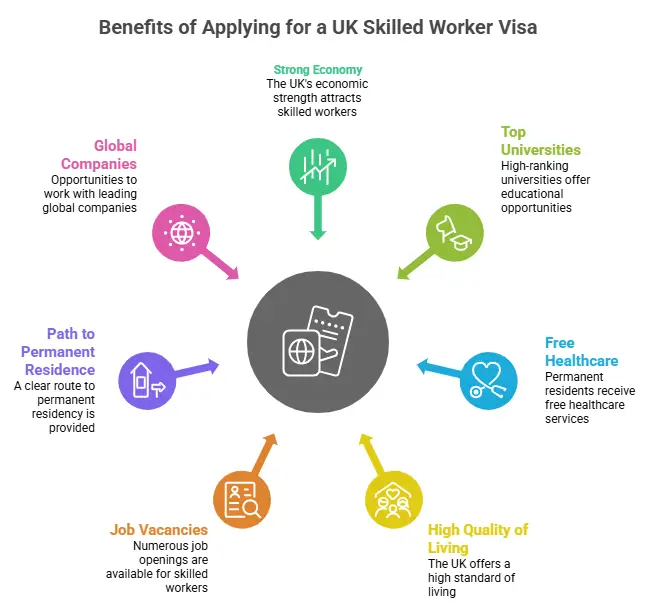
Key advantages include:
- Work legally for an approved UK employer
- Build international professional experience in the UK
- Access employment opportunities across eligible occupations
- Work with leading global companies and organisations
- Bring eligible dependants where the current rules allow
- Potentially extend your stay by meeting the relevant requirements
- Potential pathway to Indefinite Leave to Remain (ILR)
- Opportunity to build a long-term career in the UK
The Skilled Worker route is designed to help UK employers recruit eligible skilled professionals from overseas for qualifying positions.
What is the UK Skilled Worker Visa?
The UK Skilled Worker Visa allows eligible foreign nationals to live and work in the UK when they have a qualifying job with an employer that holds the appropriate sponsor licence.
The route is based on the UK's points-based immigration system. Applicants must meet the relevant requirements concerning their:
- Job
- Employer
- Occupation
- Salary
- English-language ability
- Sponsorship
- Personal circumstances
A successful applicant can generally stay in the UK for the period specified on their visa and may be able to extend their stay if they continue to satisfy the requirements.
The route can also provide a potential pathway towards Indefinite Leave to Remain (ILR) for applicants who eventually meet the separate settlement requirements.
UK Skilled Worker Visa Immigration Changes
UK immigration rules for Skilled Worker applicants have undergone significant changes, particularly concerning eligible occupations, skill levels, salary requirements and transitional arrangements.
Higher skill-level requirements
The source material states that, from 22 July 2025, most new Skilled Worker positions must meet RQF Level 6 or above, broadly corresponding to degree-level occupations.
However, transitional arrangements may apply to certain workers who already held or had applied for Skilled Worker permission before the relevant rule changes.
Applicants should therefore distinguish between:
- New Skilled Worker applications
- Existing Skilled Worker visa holders
- Applicants benefiting from transitional arrangements
The eligibility of an occupation should always be checked against the current UK immigration rules before an application is submitted.
Salary requirements
Salary requirements depend on factors such as:
- The occupation
- The applicable salary threshold
- The occupation's going rate
- Whether the applicant qualifies for a permitted salary discount
- The applicant's immigration circumstances
The supplied source identifies different salary levels for general Skilled Worker applicants, relevant PhD holders, certain new entrants and other transitional categories.
Because salary thresholds and going-rate requirements are rule-sensitive, applicants should assess the salary against the current rules applicable to their specific application, rather than relying on a single universal salary figure.
Existing Skilled Worker visa holders
The supplied content states that applicants who already hold a Skilled Worker Visa or who applied before the relevant July 2025 changes may benefit from transitional provisions in certain circumstances.
These provisions can affect:
- Visa extensions
- Changes of employer
- Continued eligibility for certain occupations
- Salary requirements
Transitional provisions should be checked individually because they do not apply identically to every applicant.
Second job
A Skilled Worker visa holder may be able to undertake additional employment if the second role satisfies the applicable immigration conditions.
The supplied material specifically refers to additional work where the role meets the relevant RQF Level 6 requirement or is included in the Immigration Salary List (ISL).
The conditions governing additional employment should be checked before starting the second job.
Benefits of the UK Skilled Worker Visa
The Skilled Worker route offers several potential benefits to eligible professionals.
Work legally in the UK
Successful applicants can work in the sponsored role for their approved employer, subject to the conditions of their immigration permission.
Bring eligible dependants
Eligible Skilled Worker applicants may be able to bring their spouse/partner and children to the UK, although important restrictions apply to dependants of workers in certain occupations and circumstances.
Spouse may work
Where a dependant is permitted to accompany a Skilled Worker, the dependant's immigration permission will generally determine their ability to work.
No general numerical cap
The supplied source highlights that there is no general cap on the number of people who can receive Skilled Worker permission. However, every applicant must still satisfy the applicable eligibility and sponsorship requirements.
Potential route to ILR
The Skilled Worker route can form part of a pathway towards Indefinite Leave to Remain, provided the applicant satisfies the separate settlement requirements.
International career opportunities
Working in the UK can provide international experience and exposure to UK and global employers across eligible sectors.
UK Skilled Worker Visa Requirements
Applicants must satisfy the relevant Skilled Worker requirements and achieve the required points under the UK immigration system.
Key requirements include:
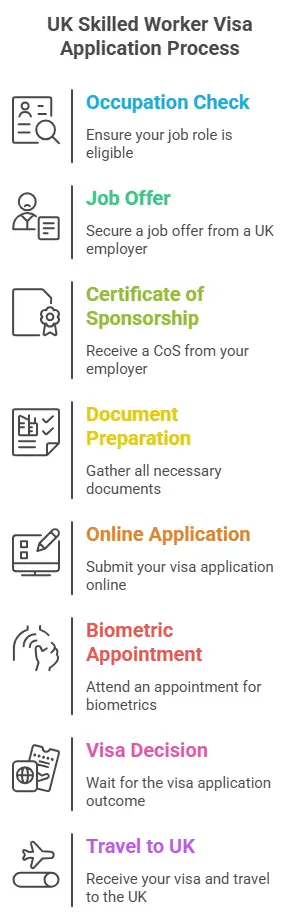
1. Eligible job offer
You generally need a qualifying job offer from a UK employer that is authorised to sponsor Skilled Worker migrants.
2. Certificate of Sponsorship
Your employer must assign you a Certificate of Sponsorship (CoS) containing information about your sponsored employment.
3. Eligible occupation
Your job must fall within an occupation eligible for the Skilled Worker route and meet the applicable skill-level requirements.
4. Salary
You must generally be paid at least the applicable salary threshold and/or the relevant occupation's going rate, subject to the rules and any permitted salary reductions that apply to your case.
5. English language
Applicants must satisfy the applicable English-language requirement unless they qualify for an exemption or can rely on another accepted basis.
6. Financial requirement
Applicants may need to demonstrate that they have sufficient funds to support themselves unless their circumstances qualify them for an exemption.
7. Genuine employment
The sponsored role must be genuine and comply with the requirements of the Skilled Worker route.
UK Skilled Worker Visa Points
The Skilled Worker route operates through a points-based system.
The applicant must meet the required points through mandatory and tradeable criteria.
These criteria can relate to:
- Sponsorship
- Appropriate skill level
- Salary
- English language
- Other qualifying characteristics
Some points are mandatory, while certain salary or applicant characteristics can affect how the remaining points are achieved.
This means applicants should not evaluate eligibility solely on their job title. The occupation code, duties, salary and sponsorship details are all important.
English Language Requirement for UK Skilled Worker Visa
English language ability is an important part of the Skilled Worker route.
The supplied source refers to an B1-level requirement covering:
- Reading
- Writing
- Speaking
- Listening
Applicants may demonstrate English ability through an accepted test or another permitted method, depending on their circumstances.
A language test is not necessarily required from every applicant because UK immigration rules provide alternative ways of demonstrating English proficiency in qualifying circumstances.
Is a Degree Required for the UK Skilled Worker Visa?
A bachelor's degree is not automatically required for every Skilled Worker application.
The important consideration is whether the proposed employment meets the applicable occupation and skill-level requirements.
However, the UK's post-2025 changes mean that many new Skilled Worker roles are subject to higher skill-level requirements.
Therefore, applicants should evaluate the specific occupation code and job duties, rather than assuming that a particular degree is either always required or never required.
UK Skilled Worker Visa Salary Requirements
Salary is one of the most important parts of a Skilled Worker application.
The applicant's salary normally needs to satisfy the relevant rules by meeting the applicable general salary threshold and/or the occupation's going rate.
The supplied source identifies different figures for categories such as:
- General Skilled Worker applicants
- Applicants with relevant PhDs
- STEM PhD holders
- New Entrants
- Certain Immigration Salary List occupations
- Workers covered by transitional provisions
Because the applicable salary depends on the applicant's occupation and circumstances, there is no single salary that applies to every Skilled Worker applicant.
Applicants should check both the general threshold and the going rate applicable to their occupation.
Documents Required for UK Skilled Worker Visa
Applicants should prepare documents based on their individual circumstances.
Common documents may include:
- Valid passport or travel document
- Certificate of Sponsorship reference number
- Job title
- Occupation code
- Annual salary details
- Employer's name
- Sponsor licence number
- Evidence of English language ability
- Proof of financial maintenance where required
- Qualification documents where relevant
- Tuberculosis test certificate where required based on country of residence
- Criminal-record documentation where applicable
- Additional documents requested by UK Visas and Immigration
The exact checklist can differ depending on the applicant's nationality, occupation, previous immigration history and circumstances.
UK Skilled Worker Visa – Frequently Asked Questions
Get answers to common questions about UK Skilled Worker Visa eligibility, sponsorship, salary requirements, documents, processing time, dependants, fees and the pathway to UK permanent residence.
The UK Skilled Worker Visa allows eligible professionals from outside the UK to live and work in the United Kingdom in an eligible job with an approved UK employer.
The route is based on the UK's points-based immigration system. Applicants must meet requirements relating to their sponsored job, employer, salary, occupation, English language ability and other applicable conditions.
The visa can provide a route to longer-term residence for eligible workers who continue to satisfy the requirements and eventually qualify for Indefinite Leave to Remain (ILR).
Yes. A qualifying job offer is generally one of the fundamental requirements for the UK Skilled Worker route.
The job must normally be with a UK employer that is authorised to sponsor Skilled Worker migrants. Once the employer agrees to sponsor you, it will normally assign a Certificate of Sponsorship (CoS).
The job itself must also meet the applicable occupation, skill-level and salary requirements. Simply receiving an employment offer does not automatically make an applicant eligible for the visa.
You generally need sponsorship from a UK employer that holds the appropriate sponsor licence for the Skilled Worker route.
Your prospective employer must be authorised to sponsor workers and must assign you a valid Certificate of Sponsorship for the qualifying position.
Before accepting an offer, applicants should check that the employer is authorised to sponsor workers and that the particular position is suitable for Skilled Worker sponsorship.
A Certificate of Sponsorship, commonly called a CoS, is an electronic record issued by an approved UK sponsor for an eligible sponsored worker.
It contains important information about the employment, including details such as the job, salary, employer and occupation information.
The CoS reference number is required when completing the Skilled Worker Visa application. A CoS is not itself a visa; it is part of the sponsorship process that supports the immigration application.
Applicants generally need to achieve 70 points under the Skilled Worker points-based system.
Points are associated with factors such as having an eligible sponsored job, meeting the required skill level, satisfying the English language requirement and meeting the applicable salary or other qualifying criteria.
The points system contains mandatory and tradeable criteria. Therefore, applicants should assess their complete profile rather than assuming that a job offer alone is sufficient.
There is no single salary figure that applies to every Skilled Worker applicant. The required salary depends on the applicable immigration rules, occupation, going rate and the applicant's circumstances.
In general, applicants must satisfy the applicable general salary threshold and/or the going rate for their occupation, subject to permitted salary discounts and exceptions.
Certain applicants, including some new entrants, relevant PhD holders and workers in qualifying occupations, may be subject to different salary provisions.
The occupation code and the job's going rate should therefore be checked before accepting an employment offer.
A bachelor's degree is not automatically required for every Skilled Worker application.
The important consideration is whether the proposed occupation meets the applicable skill-level and eligibility requirements. Following changes introduced in 2025, many new Skilled Worker positions are subject to higher skill-level requirements.
Applicants should therefore evaluate the specific occupation code and duties of the proposed position instead of assuming that a particular educational qualification is always mandatory.
English language ability is one of the requirements that can apply to Skilled Worker applicants. The supplied source refers to the B1 level for reading, writing, speaking and listening.
Applicants may demonstrate English proficiency through an accepted English-language test or another method permitted under the immigration rules.
Not every applicant necessarily needs to take a new language test. Certain applicants may be able to demonstrate English through another accepted basis or qualify for an exemption.
The exact document checklist depends on the applicant's circumstances. Common documents can include:
- Valid passport or travel document
- Certificate of Sponsorship reference number
- Proof of English language ability
- Job title and occupation information
- Annual salary details
- Occupation code
- Name of the sponsoring employer
- Sponsor licence information
- Financial evidence where required
- TB test certificate where applicable
- Criminal-record documentation where applicable
- Other supporting documents requested by UKVI
Documents should be complete and consistent with the information provided in the Certificate of Sponsorship and visa application.
Yes. Indian professionals can apply for a UK Skilled Worker Visa if they satisfy the applicable immigration requirements.
The process normally begins with finding an eligible job with a UK employer authorised to sponsor Skilled Worker migrants. The applicant must then meet the occupation, salary, English language, sponsorship and other relevant requirements.
Indian applicants should also check whether they need a tuberculosis test based on their circumstances and country of residence.
The cost depends on factors such as the length of the visa, whether you apply from inside or outside the UK, and whether your occupation qualifies for a reduced application fee.
The supplied fee information includes application fees ranging from £628 to £1,865, depending on the applicable category, duration and location of application.
Applicants may also need to pay the Immigration Health Surcharge (IHS), which the supplied source lists at £1,035 per year.
Additional costs can include biometrics, document translations, language tests, TB testing and optional priority services.
The supplied source indicates that standard applications from India may take approximately 3 to 8 weeks.
Processing times are not guaranteed and can vary depending on application volume, document verification, individual circumstances and whether UKVI requires additional information.
Where available, applicants may be able to purchase Priority or Super Priority processing for a faster decision. These services are subject to eligibility and availability and do not guarantee visa approval.
Eligible Skilled Worker applicants may be able to bring qualifying dependants to the UK.
Depending on the circumstances, dependants can include a spouse or partner and dependent children. However, the UK has introduced restrictions affecting dependants of workers in certain occupations and immigration categories.
Because dependant eligibility depends on the main applicant's route and occupation, you should check the rules that apply specifically to your proposed Skilled Worker position before making family relocation plans.
Where a spouse or partner is eligible to enter the UK as your dependant, their dependant immigration permission generally determines whether and how they can work.
However, dependant rules have changed for certain Skilled Worker occupations. Therefore, you should confirm that your spouse is eligible to obtain dependant permission before relying on this option.
The main applicant's occupation and immigration route are particularly important when assessing dependant eligibility.
A Skilled Worker Visa is linked to sponsored employment, so you cannot simply move to a completely different sponsored employer without following the applicable immigration process.
If you change employer or move into a different eligible occupation, you may need to obtain a new Certificate of Sponsorship and apply to update your immigration permission before starting the new role.
Transitional arrangements may affect certain existing Skilled Worker visa holders, so the rules applicable to your current permission should be checked before changing employment.
A Skilled Worker visa holder may be able to undertake additional employment, but the second job must satisfy the applicable immigration conditions.
The supplied source specifically identifies additional work where the role meets the relevant RQF Level 6 requirement or is included on the Immigration Salary List (ISL).
You should check the conditions attached to your immigration status before starting additional employment.
A Skilled Worker Visa can potentially be extended if you continue to satisfy the applicable requirements.
Depending on your circumstances, this can involve continuing with the same sponsored employment or meeting the requirements for a new sponsored position.
Your employer, occupation, salary, sponsorship and immigration status should all be reviewed before submitting an extension application.
The Skilled Worker route can provide a potential pathway to Indefinite Leave to Remain (ILR), which is the UK's form of permanent settlement.
However, holding a Skilled Worker Visa does not automatically grant ILR. Applicants must meet the separate settlement requirements that apply when they make their ILR application.
These requirements can include qualifying residence, continuous residence, employment and salary conditions, English-language and Life in the UK requirements where applicable, and compliance with immigration rules.
Settlement rules can change, so applicants should assess the requirements in force when they become eligible to apply.
Eligible occupations can include positions across areas such as healthcare, IT, engineering, science, education, finance, construction and other skilled professional sectors.
Eligibility is determined by the applicable occupation code and the requirements in force at the time of application. The job must also satisfy the relevant skill-level and salary requirements.
Applicants should therefore assess the actual duties and occupation code rather than relying only on a job title. Two jobs with similar titles can potentially have different immigration treatment depending on their duties and classification.
WorldVisaHelp can help skilled professionals understand the UK Skilled Worker route and prepare their application around their individual qualifications, occupation, experience and employment circumstances.
Our support can include:
- UK Skilled Worker Visa eligibility assessment
- Occupation and profile evaluation
- UK immigration points assessment
- Job and sponsorship guidance
- Certificate of Sponsorship guidance
- Salary and occupation assessment
- English-language requirement guidance
- Document checklist preparation
- Visa application documentation support
- Guidance for applicants applying from India
- Eligible dependant guidance
- Long-term UK immigration and ILR pathway guidance
If you are planning to work in the UK, start by assessing whether your occupation, qualifications, experience, salary and potential sponsorship fit the Skilled Worker route.