

Australia PR Visa for Indians
Last Updated: 20 August 2026
Why apply for Australia PR?
Australia Permanent Residency (PR) allows eligible migrants to live, work and study in Australia on a permanent basis. Permanent residents can generally remain in Australia indefinitely, subject to the conditions of their permanent visa, and may become eligible to apply for Australian citizenship after meeting the applicable residence and other requirements.
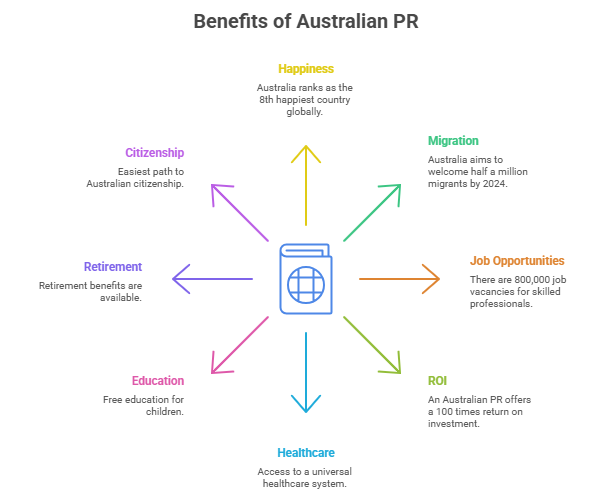
Key benefits of Australian PR include:
- Live and work in Australia permanently
- Work across eligible occupations and industries
- Study in Australia
- Access Medicare, subject to eligibility
- Include eligible family members
- Travel internationally using the travel facility attached to the permanent visa
- Build a long-term pathway towards Australian citizenship
- Access eligible social and retirement benefits subject to applicable waiting periods and rules
Australia offers several migration pathways depending on your occupation, skills, work experience, age, English ability, employer sponsorship, state nomination and family circumstances.
What is an Australian PR Visa?
An Australian PR visa gives eligible migrants permanent resident status in Australia.
For skilled professionals, some of the major pathways include:
Skilled Independent Visa — Subclass 189
The Subclass 189 Skilled Independent Visa is a points-tested permanent visa for skilled workers who receive an invitation to apply.
Key features include:
- No state or territory nomination required
- No employer sponsorship required
- Invitation required before applying
- Must meet the relevant age, occupation, skills assessment, English and points requirements
- Allows eligible holders to live and work permanently in Australia
Skilled Nominated Visa — Subclass 190
The Subclass 190 Skilled Nominated Visa is a permanent visa for skilled workers nominated by an Australian state or territory.
Applicants generally need to:
- Have an occupation eligible for the visa
- Obtain a suitable skills assessment
- Meet the English requirement
- Meet the points requirement
- Submit an Expression of Interest
- Receive state or territory nomination
- Receive an invitation to apply
Skilled Work Regional Visa — Subclass 491
The Subclass 491 Skilled Work Regional (Provisional) Visa allows eligible skilled workers to live and work in designated regional areas of Australia.
Applicants may qualify through:
- State or territory nomination, or
- Eligible family sponsorship
The 491 is a provisional visa and can provide a pathway to permanent residence through the Subclass 191 Permanent Residence (Skilled Regional) Visa, subject to meeting the applicable requirements.
Employer-Sponsored PR — Subclass 186
The Employer Nomination Scheme Visa (Subclass 186) provides a permanent residence pathway for eligible skilled workers nominated by an Australian employer.
Eligibility and requirements depend on the stream, occupation, work experience, qualifications and other applicable criteria.
Partner and Family Visas
Australia also provides permanent residence pathways through eligible family relationships, including partner and certain family visa categories.
Australia PR Process
Australia's skilled migration system is designed to attract workers whose skills and experience are needed in the Australian economy.
For points-tested skilled migration, applicants generally need to:
- Identify an eligible occupation.
- Obtain a suitable skills assessment.
- Meet the required English-language level.
- Calculate their migration points.
- Submit an Expression of Interest through SkillSelect.
- Seek state or territory nomination where required.
- Receive an invitation.
- Lodge the visa application with supporting evidence.
The appropriate pathway depends on your individual profile and the visa subclass requirements.
Australia PR Eligibility
Eligibility varies by visa subclass. For the major points-tested skilled visas, applicants generally need to meet requirements relating to:
- Age: Usually under 45 for points-tested skilled visas
- English: Meet the required English-language standard
- Occupation: Have an occupation eligible for the relevant visa
- Skills assessment: Obtain a suitable positive assessment where required
- Points: Meet the applicable points threshold
- Health: Meet health requirements
- Character: Meet character requirements
- SkillSelect: Submit an Expression of Interest and receive an invitation where required
- Nomination: Obtain state or territory nomination for visas such as Subclass 190 and 491 where applicable
Meeting the minimum points threshold does not guarantee an invitation.
Australia PR Requirements for Indians
Indian applicants considering skilled migration to Australia should generally assess:
- Age
- Highest educational qualification
- Skilled employment history
- Nominated occupation
- Skills assessment requirements
- English-language score
- Total migration points
- State or territory nomination options
- Partner's qualifications and skills, where applicable
- Australian study or work experience, where applicable
- Health and character requirements
- Supporting documentation
The strongest pathway can vary considerably between applicants, even when they have the same occupation.
Australia PR Points Calculator
For points-tested skilled migration, 65 points is generally the minimum points threshold for eligibility. However, obtaining 65 points does not mean that an applicant will automatically receive an invitation.
Points can be awarded for factors including:
| Category | Maximum / Applicable Points |
|---|---|
| Age | Up to 30 |
| English proficiency | Up to 20 |
| Skilled employment outside Australia | Up to 15 |
| Skilled employment in Australia | Up to 20 |
| Educational qualification | Up to 20 |
| Australian study / specialist education | Applicable bonus points |
| Regional study | 5 |
| Credentialled community language | 5 |
| Professional Year | 5 |
| State nomination — Subclass 190 | 5 |
| Skilled partner | 10 |
| Partner with competent English | 5 |
| No partner / eligible Australian citizen or PR partner | 10 |
| Eligible regional family sponsorship — Subclass 491 | 15 |
The exact points available depend on the applicant's circumstances and the applicable rules at the time of invitation.
Skilled Employment in Australia
| Skilled employment in Australia | Points |
|---|---|
| Less than 1 year | 0 |
| 1–2 years | 5 |
| 3–4 years | 10 |
| 5–7 years | 15 |
| 8–10 years | 20 |
Education Points
| Qualification | Points |
|---|---|
| Doctorate | 20 |
| Bachelor's or Master's degree | 15 |
| Eligible Australian diploma/trade qualification | 10 |
| Other eligible qualification recognised by the assessing authority | 10 |
Points depend on the specific qualification and the rules applying to the selected visa.
Top In-Demand Jobs in Australia for Indians
Australia's skilled migration system gives significant importance to occupations experiencing skills shortages.
Popular areas include:
| Occupation / Sector | Annual Salary Range* |
|---|---|
| IT | AUD 99,642 – 115,000 |
| Marketing & Sales | AUD 84,072 – 103,202 |
| Engineering | AUD 92,517 – 110,008 |
| Hospitality | AUD 60,000 – 75,000 |
| Healthcare | AUD 101,569 – 169,279 |
| Accounting & Finance | AUD 77,842 – 92,347 |
| Human Resources | AUD 80,000 – 99,519 |
| Construction | AUD 72,604 – 99,552 |
| Professional & Scientific Services | AUD 90,569 – 108,544 |
*Salary figures are indicative figures from the supplied source and should not be treated as guaranteed salaries or current market rates.
Frequently Asked Questions
Answers to common questions about applying for Australia PR from India.
Yes. A job offer is not required for some skilled migration pathways. The Subclass 189 Skilled Independent Visa, for example, does not require employer sponsorship or a job offer. You must still meet the relevant occupation, skills assessment, English, points and invitation requirements.
The general minimum points threshold for points-tested skilled visas is 65 points. However, reaching 65 points does not guarantee an invitation. Invitation scores can be higher depending on the visa subclass, occupation, competition and available places.
Processing time varies by visa subclass and individual circumstances. Skilled visa applications can take several months, while the overall journey may be longer because it can include skills assessment, English testing, Expression of Interest, nomination and the invitation stage. Processing times can also change based on application completeness and Department of Home Affairs priorities.
There is no single best visa for every applicant. Subclass 189 can suit skilled professionals who qualify independently, while Subclass 190 may be suitable for applicants seeking state or territory nomination. Subclass 491 can be an option for skilled workers willing to live and work in designated regional areas. The appropriate pathway depends on your occupation, age, points, English score, skills assessment and nomination options.
Eligibility depends on the occupation lists and requirements applicable to the visa subclass. Skilled occupations can include roles across healthcare, IT, engineering, construction, education, accounting, trades and other professional fields. Your occupation must be assessed by the relevant authority and meet the requirements of the visa pathway you choose.
For most points-tested skilled visas, applicants generally need to be under 45 when invited to apply. Age also affects the number of points you can claim, with applicants aged 25 to 32 receiving the maximum age points under the standard points test.
The total cost depends on the visa subclass and your individual circumstances. Expenses can include the visa application charge, skills assessment, English test, medical examination, police certificates, translations and other required services. Visa charges can change, so the applicable Department of Home Affairs fee should be checked before submitting an application.
You generally need to demonstrate English-language proficiency for points-tested skilled migration. IELTS is one accepted test, but other approved English tests may also be available depending on the visa and current requirements. A higher English score can also help eligible applicants claim additional points.
Eligible spouses or partners can generally be included in an Australia PR application, depending on the visa subclass and family circumstances. The applicant may need to provide evidence of the relationship, identity documents and other supporting information for the accompanying family member.
The assessing authority depends on your nominated occupation. Different professions are assessed by different Australian skills assessment bodies. You should identify the correct assessing authority for your occupation before submitting your Expression of Interest.
Yes. Being a student in India does not by itself prevent you from pursuing an Australian skilled migration pathway. You must independently satisfy the requirements of the selected PR visa, including the applicable occupation, skills assessment, English, points and invitation requirements.
Common documents include a valid passport, identity and birth documents, educational certificates, skills assessment, employment evidence, English test results, police clearances, health documents and relationship documents for accompanying family members. Additional evidence may be required depending on your visa subclass and circumstances.
Yes. State and territory nomination places are allocated as part of Australia's migration program. Individual states and territories can also establish their own nomination criteria and priorities. Nomination availability can therefore vary by jurisdiction, occupation and program year.
ITI qualification holders may be eligible for certain skilled migration pathways if their occupation, qualification and work experience satisfy the relevant requirements. Eligibility is not determined by an ITI certificate alone. A skills assessment for the nominated occupation is generally an important part of the process.
Subclass 189 is a Skilled Independent permanent visa and does not require state or territory nomination. Subclass 190 is a Skilled Nominated permanent visa and requires nomination by an Australian state or territory. Both are points-tested pathways and require an invitation before the visa application can be lodged.
There is no fixed annual number of skilled invitations reserved specifically for Indian applicants across all PR pathways. Invitation numbers vary by visa subclass, occupation, points score, program planning levels and government priorities.
After receiving an invitation, you can lodge the relevant visa application within the specified invitation period. You will need to provide supporting evidence for your claims, including identity, skills, English, employment, health and character documents as applicable. The Department of Home Affairs then assesses the application.
Lodging a PR application does not automatically give you the right to work in Australia. Your ability to work depends on the visa you currently hold and the conditions attached to it. If you are in Australia, check your current visa conditions and any bridging visa conditions before commencing work.
Australian permanent residence can provide a pathway to citizenship, but PR does not automatically become citizenship. Applicants must satisfy the applicable residence, character and other citizenship requirements before applying.
WorldVisaHelp can help you assess your eligibility, understand suitable Australia PR pathways, calculate your points, identify the relevant skills assessment requirements, prepare your documentation and understand the application process. The goal is to help you choose a pathway based on your actual profile rather than applying under a visa category that does not match your circumstances.