

Study in Germany for Indian Students: Universities, Fees, Scholarships & Visa
Germany has become one of the leading destinations for Indian students looking for affordable, high-quality international education. The country has around 420,000 international and doctoral students, with nearly 99,000 new international students starting in 2025/26. Indian students represent one of the largest international student communities in Germany, with around 59,000 Indian students studying there in 2024/25.
Germany has more than 400 higher education institutions offering thousands of programmes across engineering, IT, science, technology, business, healthcare and other disciplines. Many universities offer English-taught programmes, particularly at postgraduate level. Students can also benefit from research opportunities, internships, practical training and strong connections between universities and industry.
For Indian students, Germany offers an attractive combination of comparatively affordable education, internationally recognised qualifications and opportunities to build a career after graduation. Understanding university admission requirements, tuition fees, living costs, scholarships and student visa requirements is essential before planning your move.
Why Study in Germany?
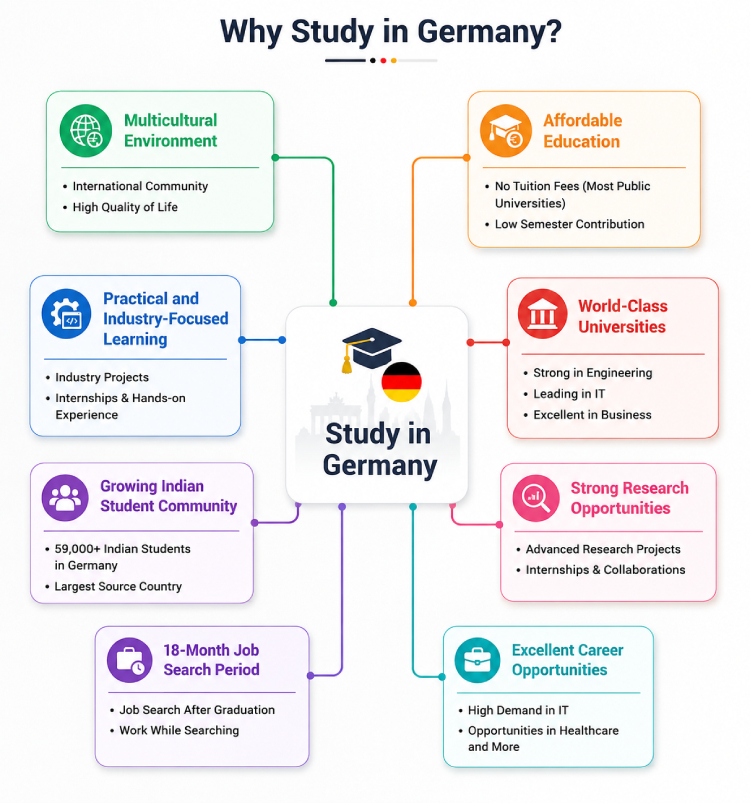
Germany offers several advantages for international students. Its public universities, strong research environment and career-focused education make it particularly attractive for students pursuing technical and professional degrees.
Key benefits of studying in Germany
- Affordable education: Many public universities do not charge tuition fees for most Bachelor's and Master's programmes. Students generally pay a semester contribution.
- Globally recognised universities: German institutions are well known for engineering, IT, science, technology, business and management.
- Strong research opportunities: Students can access advanced research facilities, laboratories and university-industry projects.
- Career opportunities: Germany has demand for qualified professionals in IT, engineering, healthcare, data science and technology.
- 18-month post-study job search: International graduates who complete eligible studies in Germany can generally stay for up to 18 months to search for qualified employment.
- Large Indian student community: Around 59,000 Indian students were studying at German higher education institutions in 2024/25.
- Practical learning: Universities of applied sciences and other institutions provide practical projects, internships and industry-based learning.
- International environment: Germany has a large international population, developed public transport and convenient access to other European countries.
Top Universities in Germany for Indian Students
Germany has more than 400 higher education institutions, including public universities, private universities and universities of applied sciences. Students can choose institutions based on their preferred course, academic profile, tuition costs, location and career objectives.
Some of Germany's prominent universities include:
| University | Approx. QS Ranking* | Approx. Semester/Admin Fee |
|---|---|---|
| Technical University of Munich (TUM) | 22 | €100–€300 |
| LMU Munich | 58 | €100–€300 |
| Heidelberg University | 80 | €150–€300 |
| Freie Universität Berlin | 88 | €100–€300 |
| RWTH Aachen University | 105 | €250–€350 |
| Karlsruhe Institute of Technology (KIT) | 98 | €150–€300 |
| Humboldt University of Berlin | 130 | Around €300 |
| Technical University of Berlin | 145 | €300–€600 |
| University of Hamburg | 193 | Around €300 |
| University of Freiburg | 201 | €150–€200 |
*Rankings and university charges can change. Students should check the institution's current information before applying. The source provides the above approximate rankings and charges.
Public vs Private Universities in Germany
Germany has a large public higher education system. Public universities generally offer lower-cost education, while private universities usually charge substantially higher tuition fees and may focus on specialised or career-oriented programmes.
| Factor | Public Universities | Private Universities |
|---|---|---|
| Tuition | Mostly tuition-free for many programmes | Usually €10,000–€40,000 per year depending on programme |
| Semester contribution | Usually applicable | Varies |
| Class size | Often larger | Generally smaller |
| English programmes | Available, particularly at Master's level | Widely available in many international programmes |
| Admission | Can be competitive | Often more flexible, depending on institution |
| Focus | Research and academic excellence | Often career and industry focused |
Important tuition exception
Non-EU students studying at public universities in Baden-Württemberg generally pay around €1,500 per semester. Certain other universities and programmes can also charge tuition fees, so students should check the exact course before making financial plans.
Popular Courses to Study in Germany
Germany offers programmes across almost every major academic field. Engineering, IT, business, science and healthcare remain popular choices among international students.
| Programme | Typical Duration | Popular Specialisations |
|---|---|---|
| Engineering | 3–4 years Bachelor's / 2 years Master's | Mechanical, Automotive, Electrical, Civil, Mechatronics, Robotics |
| Business & MBA | 1–2 years | Finance, Marketing, International Business, HR, Supply Chain |
| Computer Science & IT | Around 2 years Master's | AI, Data Science, Cybersecurity, Software Engineering |
| Humanities & Arts | Around 3 years | Psychology, History, Literature, Media Studies |
| Social Sciences | 2–3 years | Sociology, Political Science, International Relations |
| Law | 1–3 years LLM / 4–5 years State Exam | European, International, Business and IP Law |
| Natural Sciences | 2–3 years | Physics, Chemistry, Biology, Biotechnology |
| Medicine | Around 6 years | Medicine, Dentistry, Pharmacy and related fields |
The exact duration and structure vary by university and programme.
Cost of Studying in Germany
One of Germany's major advantages is its relatively affordable public higher education system. However, students still need to budget for semester contributions, accommodation, food, insurance, transportation and other living expenses.
Tuition Fees
Many public universities do not charge tuition fees for standard programmes. Students generally pay a semester contribution covering items such as administration, student services and, depending on the university, public transport.
Private universities generally charge tuition fees, while specialised programmes such as some MBA courses can be considerably more expensive.
| University Type | Approximate Tuition |
|---|---|
| Public Universities | Mostly tuition-free |
| Public Universities in Baden-Württemberg for non-EU students | €1,500/semester |
| Private Universities | Around €5,000–€20,000/year in the source |
| MBA Programmes | Can reach €65,000 total depending on institution |
Semester Contribution
Even when tuition is not charged, students generally need to pay a semester contribution.
It may include:
- Administrative services
- Student services
- Student facilities
- Public transportation benefits, depending on the university
The source estimates the contribution at around €150–€350 per semester.
Cost of Living in Germany
Living expenses depend heavily on the city and lifestyle. Munich, for example, is generally more expensive than smaller university cities.
| Expense | Approx. Monthly Cost |
|---|---|
| Accommodation | ₹25,000–₹50,000 |
| Food | ₹12,000–₹15,000 |
| Health Insurance | ₹4,000–₹6,000 |
| Miscellaneous | ₹8,000–₹12,000 |
| Estimated Total | ₹60,000–₹1.07 lakh |
The source estimates annual living expenses at approximately ₹8.9 lakh–₹13.4 lakh.
Students applying for a German student visa also need to demonstrate sufficient financial resources. The source gives a blocked-account requirement of approximately €11,904 per year. Requirements can change, so students should verify the current amount before applying.
Scholarships for Indian Students in Germany
International students can apply for scholarships offered by German organisations, universities, foundations and research institutions. Scholarships can help with living costs, travel, research and other educational expenses.
| Scholarship | Approx. Funding | Typical Eligibility |
|---|---|---|
| DAAD | Around €850–€1,300+ monthly depending on programme | Mainly Master's and PhD applicants |
| Erasmus+ | Varies by programme | Students admitted to eligible Erasmus programmes |
| Heinrich Böll Foundation | €750/month Master's; €1,000/month PhD | Academic performance and social engagement |
| Humboldt Research Fellowship | Around €2,650/month | Postdoctoral researchers |
| KAS Scholarship | Around €850/month postgraduate | Strong postgraduate/PhD applicants |
| Bayer Foundation | Around €6,400/year | Science-related programmes |
| DKFZ PhD Scholarship | Fully funded | Relevant Master's and biomedical backgrounds |
| Deutschlandstipendium | €300/month | High-performing students at participating institutions |
Scholarship availability, amounts and eligibility vary by programme and intake.
Germany University Admission Process
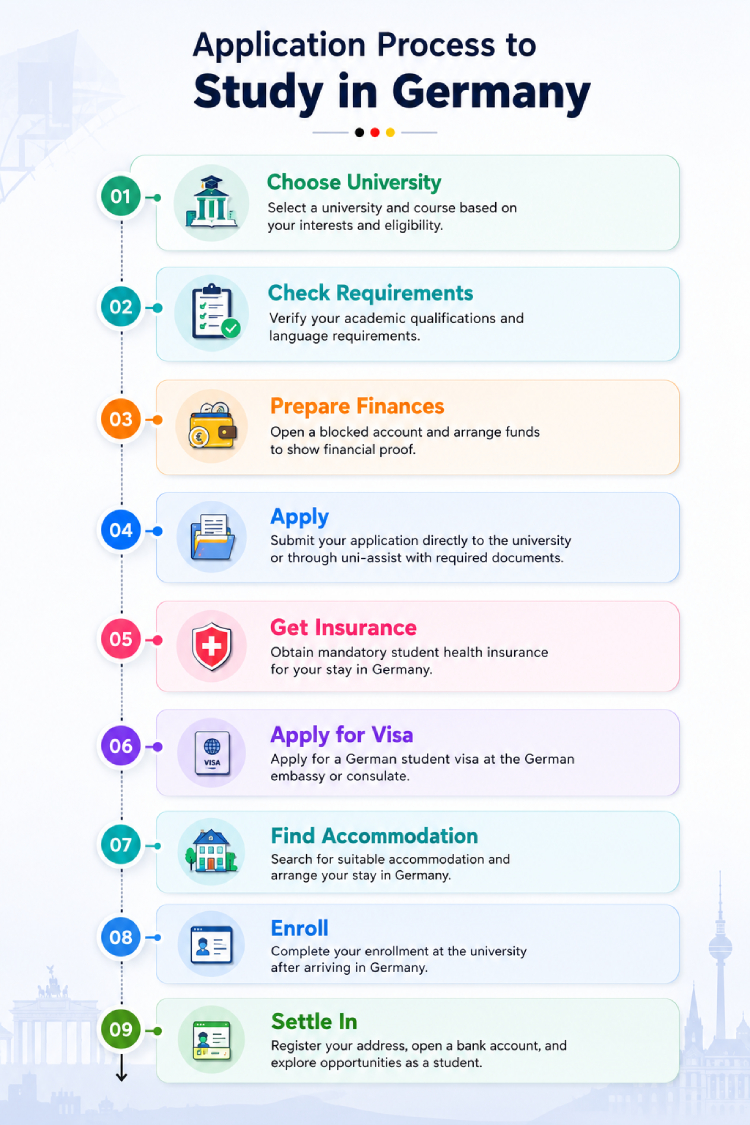
The application process depends on the university and programme. Some applications are submitted directly to the institution, while others may be handled through uni-assist.
Step 1: Choose a university and course
Compare programmes based on academic requirements, tuition, language, curriculum, location and career opportunities.
Step 2: Check eligibility
For Bachelor's programmes, Indian students may need additional qualifications or a Studienkolleg, depending on their educational background. Master's applicants generally need a relevant Bachelor's degree.
Step 3: Meet language requirements
German-taught programmes generally require German proficiency. English-taught programmes may require IELTS, TOEFL or another accepted qualification, depending on the university.
Step 4: Submit your application
Prepare academic transcripts, certificates, passport, CV, language scores and other documents requested by the university.
Step 5: Arrange financial proof
Students must demonstrate that they can cover their living expenses in Germany. A blocked account is one commonly used method.
Step 6: Obtain health insurance
Valid health insurance is generally required for international students.
Step 7: Apply for the student visa
Indian students normally need the appropriate German student visa before travelling to Germany for their studies.
Step 8: Arrange accommodation and enrol
After receiving admission and the visa, arrange accommodation and complete university enrolment and other required registration formalities.
Germany Student Visa Requirements for Indians
Indian students need to prepare their academic, financial and personal documents carefully. The source lists the following documents for a typical student visa application:
- Valid passport
- Completed and signed visa application form
- Biometric photographs
- University admission letter
- APS certificate, where applicable
- Proof of financial resources
- Health insurance
- Academic certificates and transcripts
- Language proficiency certificate
- Statement of Purpose
- Curriculum Vitae
The exact document checklist can depend on the applicant and visa category, so students should follow the current requirements of the responsible German mission.
Germany Student Visa Application Process
- Apply to German universities.
- Receive your admission letter.
- Obtain the APS certificate if applicable.
- Arrange your blocked account or other accepted financial proof.
- Obtain suitable health insurance.
- Prepare your academic and visa documents.
- Book the appropriate visa appointment.
- Attend the appointment and submit your application.
- Pay the applicable visa fee.
- Wait for the visa decision.
- Once approved, arrange travel and accommodation.
The source indicates a visa fee of around €75 for applicants aged 18 or above and €37.50 for applicants below 18, with payment made in Indian Rupees at the applicable exchange rate.
Germany Student Visa Processing Time
Student visa processing can vary depending on the German mission, application volume, document verification and individual circumstances.
The source indicates that many applications can take approximately 6–8 weeks after being forwarded to the relevant authorities, although some cases can take longer. Students should therefore apply well before the intended start of their programme.
Germany Opportunity Card for Indian Students and Graduates
The Germany Opportunity Card (Chancenkarte) is an immigration route introduced to help qualified non-EU professionals enter Germany and search for employment.
Eligible applicants can potentially enter Germany without having a job offer in advance and search for suitable employment for up to one year.
For applicants using the points-based route, points can be awarded for factors such as:
- Academic or professional qualifications
- German language ability
- English language ability
- Age
- Professional experience
- Previous connections with Germany
- Certain circumstances involving a spouse or partner
The source describes a minimum requirement of 6 points for the points-based route.
Germany Study Intakes
German universities generally have two major academic intakes.
Winter Intake
The winter semester generally starts in October and is the larger intake.
| Activity | Typical Planning Period |
|---|---|
| Research universities/courses | January–February |
| APS preparation | March onwards |
| University applications | April–July depending on deadline |
| Blocked account | Around May onwards |
| Student visa | Around July onwards |
| Travel | September |
| Classes | October |
Deadlines differ significantly by university and programme, so students should always check the individual course deadline.
Summer Intake
The summer semester generally starts in April. Fewer programmes may be available compared with the winter intake.
| Activity | Typical Planning Period |
|---|---|
| University applications | Usually by January |
| APS preparation | Around September |
| Blocked account | Around November |
| Visa application | Around December |
| Travel | March |
| Classes | April |
Part-Time Jobs in Germany for Indian Students
International students can work part-time while studying, subject to the applicable German student residence rules.
The source states that international students can generally work up to 140 full days or 280 half days per year, with working arrangements during the semester and semester breaks subject to the applicable rules.
Students can find jobs through:
- University career centres
- University notice boards
- Company websites
- Online job portals
- Restaurants and cafés
- Retail stores
- Student assistant positions
- Private tutoring
Basic German can improve opportunities, particularly for customer-facing jobs.
Approximate Part-Time Salaries
| Job | Approx. Hourly Pay |
|---|---|
| Restaurant/Café Staff | €12–€14 |
| Retail Assistant | €12–€15 |
| Delivery Jobs | €12–€16 |
| Warehouse Assistant | €12–€15 |
| Private Tutor | €15–€25 |
| University Assistant | €12–€17 |
| IT/Technical Assistant | €15–€20 |
The source provides these figures as approximate salary ranges. Actual pay varies by employer, location, experience and applicable wage rules.
Post-Study Work Opportunities in Germany
Germany provides international graduates with a route to remain in the country after completing eligible studies and search for employment.
Graduates can generally receive an 18-month residence period for seeking qualified employment after completing their studies. During this period, they can work while searching for a suitable long-term position. Once they obtain qualifying employment, they may transition to an appropriate employment residence permit or, where eligible, an EU Blue Card.
This gives Indian graduates time to:
- Search for relevant jobs
- Attend interviews
- Build professional connections
- Gain work experience
- Transition into long-term employment
Permanent Residency After Studying in Germany
German graduates can potentially progress from post-study employment to long-term residence.
The source states that graduates may qualify for a settlement permit after meeting applicable employment and residence conditions, including requirements relating to pension contributions, language skills, income and living arrangements.
Typical considerations include:
- Required period of employment
- Pension contributions
- German language proficiency
- Stable income
- Adequate accommodation
- Knowledge of German society and legal system
The exact settlement requirements depend on the residence status and the applicant's circumstances.
Best Cities to Study in Germany
Choosing the right city is important because living costs, university options and employment opportunities vary across Germany.
Munich
Munich is home to major institutions such as TUM and LMU and has strong opportunities in technology, engineering and business. It also has a large international and Indian community. However, living costs are comparatively high.
Approx. living cost: €1,200–€1,500/month.
Berlin
Berlin is a major international and startup hub with several leading universities. It offers a multicultural environment and extensive opportunities in technology, business and creative industries.
Approx. living cost: €900–€1,200/month.
Hamburg
Hamburg has a strong economy, international business environment and access to the University of Hamburg and other institutions.
Approx. living cost: €950–€1,200/month.
Aachen
Aachen is particularly popular among engineering students because of RWTH Aachen University. Compared with Munich, the city can offer a more affordable student lifestyle.
Approx. living cost: €750–€950/month.
The source provides these city-level estimates as approximate figures. Actual expenses depend on accommodation and lifestyle.
Build Your Future in Germany
Germany can be a strong option for Indian students seeking internationally recognised education without the tuition levels commonly associated with destinations such as the USA or UK.
The combination of public universities, research opportunities, industry exposure and post-study employment options makes Germany particularly relevant for students in engineering, IT, science, business and other professional fields.
A successful application requires more than choosing a university. Students should plan their course selection, academic eligibility, APS requirements, language tests, financial proof, accommodation and visa application well in advance.
With the right preparation, studying in Germany can become the first step toward an international education, professional career and potential long-term residence.
How WorldVisaHelp Can Help
WorldVisaHelp can assist students through the major stages of planning their Germany education journey.
Our Germany study support can include:
- University and course selection guidance
- Eligibility assessment
- Application planning
- Documentation checklist
- SOP and LOR guidance
- IELTS/PTE and language preparation guidance
- APS process guidance
- Student visa documentation support
- Financial-proof and blocked-account guidance
- Visa interview preparation
- Pre-departure planning
- Post-study career and immigration guidance
Start planning your Germany study journey with WorldVisaHelp and choose a course and university based on your academic profile, budget and long-term career goals.
Frequently Asked Questions
Get answers to common questions about studying in Germany, universities, tuition fees, scholarships, student visas, living costs and post-study opportunities for Indian students.
Germany is a popular destination for Indian students because many public universities offer programmes with little or no tuition fees, while maintaining strong academic and research standards. German universities are particularly well known for engineering, IT, science, technology, business and management.
Students can also benefit from practical learning, internships, research opportunities and access to a strong European job market. International graduates may also receive an 18-month period to search for qualified employment after completing eligible studies.
Germany has a large and growing international student population. According to the source information, around 59,000 Indian students were studying at German higher education institutions during the 2024/25 period.
India has therefore become one of the most important source countries for international students in Germany. The growing Indian student community can also make the transition to studying and living in Germany easier for new students.
Germany has more than 400 higher education institutions offering thousands of programmes across different disciplines. Students can choose from public universities, private universities and universities of applied sciences.
The right institution depends on your course, academic qualifications, preferred language, budget, location and career objectives. It is important to compare individual programmes rather than selecting a university based only on its ranking.
Many public universities in Germany do not charge tuition fees for standard Bachelor's and Master's programmes. However, students generally need to pay a semester contribution for administrative and student services and, depending on the university, transportation benefits.
There are important exceptions. For example, non-EU students studying at public universities in Baden-Württemberg generally pay around €1,500 per semester. Some other universities and specialised programmes can also charge tuition fees.
The total cost depends on the university, course and city. At many public universities, tuition can be minimal, but students still need to budget for the semester contribution and living expenses.
| Expense | Approximate Cost |
|---|---|
| Accommodation | ₹25,000–₹50,000/month |
| Food | ₹12,000–₹15,000/month |
| Health Insurance | ₹4,000–₹6,000/month |
| Miscellaneous | ₹8,000–₹12,000/month |
| Total estimated living cost | ₹60,000–₹1.07 lakh/month |
Germany has several highly regarded universities. Popular institutions include Technical University of Munich, LMU Munich, Heidelberg University, RWTH Aachen University, Freie Universität Berlin, Karlsruhe Institute of Technology and other leading institutions.
The best university for you depends on your intended programme. Engineering students may prioritise institutions such as TUM or RWTH Aachen, while students in other disciplines should compare programme curriculum, research opportunities, admission requirements and costs.
Popular fields include engineering, computer science and IT, business management, natural sciences, social sciences, law, humanities and medicine.
| Field | Popular Areas |
|---|---|
| Engineering | Automotive, Mechanical, Electrical, Civil, Robotics |
| IT & Computer Science | AI, Data Science, Cybersecurity, Software Engineering |
| Business | Finance, Marketing, International Business, MBA |
| Natural Sciences | Physics, Chemistry, Biology, Biotechnology |
| Social Sciences | Political Science, Sociology, Public Policy |
Public universities are generally more affordable and many do not charge tuition fees for standard programmes. They often have strong research capabilities and can have competitive admission processes.
Private universities generally charge tuition fees but may offer smaller classes, specialised programmes and more flexible admission options. The choice should be based on the specific programme, academic quality, cost and career outcomes.
IELTS is not required for every programme in Germany. The requirement depends on the language of instruction and the university's admission rules.
English-taught programmes may accept IELTS, TOEFL or another approved English-language qualification. German-taught programmes generally require evidence of German language proficiency, such as TestDaF or DSH. Always check the language requirements of the specific programme before applying.
The APS certificate is used to verify the academic credentials of students from certain countries, including India, who are applying to study in Germany.
The source identifies the APS certificate as an important requirement for Indian student visa applicants, while also noting that exceptions can apply, including for certain PhD, postdoctoral and scholarship applicants. Students should confirm whether an exemption applies to their individual case.
Students need to demonstrate sufficient financial resources to cover their living expenses in Germany. A blocked account (Sperrkonto) is one commonly used method of providing this financial proof.
The source gives an amount of approximately €11,904 per year. Because financial requirements can change, students should verify the current amount applicable when submitting their visa application.
A typical Germany student visa application requires documents proving your identity, university admission, academic background, finances and health insurance.
| Document | Purpose |
|---|---|
| Passport | Identity and travel document |
| University Admission Letter | Proof of admission to a German institution |
| APS Certificate | Academic document verification where applicable |
| Financial Proof | Evidence that you can support yourself |
| Health Insurance | Proof of required insurance coverage |
| Academic Documents | Certificates and transcripts |
| Language Certificate | Proof of required German or English proficiency |
| SOP and CV | Information about your study plans and background |
Student visa processing times can vary depending on the German mission, application volume, document verification and individual circumstances.
The source indicates that student visa applications can generally take around 6–8 weeks after being forwarded to the relevant authorities, although some applications can take longer. Indian students should therefore begin the visa process as soon as they have the required admission and supporting documents.
The Germany Opportunity Card, known as the Chancenkarte, is an immigration route that allows eligible skilled professionals from outside the EU to enter Germany and search for employment.
Unlike a conventional employment route, eligible applicants can use this pathway without necessarily having a job offer before entering Germany. The points-based route considers factors such as qualifications, professional experience, language ability and age.
Under the points-based route described in the source, applicants need at least 6 points. Points can be awarded for several factors, including qualifications, language skills, age and professional experience.
| Factor | Points Mentioned in Source |
|---|---|
| University Degree | 3 points |
| German Language A2 or higher | 1 point |
| English Language B2 or higher | 1 point |
| Age under 35 | 2 points |
| Age 35–40 | 1 point |
| Work experience/training in Germany | 2 points |
| Spouse/partner with recognised degree | 1 point |
International students can work part-time in Germany subject to the conditions attached to their student residence status. The source states that students can generally work up to 140 full days or 280 half days per year.
Students can find opportunities through university career centres, company websites, online job portals, restaurants, retail businesses and university student-assistant positions. Basic German can improve opportunities, especially in customer-facing jobs.
Part-time earnings depend on the job, city, employer and experience. The source gives several approximate hourly salary ranges.
| Part-Time Job | Approx. Hourly Pay |
|---|---|
| Restaurant/Café Staff | €12–€14 |
| Retail Assistant | €12–€15 |
| Delivery Jobs | €12–€16 |
| Warehouse Assistant | €12–€15 |
| Private Tutor | €15–€25 |
| IT/Technical Assistant | €15–€20 |
Yes. Eligible international graduates can generally obtain an 18-month residence period after completing their studies to search for qualified employment.
During this period, graduates can look for suitable positions, attend interviews and gain employment experience. After securing qualifying employment, they may be able to transition to an appropriate work residence permit or an EU Blue Card if they meet the requirements.
Studying in Germany can be the beginning of a longer-term immigration pathway. After graduation, eligible students can move into qualified employment and later apply for a settlement permit when they satisfy the applicable requirements.
Requirements can involve employment history, pension contributions, German language skills, stable income, suitable accommodation and knowledge of German society. The exact timeline depends on the residence status and individual circumstances.
There is no single best city for every student. Your choice should depend on your university, programme, budget, accommodation availability and career goals.
| City | Key Advantage | Approx. Monthly Living Cost |
|---|---|---|
| Munich | TUM, LMU, technology and engineering opportunities | €1,200–€1,500 |
| Berlin | Startups, international environment and major universities | €900–€1,200 |
| Hamburg | Strong economy and international business environment | €950–€1,200 |
| Aachen | RWTH Aachen and strong engineering focus | €750–€950 |
Munich is attractive for students targeting leading technical universities but has higher living costs. Berlin offers a strong international and startup environment, while Aachen can be especially attractive for engineering students looking for a comparatively affordable student city.