

Dubai Work Visa for Indians
Dubai, the commercial hub of the UAE, offers opportunities across technology, finance, construction, healthcare, logistics, aviation, hospitality and other major industries. Its international workforce, modern infrastructure and absence of personal income tax make it an attractive destination for Indian professionals.
A Dubai Work Visa allows eligible foreign nationals to legally live and work in Dubai. The appropriate route depends on whether you have a UAE job offer, work independently, qualify as a skilled professional, are an investor or work remotely for an overseas company.
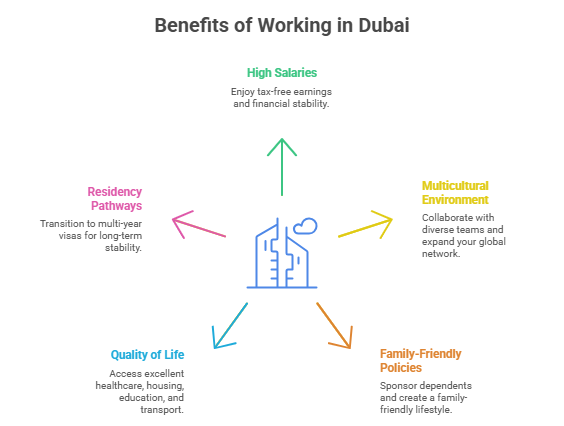
Why Work in Dubai?
- High demand for skilled professionals
- No personal income tax
- Access to multinational companies
- Opportunities across multiple industries
- Multicultural working environment
- Family sponsorship options
- Access to UAE banking and resident services
- Potential progression to Green or Golden residency
- Strong demand for Indian professionals
The source states that more than 3.5 million Indians are already working or residing in the UAE, with Indian professionals particularly represented in technology, engineering, healthcare, finance, construction, hospitality and retail.
Types of Dubai Work Visas
Dubai has several residence and work-related routes. The correct category depends primarily on your employment situation and eligibility.
| Visa Type | Best For | Typical Duration | Sponsor Model |
|---|---|---|---|
| Employment Visa | UAE job offer holders | 1–3 years | Employer-sponsored |
| Green Visa | Skilled professionals & freelancers | 5 years | Self-sponsored |
| Golden Visa | Investors, exceptional talent & selected professionals | 10 years | Self-sponsored |
| Freelance Permit | Independent professionals | 1–2 years | Free-zone authority |
| Virtual Work Visa | Overseas remote workers | 1 year | Self-sponsored |
The source specifically describes the Employment Visa as the standard route for full-time employment, while Green, Golden, Freelance and Virtual Work categories provide alternatives for eligible applicants.
Which Dubai Work Visa Is Right for You?
| Your Situation | Suitable Route |
|---|---|
| You have a UAE company job offer | Employment Visa |
| You are a skilled professional earning AED 15,000+ per month | Green Visa |
| You are an eligible freelancer earning AED 360,000+ annually | Green Visa – Freelancer category |
| You are an investor or exceptional talent | Golden Visa |
| You work independently with multiple clients | Freelance Permit |
| You work remotely for an overseas employer | Virtual Work Visa |
Dubai Work Visa FAQs
Find answers to common questions about Dubai Work Visa eligibility, visa types, costs, processing time, family sponsorship and work opportunities.
A Dubai Work Visa is a UAE residence and work authorization that allows eligible foreign nationals to legally live and work in Dubai. The route depends on your employment or professional situation.
The standard Employment Visa is normally sponsored by a UAE employer, while options such as the Green Visa, Golden Visa, Freelance Permit and Virtual Work Visa can provide self-sponsored or alternative residence routes subject to their specific eligibility conditions.
Yes. Indian citizens generally need the appropriate UAE work authorization and residence status to legally work in Dubai. A tourist or visit visa does not give you permission to take up ordinary employment in the UAE.
For a standard job, the UAE employer normally handles the employment-related sponsorship and residence process. Other categories are available for eligible freelancers, skilled professionals, investors and remote workers.
| Visa Type | Best For | Typical Duration | Sponsor Model |
|---|---|---|---|
| Employment Visa | Professionals with a UAE job offer | 1–3 years | Employer-sponsored |
| Green Visa | Eligible skilled professionals and freelancers | 5 years | Self-sponsored |
| Golden Visa | Investors, exceptional talents and eligible professionals | 10 years | Self-sponsored |
| Freelance Permit | Independent professionals and consultants | 1–2 years | Free zone authority |
| Virtual Work Visa | Remote workers employed outside the UAE | 1 year | Self-sponsored |
The correct category depends on your job offer, income, professional qualifications, investment or remote-work arrangement.
Yes, depending on your circumstances. A standard Employment Visa normally requires a UAE job offer and employer sponsorship, but Dubai and the UAE have alternative residence routes.
Eligible applicants may consider options such as the Green Visa, Golden Visa, Freelance Permit or Virtual Work Visa. Each has different requirements, so simply being a skilled worker does not automatically guarantee eligibility.
The Green Visa is a self-sponsored UAE residence route intended for eligible categories of skilled professionals, freelancers and other qualifying individuals. It can provide a longer residence period without relying on a traditional employer sponsor.
The supplied source describes a 5-year Green Visa route and states an AED 15,000 monthly income threshold for the skilled-professional route. Eligibility depends on the applicable category and current UAE rules, so the threshold should be confirmed before applying.
The UAE Golden Visa is a long-term residence programme for qualifying investors, exceptional talents and selected professional categories. The source describes a 10-year self-sponsored residence option with family-related benefits.
Eligibility is not based on employment alone. Applicants must meet the requirements of the relevant Golden Visa category, and investment or professional criteria can differ between categories.
| Expense | Indicative Cost |
|---|---|
| Work / Entry Permit | AED 1,000–1,500 |
| Residence Stamping | AED 500–1,000 |
| Emirates ID | AED 170–370 |
| Medical Fitness Test | AED 300–500 |
| Health Insurance | Varies |
| Total Government + Medical | AED 2,000–3,500 approximately |
These are indicative figures from the supplied source. Actual costs can vary according to the visa category, emirate, free zone, medical requirements, insurance and employer arrangements.
| Visa Type | Indicative Processing Time |
|---|---|
| Employment Visa | 7–10 working days |
| Green Visa | 2–3 weeks |
| Freelance Permit | 2–3 weeks |
| Golden Visa | 3–5 weeks |
| Virtual Work Visa | Subject to application category |
Processing times are indicative and depend on documentation, the sponsoring authority, employer category, emirate and immigration review. Complete applications generally move faster than applications requiring additional verification.
Common documents can include a valid passport, passport photographs, employment offer or contract where applicable, educational certificates, professional experience documents, CV, medical fitness documents and other personal records.
Depending on the visa category, applicants may also need proof of income, accommodation, insurance, police clearance or documents supporting their investment, freelance activity or overseas employment.
Medical fitness testing is part of the residence process for many UAE work and residence categories. The applicant may need to complete the required health screening through an authorized centre.
The supplied 2026 source also refers to AI-assisted health screening for certain employment and long-term visa applications. Because this is a recent process change, applicants should confirm the current requirement for their specific visa category before applying.
Salary varies significantly by profession, experience, employer and industry. The source gives the following broad monthly ranges:
Technology, finance, engineering, healthcare, logistics and senior management roles can command higher salaries, while entry-level salaries vary considerably by occupation.
Dubai's major employment sectors include technology, finance, logistics, construction, aviation and healthcare. Indian professionals are also active in engineering, hospitality, retail and business services.
Technology roles such as software development, data and cybersecurity can be particularly attractive, while engineering, healthcare, construction and logistics also provide opportunities for qualified professionals.
Eligible UAE residents can generally sponsor qualifying family members subject to the applicable residence and income requirements. The supplied source covers spouses and children and notes that additional conditions can apply depending on the dependent's age and status.
Family members may need their own residence documentation, medical examination, Emirates ID and health insurance. Schooling and childcare costs should also be considered when planning a move.
A spouse holding dependent residence status does not automatically have unrestricted employment rights. If the spouse wants to work, the appropriate UAE work authorization or employment arrangement is required.
The exact process depends on the employer and the spouse's residence status. Employers should ensure the correct work permit is in place before employment begins.
Yes. Dubai has freelance and self-sponsored residence options for eligible independent professionals. Freelance permits can allow professionals to work with multiple clients without the traditional employer-sponsored employment structure.
Common areas include technology, media, design, marketing, education and consulting. The specific permit, free zone and professional activity must match the work you intend to perform.
The Virtual Work Visa is designed for people who work remotely for an employer or business outside the UAE and want to live in Dubai while continuing that overseas work arrangement.
The supplied source lists a minimum overseas employment income of USD 3,500 per month and a 1-year duration. Applicants should confirm the current income threshold and documentation requirements when applying.
The source states that the UAE does not impose personal income tax on individual employment income. This can make Dubai attractive to professionals comparing take-home pay across international destinations.
However, personal income tax and business taxation are different concepts. Businesses and qualifying freelance activities can be subject to UAE Corporate Tax, so self-employed professionals should consider their business structure and tax obligations separately.
Dubai residence status and an Emirates ID generally make it possible for residents to apply for UAE banking services. Banks can request additional documents such as proof of employment, salary information, passport and residence details.
Approval is determined by the individual bank's requirements and compliance checks, so holding a residence visa does not automatically guarantee account approval.
| Step | What Happens |
|---|---|
| 1. Select Visa Route | Choose Employment, Green, Golden, Freelance or Virtual Work route. |
| 2. Secure Eligibility | Obtain a UAE job offer or meet the requirements of the selected self-sponsored route. |
| 3. Submit Application | Employer, free zone or applicant submits the relevant application. |
| 4. Medical & ID | Complete medical requirements and Emirates ID procedures where applicable. |
| 5. Residence Approval | Complete the residence process and receive the relevant UAE status. |
| 6. Start Work | Begin employment or permitted professional activity only after the required authorization is in place. |
The exact process differs according to the visa category, sponsor and issuing authority.
Dubai offers opportunities across technology, engineering, finance, healthcare, construction, logistics, aviation and hospitality. The source also highlights the large Indian community in the UAE and the presence of major multinational companies.
Other attractions include the absence of personal income tax, international work exposure, modern infrastructure and several residence pathways. The best visa route depends on whether you already have a UAE job offer, qualify for a self-sponsored route or work independently.