

Germany Tourist Visa for Indians
The Germany Tourist Visa (Schengen Type C) is a short-stay visa for travellers who want to visit Germany temporarily. It can cover tourism, visiting family or friends, certain short courses and eligible business-related activities.
The standard Schengen short-stay framework allows a stay of up to 90 days in any 180-day period.
Indian passport holders should apply for the appropriate Schengen visa before travelling when a visa is required for their circumstances.
Why Visit Germany?
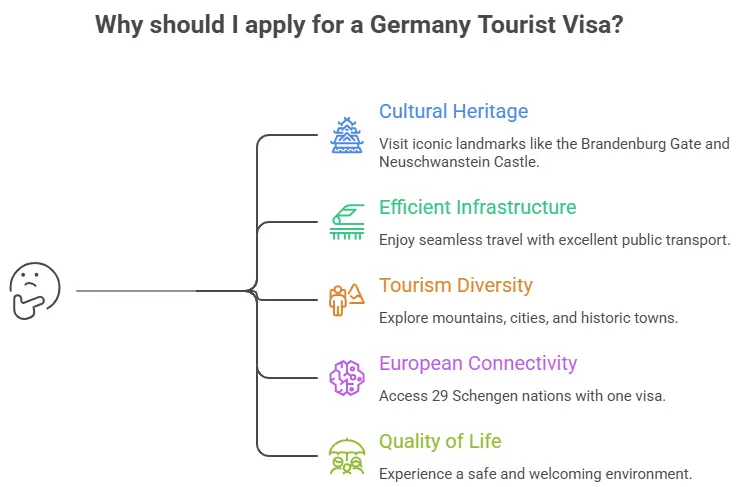
Germany combines historic attractions, modern cities, natural scenery and strong international connectivity.
Major reasons to visit Germany
- Explore landmarks such as the Brandenburg Gate, Neuschwanstein Castle and Cologne Cathedral.
- Experience Germany's historic towns, museums and cultural attractions.
- Travel through different regions, from Alpine landscapes to major urban centres.
- Use Germany as a base for eligible travel across the Schengen Area.
- Attend international exhibitions, conferences and trade fairs.
- Experience Germany's public transportation network and well-connected cities.
- Explore destinations such as Berlin, Munich, Cologne, Hamburg and Rothenburg ob der Tauber.
Germany Tourism and Travel Trends
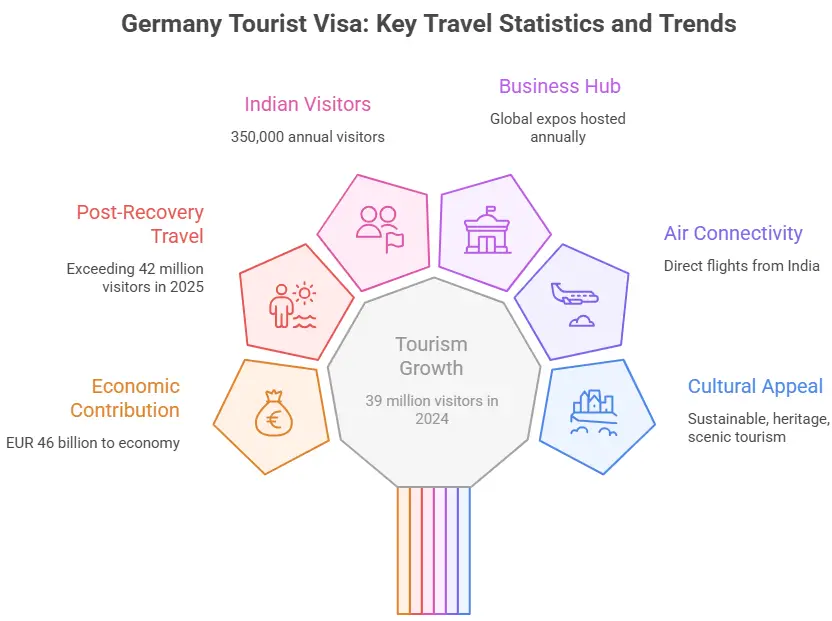
Germany continues to attract international visitors for tourism, family travel and professional events. The country is also an important destination for international trade fairs and exhibitions.
Indian travellers form an important non-EU visitor market, with travel linked to holidays, family visits and professional events. Germany's major cities are also connected to India through international air routes.
Popular travel purposes
| Travel Purpose | Examples |
|---|---|
| Tourism | Sightseeing, holidays and cultural travel |
| Family Visit | Visiting relatives and friends |
| Business | Meetings, conferences and corporate visits |
| Trade Fairs | Exhibitions and industry events |
| Events | Cultural and professional events |
| Short Courses | Certain eligible short-term courses |
Benefits of a Germany Schengen Tourist Visa
A German Schengen Type C visa can provide several advantages for eligible travellers.
Key benefits
Travel across the Schengen Area:
A valid Schengen visa issued by Germany can allow eligible travel to other Schengen countries, subject to the visa's territorial validity and the applicable entry conditions.
Short-term travel flexibility:
The visa is designed for temporary visits and can allow stays of up to 90 days within the applicable 180-day period.
Tourism and family visits:
Travellers can use the visa for holidays, sightseeing and eligible visits to family or friends.
Business and exhibitions:
Eligible short-term business activities, trade fairs and professional events can be covered by the appropriate Schengen category.
No employment:
The visa is intended for short-term travel and does not generally authorise employment in Germany.
Best Places to Visit in Germany
Germany offers destinations ranging from major European cities to preserved medieval towns.
Berlin
Germany's capital combines historic landmarks with museums, art, nightlife and contemporary culture. Visitors can explore the Brandenburg Gate, Museum Island, remnants of the Berlin Wall and Charlottenburg Palace.
Munich
Munich is the capital of Bavaria and is known for Marienplatz, Oktoberfest, Nymphenburg Palace and the BMW Museum. It is also a convenient starting point for visiting attractions such as Neuschwanstein Castle.
Cologne
Cologne sits on the Rhine and is best known for its impressive Gothic cathedral. The city also offers museums, historic churches, nightlife and cultural festivals.
Hamburg
Hamburg is a major port city with a strong maritime identity. Popular attractions include the Elbphilharmonie, Miniatur Wunderland and Alter Elbtunnel.
Rothenburg ob der Tauber
This historic town is famous for its medieval architecture, cobblestone streets, half-timbered buildings and preserved city walls. It is also an important stop along Germany's Romantic Road.
Germany Tourist Visa Eligibility for Indians
Applicants need to demonstrate that they meet the requirements for a short-term Schengen visit.
Main eligibility requirements
- Valid passport: The passport should meet Schengen validity requirements and have sufficient blank pages.
- Temporary travel purpose: You should demonstrate that your visit is temporary.
- Financial capacity: You must have sufficient funds for accommodation, transportation and daily expenses.
- Travel insurance: Schengen-compliant insurance with at least €30,000 medical coverage is required.
- Accommodation: Hotel reservations, accommodation evidence or an appropriate invitation may be required.
- Strong home-country ties: Employment, family, property or other circumstances can help demonstrate your intention to return.
- Immigration history: Previous overstays or immigration violations can negatively affect an application.
- Health and character: Additional documentation may be requested where applicable.
Documents Required for Germany Tourist Visa
Applicants should prepare a complete and consistent application file.
| Document | Purpose |
|---|---|
| Valid Passport | Identity and international travel |
| Visa Application Form | Formal Schengen application |
| Cover Letter | Explains travel purpose and itinerary |
| Flight Booking | Evidence of intended travel |
| Accommodation Proof | Hotel booking or host invitation |
| Travel Insurance | Minimum required Schengen coverage |
| Bank Statements | Evidence of financial capacity |
| Income Tax Returns | Supports financial and economic profile |
| Employment Documents | Shows employment and approved leave |
| Proof of Home Ties | Demonstrates intention to return |
| Biometrics | Required as applicable |
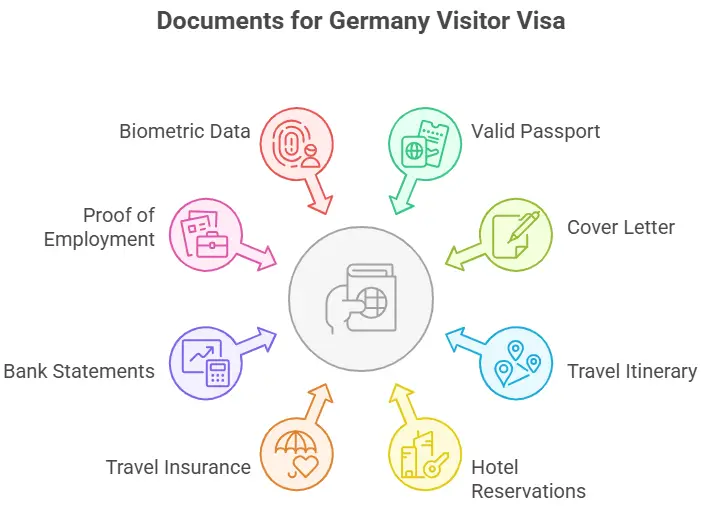
The source specifically lists passport, cover letter, travel itinerary, accommodation, insurance, six months of bank statements, income-tax returns, employment evidence and proof of home-country ties among the documents.
Germany Tourist Visa – FAQs
Find answers to common questions about Germany Tourist Visa requirements, documents, fees, processing time, financial requirements and the application process for Indians.
A Germany Tourist Visa is a Schengen Type C short-stay visa for travellers who want to visit Germany for tourism, sightseeing, visiting family or friends, attending certain short courses, or participating in eligible business events. It generally allows a stay of up to 90 days within a 180-day period.
The visa is intended for temporary visits and does not permit ordinary employment in Germany.
Yes. Indian passport holders generally need a Schengen visa to visit Germany for tourism or other short-stay purposes. The application is normally submitted through the applicable German visa application process in India.
Indian travellers should not assume that ETIAS replaces the Schengen visa requirement. ETIAS does not provide a visa exemption for Indian passport holders.
A Germany Tourist Visa is a short-stay Schengen visa that generally allows you to stay for up to 90 days within a 180-day period.
The exact validity and permitted stay are determined by the visa issued to you. You must follow the dates and conditions printed on your visa sticker.
Applicants generally need a valid passport, completed visa application, photographs, travel itinerary, flight reservations, accommodation evidence, travel medical insurance, financial documents and evidence of employment or other strong ties to India.
| Document | Purpose |
|---|---|
| Passport | Proof of identity and international travel document |
| Application Form | Provides personal and travel information |
| Flight Itinerary | Shows intended travel arrangements |
| Accommodation | Confirms where you plan to stay |
| Travel Insurance | Provides required medical coverage |
| Financial Proof | Demonstrates ability to fund the trip |
The source guidance indicates approximately €45–€75 per day as a financial planning benchmark. For a 15-day trip, this corresponds to roughly €675–€1,125 before considering other trip expenses.
| Trip Duration | Approx. Daily Guideline | Approx. Funds |
|---|---|---|
| 7 days | €45–€75/day | €315–€525 |
| 15 days | €45–€75/day | €675–€1,125 |
| 30 days | €45–€75/day | €1,350–€2,250 |
Applicants should also demonstrate that their overall finances are consistent with the proposed flights, accommodation and other travel costs. :contentReference[oaicite:1]{index=1}
The source lists the adult Schengen visa fee as €90, which was approximately ₹9,900 based on the conversion used in the source. Children aged 6–12 are listed at €45, while children under 6 are generally listed as fee-exempt.
| Applicant | Visa Fee |
|---|---|
| Adult | €90 |
| Child 6–12 years | €45 |
| Child under 6 | Free |
VFS service charges may apply separately and can change over time.
Standard processing is indicated as approximately 15–30 working days. During periods of high demand, processing can take longer, with the source indicating that it may reach up to approximately 45 days during peak periods.
Applicants should therefore avoid making non-refundable travel commitments before receiving their visa.
The application process involves preparing your documents, completing the applicable online VIDEX form, arranging a visa appointment, submitting your application and biometrics, and waiting for the German authorities to make a decision.
- Check the visa requirements.
- Prepare the required documents.
- Complete the VIDEX application.
- Book the appropriate visa appointment.
- Submit documents and biometrics.
- Pay the applicable fees.
- Wait for the visa decision.
- Collect your passport after processing.
VIDEX is the online application system used to complete the relevant German visa application form. Applicants enter their personal information, travel details and other required information before submitting the application through the appropriate process.
Information should be entered carefully because inconsistencies between the form and supporting documents can create delays or complications.
Applicants in India generally provide their fingerprints and photograph through the designated visa application centre as part of the Schengen application process.
The source identifies VFS Global as the relevant application-centre provider for Germany in India. The exact centre and appointment procedure depend on the applicant's location and the current German visa application arrangements.
Yes. Travel medical insurance is a key requirement for a Schengen Tourist Visa. The source specifies minimum coverage of €30,000.
The policy should cover the relevant Schengen area and the complete travel period. The source recommends considering higher coverage, such as €50,000, for additional protection.
A Germany-issued Schengen Type C visa can generally allow travel within the Schengen Area during its validity, subject to the conditions of the visa. The source refers to access to the Schengen area's 29 participating countries.
Your main destination and travel itinerary should be consistent with the purpose for which the visa was requested.
No. A standard Germany Tourist Visa is intended for short-term visits such as tourism, visiting family or friends and eligible short business activities. It is not an ordinary employment visa.
If your objective is to take up employment in Germany, you should explore the appropriate German work or skilled-worker residence route instead of relying on a tourist visa.
Yes, an invitation letter is not necessarily required for an ordinary tourism application when you can independently demonstrate your travel purpose, accommodation, financial capability and intention to return.
An invitation may become relevant when you are visiting family, friends or another host in Germany. In that situation, appropriate supporting documents should be included.
Eligible short-term business activities can be covered by the Schengen short-stay framework. Germany hosts major international trade fairs and business events.
Examples mentioned in the source include Hannover Messe, ITB Berlin, IFA Berlin, Bauma Munich, Medica Düsseldorf and ACHEMA Frankfurt. Applicants should provide appropriate evidence of the business purpose, such as an official invitation or event registration where applicable.
Refusals can occur when an application does not sufficiently establish the purpose of travel, financial ability or intention to leave the Schengen Area after the proposed visit.
| Potential Issue | Why It Can Matter |
|---|---|
| Insufficient finances | May raise concerns about funding the trip |
| Weak home-country ties | May make temporary intent less convincing |
| Unclear itinerary | May create doubts about the purpose of travel |
| Inconsistent documents | Can undermine the credibility of the application |
| Missing documents | Can prevent assessment of eligibility |
The source indicates that applicants can submit a Schengen visa application up to 6 months before the planned journey.
It also indicates that applications should generally be submitted no later than 15 days before departure. Because appointments and processing times can vary, applying well in advance is preferable.
The source describes a Cascade arrangement under which certain Indian applicants with a compliant history of Schengen visas may qualify for longer-validity multiple-entry visas.
The source specifically refers to applicants who have used at least two Schengen visas during the previous three years, with a possible progression to longer-validity multiple-entry visas. Eligibility depends on the applicable current rules and the applicant's individual travel history.
A Germany Tourist Visa and the Opportunity Card are separate immigration routes. A tourist visa should not be treated as an automatic pathway to obtaining an Opportunity Card.
The Opportunity Card is designed for eligible non-EU nationals seeking qualified employment opportunities in Germany and has its own eligibility, qualification, language, financial and application requirements.
WorldVisaHelp can help applicants understand the Germany Tourist Visa requirements, organise supporting documents, review the application information and prepare a structured submission.
The objective is to make the application more organised and reduce avoidable errors in areas such as financial evidence, travel plans, accommodation, insurance and supporting documentation.