
What is an H-1B Visa in the USA?
The H-1B Visa is a non-immigrant US work visa that allows US employers to employ foreign professionals in qualifying specialty occupations.
A specialty occupation generally requires specialised theoretical or technical knowledge and normally requires a qualifying degree or equivalent combination of education and experience.
The H-1B process is employer-driven. The US employer generally:
- Identifies a suitable foreign professional.
- Completes the required Department of Labor process.
- Registers the candidate for the H-1B cap when registration is required.
- If selected, files the H-1B petition with USCIS.
- After approval, the beneficiary completes the applicable visa or status process.
The H-1B classification generally permits an initial period of up to three years, with extensions potentially available up to a six-year maximum under the standard rule, subject to applicable exceptions.
How Does the H-1B Visa Process Work?
The H-1B process involves several stages and is primarily handled by the sponsoring employer.
Employer sponsorship
The employer must generally sponsor the foreign professional for the qualifying position.
Labor Condition Application
The employer generally obtains an approved Labor Condition Application (LCA) from the US Department of Labor.
The LCA addresses requirements concerning the employment of the H-1B worker and protections for US workers.
H-1B registration and selection
For cap-subject cases, the employer registers the prospective H-1B worker with USCIS.
If registrations exceed the available annual allocation, USCIS conducts the applicable selection process.
Petition filing
A selected employer can generally proceed with filing the H-1B petition during the designated filing period.
USCIS decision
USCIS reviews the petition and may approve it, deny it or issue a Request for Evidence (RFE) requiring additional information.
Visa application
If the beneficiary is outside the United States and the petition is approved, they generally proceed through the applicable US Department of State visa application process.
Entry to the USA
After receiving the appropriate visa and being admitted to the United States, the beneficiary can begin working according to the conditions of their H-1B status.
H-1B Visa Lottery and Selection Process
The H-1B programme has an annual cap for regular cap-subject cases, with an additional allocation for qualifying beneficiaries with a US master's degree or higher.
The supplied source states that, beginning with the FY 2027 cap season, USCIS moved from the previous random selection approach to a wage-based weighted selection system.
Under the source's described system:
| Wage Level | Selection Entries |
|---|---|
| Level I — Entry Level | 1 entry |
| Level II — Qualified Worker | 2 entries |
| Level III — Experienced Worker | 3 entries |
| Level IV — Senior/Fully Competent | 4 entries |
A higher wage level therefore provides more entries in the selection system described in the source. However, the actual selection probability depends on the total registration pool and the applicable rules for that fiscal year.
Important: H-1B selection is not the same as visa approval. Being selected allows the sponsoring employer to proceed with the petition; USCIS must still approve the petition.
H-1B Visa Cap
The H-1B programme is subject to an annual statutory cap for cap-subject cases.
The source identifies:
- 65,000 regular H-1B visas
- 20,000 additional places for qualifying applicants with a US master's degree or higher
High demand can result in more registrations than available places, which is why USCIS uses a registration and selection process for cap-subject cases.
Certain H-1B cases may be exempt from the annual cap depending on the employer and circumstances.
H-1B Visa Eligibility Requirements
To qualify for an H-1B position, the applicant generally needs to satisfy the requirements for a specialty occupation.
Common requirements include:
- Valid passport
- Qualifying bachelor's degree or higher, or an accepted equivalent
- Degree or experience related to the proposed specialty occupation
- A qualifying job offer from a US employer
- Employer sponsorship
- An occupation that meets the specialty-occupation requirements
- Required Labor Condition Application
- H-1B petition approval
The supplied source also recognises that a combination of education and progressive professional experience can, in appropriate circumstances, be used as an equivalent to a bachelor's degree.
Who Can Apply for an H-1B Visa?
The H-1B route is generally suitable for professionals whose proposed US employment qualifies as a specialty occupation.
Common fields include:
- Information Technology
- Software Development
- Engineering
- Finance
- Mathematics
- Science
- Architecture
- Medicine
- Data and technology-related professions
- Other specialised professional occupations
The occupation must satisfy the applicable specialty-occupation requirements. Simply having a degree does not automatically make every job eligible for H-1B sponsorship.
Is a Bachelor's Degree Required for H-1B?
A qualifying bachelor's degree or equivalent is generally required for a specialty occupation.
The degree should normally be related to the proposed position.
In appropriate cases, an applicant may qualify through an equivalent combination of education and progressive work experience rather than holding a US bachelor's degree specifically.
The supplied source identifies a bachelor's or master's degree, an equivalent foreign degree, or a combination of education and experience as possible ways to satisfy the qualification requirement.
H-1B Visa for Indians
Indian professionals represent a major group of H-1B applicants because of the large number of Indian professionals working in fields such as:
- IT
- Software engineering
- Finance
- Engineering
- Data and analytics
- Science
- Healthcare
- Technology
However, an Indian applicant cannot independently apply for an H-1B without the required US employment and sponsorship structure.
The process normally begins with a US employer willing and able to sponsor the candidate.
For applicants outside the United States, the current fee structure and any supplemental fees applicable to offshore H-1B petitions should be carefully assessed with the sponsoring employer before proceeding.
H-1B Visa Validity
An H-1B worker can generally receive an initial period of stay of up to three years.
The standard H-1B maximum is generally six years, although certain circumstances can allow H-1B status beyond six years, particularly where the worker is progressing through the employment-based permanent residence process.
The six-year period should therefore not be interpreted as an automatic Green Card eligibility date. Permanent residence is a separate immigration process with its own requirements.
Can H-1B Holders Change Employers?
Yes, H-1B workers can potentially change employers.
The new employer generally needs to file the appropriate H-1B petition before the worker begins employment under the new sponsorship.
This is commonly referred to as H-1B portability.
The new employment must still qualify under the H-1B specialty-occupation requirements.
The supplied source specifically identifies employer changes and portability as important H-1B features.
What is H-1B Dual Intent?
The H-1B classification is considered a dual-intent visa category.
This means an H-1B worker can generally hold temporary H-1B status while also pursuing lawful permanent residence in the United States.
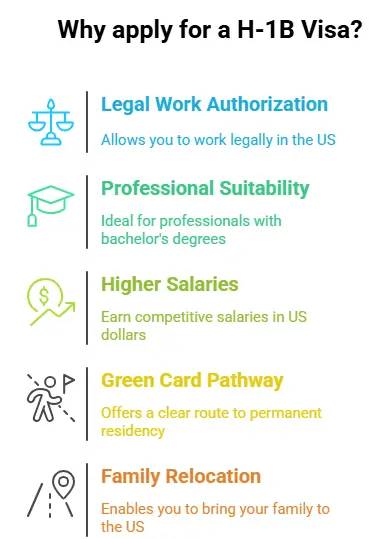
This is an important advantage for professionals who eventually want to obtain a US Green Card.
However, an H-1B visa does not automatically convert into a Green Card. The applicant must qualify for and complete a separate employment-based or other applicable permanent-residence process.
Can H-1B Holders Bring Their Family to the USA?
Eligible H-1B workers can generally have qualifying dependants accompany them in H-4 status.
Typically, qualifying dependants include:
- Spouse
- Unmarried children under the applicable age limit
The supplied source refers to dependent spouses and children under 21.
H-4 employment eligibility is subject to separate rules. Certain H-4 spouses may qualify for employment authorisation if they meet the applicable requirements.
H-1B Visa Documents Required
The exact documents vary according to the applicant, employer and petition.
Common documentation can include:
Applicant documents
- Valid passport
- Educational certificates
- Degree transcripts
- Professional experience documents
- Resume/CV
- Previous immigration documents where applicable
- Current or previous US status documents where applicable
Employer and petition documents
- Job offer
- Job description
- Certificate or evidence of sponsorship as applicable
- Labor Condition Application
- Form I-129 petition
- Employer information
- Supporting evidence demonstrating that the position qualifies as a specialty occupation
Visa-stage documents
Applicants applying for a visa outside the United States may also need:
- DS-160 confirmation
- Passport
- H-1B approval documentation
- Visa appointment documentation
- Supporting employment and qualification documents
The exact checklist should be prepared according to the applicant's individual case.
H-1B Visa Application Process from India
For an applicant in India, the process involves both the US employer's petition process and the applicant's visa application.
Step 1: Find a sponsoring US employer
Secure a qualifying position with an employer prepared to sponsor you.
Step 2: Employer completes the required H-1B process
The employer handles the required registration, LCA and petition process.
Step 3: H-1B selection
If the case is cap-subject, the employer must first obtain selection through the applicable USCIS registration process.
Step 4: File the H-1B petition
The employer files the H-1B petition with USCIS after selection.
Step 5: USCIS adjudication
USCIS reviews the petition and may approve it or request additional evidence.
Step 6: Complete DS-160
Once the petition is approved and the applicant needs a visa from abroad, the applicant completes the applicable nonimmigrant visa application process.
Step 7: Pay the applicable visa fee
The required Department of State visa fee must be paid according to the current fee schedule.
Step 8: Attend the required appointments
Applicants may need to attend the required Visa Application Centre and/or US Embassy or Consulate appointments for biometrics and an interview, depending on the applicable procedure.
Step 9: Visa decision
After the visa process is completed, the applicant receives the applicable decision.
Step 10: Travel to the USA
Once authorised to travel and admitted by US Customs and Border Protection, the worker can begin employment according to the approved H-1B terms.
The supplied source outlines the India-based DS-160, fee payment, VAC and interview stages.
H-1B Visa Fees
H-1B immigration involves multiple fees, and many of the primary petition-related fees are generally the responsibility of the sponsoring employer.
The supplied source lists the following fees:
| Fee Type | Amount (USD) | Typical Payer |
|---|---|---|
| H-1B Registration | $215 | Employer |
| Form I-129 | $780 regular / $460 small employers & nonprofits | Employer |
| ACWIA Training Fee | $750 / $1,500 | Employer |
| Fraud Prevention Fee | $500 | Employer |
| Public Law 114-113 Fee | $4,000 where applicable | Employer |
| Asylum Program Fee | $600 / $300 / $0 depending on employer | Employer |
| Premium Processing | $2,965 | Employer / Employee in limited cases |
| Supplemental New-Petition Fee | $100,000 where applicable | Employer |
Important $100,000 supplemental fee
The supplied source states that a $100,000 supplemental fee is currently applicable to certain new H-1B petitions involving beneficiaries outside the United States, with the stated effective date of September 21, 2025.
It also describes exceptions for certain extensions and change-of-status cases involving beneficiaries already in the United States.
Because this is a major and highly time-sensitive fee issue, employers should verify whether it applies to the specific petition before filing.
H-1B Premium Processing
Premium Processing is an optional expedited USCIS service available for eligible petitions.
The supplied source lists the premium processing fee as $2,965 and states that USCIS generally takes action within 15 business days under the applicable premium-processing timeframe.
Premium Processing accelerates USCIS action on an eligible petition; it does not guarantee approval.
How Long Does H-1B Processing Take?
H-1B processing can involve several separate timelines.
Registration and selection
For cap-subject cases, the employer must first complete the registration process and wait for the selection result.
USCIS petition processing
The petition can then undergo USCIS adjudication.
The supplied source gives an indicative 2–6 month range for regular petition processing, although actual processing times can vary significantly.
Premium Processing
Where available, Premium Processing can provide USCIS action within the applicable 15-business-day timeframe.
Visa processing
After petition approval, an applicant outside the United States must complete the applicable visa process. The time required can vary from a few days to several weeks depending on the circumstances and appointment availability.
When Should I Apply for an H-1B Visa?
H-1B cap preparation generally begins months before the US fiscal year.
The supplied source outlines the following general sequence:
January–February
Employers and candidates prepare:
- LCA
- Educational documents
- Professional documents
- Job description
- Specialty-occupation evidence
Early March
USCIS typically opens the electronic registration period for the upcoming cap season.
The supplied source lists a $215 registration fee per beneficiary.
Late March
USCIS conducts the applicable selection process and notifies employers through their online accounts.
April onwards
Selected employers can generally proceed with filing their cap-subject petitions during the applicable filing period.
October 1
For approved cap-subject cases following the normal annual cycle, H-1B employment can generally begin with the new fiscal year, subject to the terms of the approval and admission/status requirements.
H-1B Visa Extension Process
H-1B workers who remain eligible can apply for an extension through their sponsoring employer.
The general process includes:
- Check eligibility for extension.
- Collect passport, I-94, pay records, LCA and approval documentation.
- Employer prepares Form I-129.
- Pay the applicable filing fees.
- Submit the petition to USCIS.
- Respond to an RFE if USCIS requests additional evidence.
- Receive the USCIS decision.
- Continue employment under the applicable extension rules.
The supplied source also refers to the 240-day automatic extension rule in qualifying circumstances while a timely extension petition is pending.
H-1B Visa Challenges
The H-1B process can be complex for both workers and employers.
Competitive selection
Cap-subject H-1B cases can face significant competition for the available allocation.
Documentation
Errors or inconsistencies in the petition can result in delays, RFEs or denial.
Changing immigration rules
US immigration policies can change, meaning applicants and employers need to work with the rules applicable to their specific filing.
Employer costs
H-1B sponsorship involves multiple government and legal costs for employers.
Requests for Evidence
USCIS may issue an RFE when it needs additional evidence to determine whether the petition meets the requirements.
Dependants
H-4 dependant employment rights are subject to separate eligibility rules and should not be assumed automatically.
H-1B Visa to Green Card
One of the major advantages of H-1B status is its dual-intent nature.
An H-1B worker can pursue permanent residence while maintaining H-1B status.
A common employment-based process can involve:
- Employer sponsorship
- PERM labour certification where required
- Immigrant petition
- Priority-date processing
- Adjustment of status or immigrant visa processing
- Grant of permanent residence
The specific Green Card pathway depends on the worker's occupation, qualifications, employer, employment-based category and individual circumstances.
H-1B status itself does not automatically provide a Green Card.
Why Choose WorldVisaHelp for H-1B Visa Assistance?
WorldVisaHelp can help professionals understand the H-1B process and organise their immigration strategy around their individual circumstances.
Our support can include:
- H-1B eligibility assessment
- Specialty-occupation profile evaluation
- US job and sponsorship guidance
- Educational and professional document assessment
- H-1B registration guidance
- Petition documentation support
- LCA and sponsorship process guidance
- Visa application guidance for applicants from India
- H-1B extension guidance
- Employer-change and portability guidance
- Dependent visa guidance
- Long-term Green Card pathway guidance
The H-1B process involves both employer sponsorship and immigration compliance. A strong application therefore requires careful attention to the job, occupation, qualifications, salary, documentation and applicable USCIS requirements.
WorldVisaHelp can help you understand the process and prepare for the appropriate stage of your US immigration journey.
H-1B Visa – Frequently Asked Questions
Find answers to common questions about H-1B eligibility, the selection process, fees, validity, employer changes, family members and the pathway from H-1B status to permanent residence in the USA.
The H-1B is a U.S. nonimmigrant work visa that allows U.S. employers to employ qualified foreign professionals in specialty occupations. These positions generally require theoretical or technical expertise and are commonly found in areas such as information technology, finance, architecture, science and other professional fields.
The H-1B process is employer-sponsored. A U.S. employer generally must obtain the required labor certification steps and file an H-1B petition with U.S. Citizenship and Immigration Services (USCIS).
H-1B eligibility generally requires a professional position in the United States that qualifies as a specialty occupation and an applicant who has the required academic or professional qualifications.
- A qualifying job with a U.S. employer
- A position that qualifies as a specialty occupation
- A bachelor's degree or higher in a relevant specialty, or an accepted equivalent
- Relevant education and/or qualifying progressive work experience where applicable
- The required employer petition and supporting documentation
A bachelor's degree or higher in a field related to the specialty occupation is generally required. Depending on the circumstances, an equivalent combination of education and qualifying professional experience may also be accepted.
The qualification must be appropriate for the position being offered. Applicants should therefore provide academic records, degree certificates and relevant professional experience evidence where applicable.
H-1B visas subject to the annual cap can require electronic registration and selection when the number of registrations exceeds the available quota.
An employer first registers the prospective H-1B worker during the designated registration period. If the registration is selected, the employer can generally proceed with filing the full H-1B petition during the applicable filing period.
Selection does not by itself mean that an H-1B visa has been approved. The employer must still submit the required petition and supporting evidence, and USCIS must approve it.
The standard annual H-1B cap is generally 65,000 visas, with an additional 20,000 places available for eligible beneficiaries who hold a U.S. master's degree or higher.
Because demand can exceed the available quota, cap-subject applicants may have to go through the H-1B registration and selection process.
Yes. Indian professionals can be sponsored for H-1B employment in the United States if they meet the applicable eligibility requirements and have a qualifying U.S. employer willing to sponsor them.
The applicant's nationality does not replace the H-1B requirements. The job must qualify, the applicant must have the required qualifications, and the employer must complete the appropriate petition process.
H-1B status is generally granted for an initial period of up to three years. It can normally be extended for another period, with the standard maximum period of H-1B stay generally reaching six years.
Certain circumstances connected with employment-based permanent residence may affect how long an H-1B worker can remain beyond the standard six-year period.
Yes, an H-1B worker can generally change employers through the required H-1B petition process. The new employer must file the appropriate petition on the worker's behalf.
H-1B portability rules can allow an eligible H-1B worker to begin employment with the new employer after the applicable petition is properly filed, subject to the requirements of the portability rules.
Yes. H-1B status is compatible with the intention to pursue permanent residence in the United States. This is commonly described as the H-1B's dual-intent characteristic.
However, an H-1B visa does not automatically lead to a Green Card. Permanent residence requires a separate immigration process, such as an employment-based immigrant petition and the applicable adjustment of status or immigrant visa process.
Eligible H-1B workers may generally have their spouse and qualifying children accompany or join them in the United States in H-4 dependent status.
H-4 status is dependent on the principal H-1B worker's status. Employment authorization for certain H-4 spouses is subject to separate eligibility requirements and applicable rules.
The exact documentation depends on the case, employer and occupation. Common supporting documents can include:
- Valid passport
- Degree certificates and academic records
- Evidence of relevant professional experience
- Employment offer and job details
- Evidence that the position qualifies as a specialty occupation
- Labor Condition Application (LCA), where required
- Employer petition and supporting corporate documents
- Required immigration forms and photographs
- DS-160 for consular visa processing where applicable
The Labor Condition Application, or LCA, is an important part of the H-1B process and is associated with the U.S. Department of Labor. It contains required attestations by the employer regarding the employment conditions and wage obligations for the H-1B worker.
The employer generally needs the certified LCA before proceeding with the H-1B petition filing with USCIS.
H-1B costs depend on the petition and the employer. The overall government-fee amount can include the registration fee, Form I-129 filing fee, applicable ACWIA fee, fraud-prevention fee and other charges depending on the case.
Additional fees can apply in specific circumstances, including certain employers, expedited processing and other statutory requirements. The employer is generally responsible for the applicable petition-related fees under the relevant rules.
Premium processing is an expedited USCIS service available for eligible immigration filings for an additional government fee. For eligible H-1B petitions, it can significantly shorten the USCIS response timeframe compared with regular processing.
Premium processing does not guarantee approval. USCIS may approve the petition, issue a request for evidence, deny it or take another permitted action within the applicable premium-processing timeframe.
H-1B processing time depends on the stage of the application and whether the petition uses regular or premium processing. The registration and selection stage follows the annual H-1B registration schedule, while petition adjudication depends on USCIS processing conditions.
Premium processing can provide a faster USCIS response for eligible petitions. Consular visa processing after petition approval is a separate stage and can take additional time.
Preparation should begin before the annual registration window. Employers and applicants should have the job details, qualification documents and required information ready in advance.
The source process timeline identifies January and February as the preparation period, followed by registration in early March, selection notifications later in March and petition filing from April onward for selected registrations.
The standard maximum period of H-1B stay is generally six years. However, certain employment-based permanent-residence situations can allow additional H-1B time under applicable immigration rules.
These extensions depend on the circumstances of the Green Card process and the specific statutory requirements. They should not be treated as an automatic extension available to every H-1B holder.
Yes. An applicant can be sponsored for an H-1B position while outside the United States. After the petition process, the worker may need to complete the applicable U.S. visa application and consular process before traveling to the United States to begin employment.
The exact steps depend on whether the case involves consular processing, a change of status or another immigration procedure.
The H-1B process can be competitive and documentation-intensive. Common challenges include:
- Limited annual cap availability
- Registration and selection requirements
- Demonstrating that the position qualifies as a specialty occupation
- Providing evidence of the applicant's qualifications
- Employer compliance requirements
- Requests for Evidence (RFEs)
- Changes in immigration policies and procedures
- Significant employer and immigration costs
WorldVisaHelp can assist applicants with understanding the H-1B process, reviewing eligibility factors, organizing documentation and preparing for the different stages of the application journey.
Because H-1B cases are employer-sponsored and can involve complex immigration requirements, the appropriate strategy depends on the applicant's qualifications, proposed occupation, employer and immigration history.
WorldVisaHelp can help you understand the requirements and prepare your case more systematically before proceeding with the relevant filing or professional immigration advice.