
Key Switzerland Work Visa Facts
| Factor | Details |
|---|---|
| Main work permits | L Permit and B Permit |
| 2026 B Permit quota | 4,500 |
| 2026 L Permit quota | 4,000 |
| Typical working hours | Around 40–42 hours per week |
| D Visa | National long-stay entry visa |
| Long-term settlement | C Permit |
| Indicative processing | Around 4–12 weeks for permit processing, plus visa processing |
| Main applicant profile | Highly qualified non-EU/EFTA professionals |
Types of Switzerland Work Permits
Switzerland uses different residence and work permits depending on the applicant's employment arrangement and intended duration of stay.
| Permit | Validity | Who It Is For |
|---|---|---|
| L Permit | Up to 1 year | Fixed-term employment contracts of up to 12 months |
| B Permit | 1 year, renewable | Long-term or permanent employment |
| C Permit | Indefinite | Long-term settlement after meeting residence requirements |
| G Permit | Employment-linked | Cross-border commuters from neighbouring countries |
| Ci Permit | Linked to sponsor | Eligible family members of Swiss residents |
| Type D Visa | Entry visa | Non-EU nationals entering Switzerland for long-term work/residence |
For applicants living in India, the L and B Permits are the principal employment routes. The Type D visa is the entry document, while the L or B Permit provides the relevant residence and work status after arrival.
Switzerland Work Permit Quota 2026
Switzerland limits the number of permits issued to workers from outside the EU/EFTA area. The 2026 quota includes 4,500 B Permits and 4,000 L Permits. The quota is distributed across Switzerland's cantons, making availability dependent not only on the applicant's profile but also on the relevant canton and timing.
2026 Quota
| Permit | Annual Quota |
|---|---|
| B Permit | 4,500 |
| L Permit | 4,000 |
| Total | 8,500 |
Applicants should therefore begin the process early. A strong candidate can still face delays or refusal if the relevant quota is unavailable.
Switzerland Work Visa Eligibility for Indians
Switzerland generally prioritises highly qualified professionals from outside the EU/EFTA region. Applicants are expected to have suitable qualifications and professional experience for the position.
Typical requirements include:
- A university degree or recognised professional qualification
- Relevant professional experience
- A valid Swiss job offer or employment contract
- Proof of professional qualifications
- Evidence of work experience
- Valid passport
- Financial documentation where required
- Health insurance
- Police clearance certificate
- Proof of accommodation
- Passport-size photographs
- Updated CV and personal documents
The proposed salary should also correspond to Swiss market conditions and the relevant sector. Language skills can be important depending on the job and location. German is widely used in cities such as Zurich, Bern and Basel, while French is dominant in Geneva and Lausanne. English is commonly used in international technology and pharmaceutical workplaces.
In-Demand Jobs in Switzerland
Switzerland has opportunities for qualified professionals across technology, finance, healthcare, pharmaceuticals and engineering.
| Occupation | Average Salary Range | Approx. INR |
|---|---|---|
| Software Engineer / Full-Stack Developer | CHF 95,000–140,000 | ₹91–134 LPA |
| Data Scientist / AI Researcher | CHF 110,000–160,000 | ₹106–154 LPA |
| Machine Learning Engineer | CHF 180,000–350,000 | ₹173–336 LPA |
| Cybersecurity Specialist | CHF 92,000–145,000 | ₹88–139 LPA |
| Quantitative Analyst | CHF 107,000–160,000 | ₹103–154 LPA |
| Investment Banker / Wealth Manager | CHF 116,000–220,000 | ₹111–211 LPA |
| Civil / Structural Engineer | CHF 90,000–130,000 | ₹86–125 LPA |
| Specialist Doctor | CHF 150,000–350,000+ | ₹144–336 LPA+ |
| Nurse / Healthcare Assistant | CHF 60,000–100,000 | ₹58–96 LPA |
| Pharmaceutical Scientist | CHF 80,000–150,000 | ₹77–144 LPA |
The salary figures above are those provided in the source material and should be treated as indicative rather than guaranteed offers.
Salary by Experience
| Experience | Indicative Annual Salary |
|---|---|
| Entry Level – 0–3 years | CHF 55,000–75,000 |
| Mid Level – 3–8 years | CHF 80,000–110,000 |
| Senior Level – 8+ years | CHF 120,000–200,000+ |
Indicative Salary Growth
Entry Level       CHF 55K ─────────────── CHF 75K
Mid Level         CHF 80K ─────────────────────── CHF 110K
Senior Level      CHF 120K ───────────────────────────────────────── CHF 200K+
Best Swiss Cities for Indian Professionals
Different Swiss cities have different employment strengths.
| City | Major Sectors | Key Advantage |
|---|---|---|
| Zurich | IT, finance, banking, consulting | Major technology and financial centre |
| Geneva | International organisations, pharma, finance | Strong international and French-English environment |
| Basel | Pharmaceuticals, life sciences | Major pharmaceutical hub |
| Bern | Government, IT, engineering | Swiss capital with diverse employment opportunities |
| Lausanne | Education, technology, biotechnology | Strong research and innovation ecosystem |
Switzerland Job Market for Skilled Professionals
Switzerland continues to experience demand for qualified workers, particularly in IT, pharmaceuticals, engineering and healthcare. The source material also highlights a potential shortage of hundreds of thousands of workers by the end of the decade, driven partly by demographic changes and technological development.
IT remains an important area of demand, with cybersecurity and artificial intelligence among the specialised fields offering strong career opportunities.
For 2026, the principal quota figures remain:
- 4,000 L Permits
- 4,500 B Permits
How to Apply for a Switzerland Work Visa from India
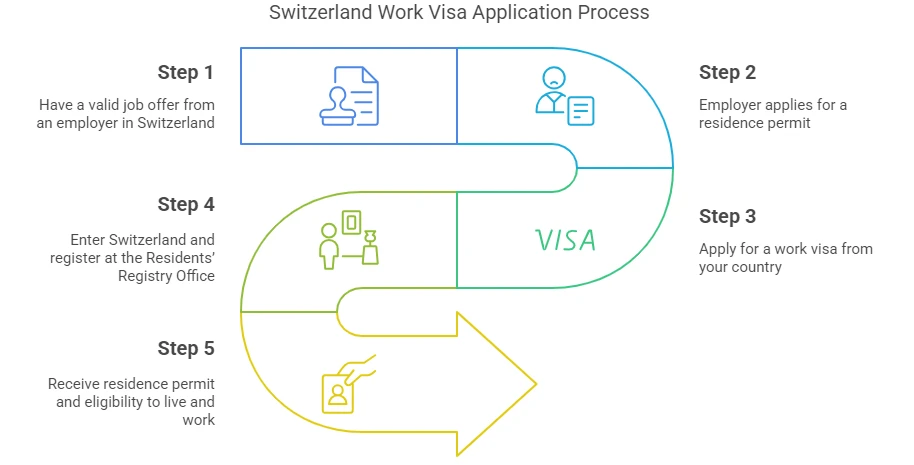
The Switzerland work visa process is primarily employer-led. A non-EU applicant normally needs to secure employment first, after which the Swiss employer begins the relevant work permit procedure.
Step 1: Secure a Swiss Job Offer
You need a written employment offer or signed contract from a Swiss employer willing to employ and sponsor you.
For non-EU/EFTA applicants, the employer may need to demonstrate that the position cannot suitably be filled by an available Swiss or EU/EFTA candidate.
Step 2: Employer Applies for the Work Permit
The Swiss employer submits the application to the appropriate cantonal authority. The application normally includes information about the employment, salary, qualifications and labour-market requirements.
The application may then proceed to the federal State Secretariat for Migration (SEM) where applicable.
Step 3: Receive Approval
Once the relevant cantonal and federal authorities approve the application, the employer receives confirmation allowing the applicant to proceed with the entry visa process.
Step 4: Apply for the National D Visa
After work authorization is approved, the applicant applies for a Swiss National Type D Visa through the appropriate Swiss diplomatic or visa application channel in India.
Step 5: Submit Biometrics
Applicants must complete the required biometric and visa formalities.
Step 6: Travel to Switzerland
Once the D Visa is approved, the applicant can travel to Switzerland within the permitted period.
Step 7: Register After Arrival
After arriving in Switzerland, the worker must register with the relevant local/cantonal authorities within the prescribed period.
Step 8: Receive the L or B Permit
The residence and work permit allows the applicant to legally live and work in Switzerland under the conditions attached to the permit.
Step 9: Obtain Health Insurance
Applicants must arrange the required Swiss health insurance after arrival within the applicable timeframe.
Switzerland Work Visa – Frequently Asked Questions
Get answers to common questions about Switzerland Work Visas, L and B Permits, eligibility, quotas, documents, fees, processing times and permanent residence for Indian professionals.
A Switzerland Work Visa is a national Type D visa that allows eligible non-EU/EFTA nationals to enter Switzerland for employment and long-term professional activities. After arrival, the applicant receives the relevant residence and work permit, such as an L or B Permit.
For Indian professionals, the process generally starts with a Swiss job offer and employer-sponsored work permit application before the applicant applies for the national D visa.
Yes. Indian citizens are non-EU/EFTA nationals and generally require Swiss work authorization before taking up employment in Switzerland. The exact requirements depend on the occupation, qualifications, employment contract and permit category.
Unlike EU/EFTA citizens, Indian applicants are subject to stricter eligibility rules and annual quotas for certain work permits.
| Permit | Purpose | Typical Validity |
|---|---|---|
| L Permit | Short-term employment | Up to 1 year |
| B Permit | Long-term employment | 1 year, renewable |
| C Permit | Settlement / permanent residence | Indefinite |
| G Permit | Cross-border employment | Employment-linked |
| Type D Visa | Entry for long-term stay | Entry visa |
For Indian applicants residing in India, the L and B Permits are the main employment routes. The Type D visa is used for entry, while the residence permit governs the applicant's stay and employment.
The L Permit is intended for short-term employment and is generally linked to a fixed-term contract of up to one year. The B Permit is designed for longer-term employment and is generally renewable annually.
The appropriate permit depends on the employment contract, job, applicant's circumstances and approval from the Swiss authorities.
According to the supplied source, Switzerland has allocated 8,500 permits for non-EU/EFTA workers in 2026. This consists of 4,500 B Permits and 4,000 L Permits.
| Permit | 2026 Quota |
|---|---|
| B Permit | 4,500 |
| L Permit | 4,000 |
| Total | 8,500 |
Quotas are distributed among Switzerland's cantons, so availability can depend on the canton and timing of the application.
The supplied source describes employer-sponsored employment as the main route for Indian professionals. A written job offer or signed employment contract is therefore a key requirement for the standard L or B Permit process.
Switzerland has strict rules for non-EU/EFTA workers, so simply travelling to Switzerland to search for employment does not replace the requirements of an approved work permit.
Switzerland generally targets highly qualified non-EU/EFTA professionals. Applicants should have suitable education or professional qualifications and relevant experience for the proposed position.
- Valid passport
- Swiss job offer or employment contract
- Relevant qualifications
- Relevant professional experience
- Proof of employment and salary
- Police clearance certificate
- Health insurance
- Proof of accommodation where required
- Financial documents where applicable
The supplied material identifies strong demand across IT, pharmaceuticals, finance, healthcare, engineering and research. Technology roles such as software development, artificial intelligence and cybersecurity are particularly relevant to skilled international professionals.
| Sector | Examples |
|---|---|
| IT | Software, AI, machine learning, cybersecurity |
| Finance | Investment banking, quantitative analysis, wealth management |
| Healthcare | Doctors, nurses and healthcare professionals |
| Engineering | Civil, structural and specialist engineering |
| Pharmaceuticals | Scientists, researchers and life-science professionals |
The exact document checklist depends on the permit category and canton. Common documents include the applicant's passport, employment contract, qualification certificates and proof of professional experience.
| Document | Purpose |
|---|---|
| Passport | Identity and travel document |
| Employment Contract | Evidence of Swiss employment |
| Qualification Certificates | Proof of education or professional qualification |
| Experience Letters | Evidence of relevant work experience |
| Police Clearance Certificate | Character documentation |
| Health Insurance | Required insurance evidence where applicable |
| Accommodation Proof | Evidence of intended residence where required |
The supplied source does not identify IELTS as a universal requirement for a Switzerland Work Visa. Language requirements can depend on the employer, profession and canton.
German is commonly used in areas such as Zurich, Bern and Basel, while French is widely used in Geneva and Lausanne. English is frequently used by international companies, especially in technology and pharmaceutical sectors.
Yes, for the standard employer-sponsored route, the Swiss employer plays a central role in the work permit application. The employer submits the application to the relevant cantonal authority and provides employment and labour-market information.
The employer may also need to demonstrate that the position could not suitably be filled by an available Swiss or EU/EFTA candidate.
The labour market test is part of Switzerland's approach to recruiting non-EU/EFTA workers. For applicable positions, the employer must demonstrate that a suitable Swiss or EU/EFTA candidate was not available for the role.
This requirement is one reason why obtaining a Swiss Work Permit can be more difficult for non-EU applicants than for EU/EFTA citizens. The employer normally provides the relevant evidence during the permit application.
The application begins with securing an eligible Swiss job offer. The employer then submits the work permit application to the relevant cantonal authority. Once the required approvals are obtained, the applicant proceeds with the National Type D visa application.
- Secure a Swiss employment offer.
- Employer submits the work permit application.
- Complete cantonal and federal approval procedures.
- Receive the required approval or confirmation.
- Apply for the National Type D visa in India.
- Submit documents and biometrics.
- Travel to Switzerland after visa approval.
- Register with the local authorities after arrival.
- Receive the relevant L or B residence permit.
- Arrange the required Swiss health insurance.
Processing time varies according to the canton, employment category, quota availability, employer documentation and the complexity of the application.
| Stage | Indicative Time |
|---|---|
| Cantonal Review | 3–8 weeks |
| Federal SEM Approval | 1–2 additional weeks |
| Work Permit Process | Approximately 4–12 weeks |
| Complete Planning Period | Allow around 3–4 months |
Applicants should apply well before their intended employment start date because additional time may be required for document preparation and visa issuance.
The total cost depends on the canton, permit category and services required. The supplied source estimates total expenses of approximately CHF 400–1,100 or more when permit, visa, registration, documentation and related charges are included.
| Cost Component | Indicative Amount |
|---|---|
| Cantonal Permit Fee | CHF 100–300+ |
| Residence Registration | CHF 50–65 |
| National D Visa | CHF 60–100 |
| Translation / Documentation | CHF 100–300 |
| VFS Service, where applicable | Approx. CHF 30–50 |
Fees can change and may vary by canton, so applicants should verify the current charges before submitting an application.
Salaries vary significantly by occupation, experience, canton and employer. The supplied source gives the 2024 Swiss Federal Statistical Office median salary as approximately CHF 84,288 per year.
| Experience | Indicative Annual Salary |
|---|---|
| Entry Level | CHF 55,000–75,000 |
| Mid Level | CHF 80,000–110,000 |
| Senior Level | CHF 120,000–200,000+ |
Highly specialised positions in AI, finance, pharmaceuticals and other high-demand sectors can command substantially higher salaries.
Family reunification can be available to eligible Swiss residents, subject to the requirements attached to the worker's residence status and the applicable family immigration rules.
The supplied source identifies the Ci Permit as a route associated with eligible family members of Swiss residents who wish to work. The exact family rights and permit arrangements depend on the sponsor's status and the family member's circumstances.
Eligible family members may have employment rights depending on the residence status and family permit they receive. The specific conditions should be checked before the spouse begins employment.
Family members should not assume that the principal applicant's work permit automatically grants identical employment rights to every dependent. The applicable family residence category determines those rights.
The supplied source describes the C Permit as the long-term settlement route. For Indian nationals, it states that an application can generally be considered after 10 years of continuous legal residence, subject to the applicable requirements.
Requirements mentioned in the source include German or French language proficiency, financial self-sufficiency, a clean criminal record and integration requirements. Permanent residence is not automatic simply because an applicant has worked in Switzerland for 10 years.
WorldVisaHelp can help Indian professionals understand the Switzerland Work Visa process and determine which permit route may be relevant to their profile. Support can include eligibility assessment, document checklist preparation, application guidance and review of employment and qualification documents.
Because Switzerland applies strict requirements to non-EU/EFTA workers and operates annual permit quotas, selecting the appropriate route and preparing the application correctly is an important part of the process.