

Australia Work Visa
Last Updated: 12 August 2026
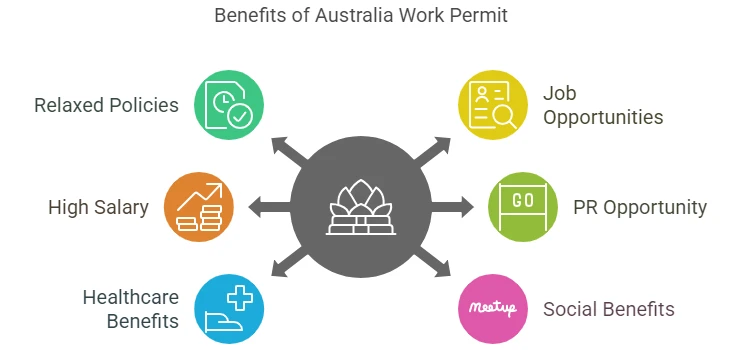
Why Choose an Australia Work Visa?
- Multiple pathways for skilled professionals
- Strong demand for qualified workers across key industries
- Competitive salaries across professional and skilled occupations
- Potential pathways to Australian permanent residency
- Access to Australia's high standard of living
- Healthcare and social benefits, subject to visa and residency eligibility
Australia Work Visa
An Australian work visa allows eligible foreign nationals to live and work in Australia under the conditions of their specific visa. Australia offers both temporary and permanent work visa pathways, with eligibility depending on factors such as occupation, qualifications, work experience, employer sponsorship, skills assessment and the type of employment.
For Indian professionals, Australia provides several options through skilled migration, employer sponsorship, regional migration and other temporary work pathways.
Australia Work Visa for Indians
Australia continues to attract Indian professionals seeking international career opportunities, higher earning potential and long-term settlement options.
Depending on your occupation and circumstances, you may qualify for an employer-sponsored visa, skilled migration pathway or regional visa. Selecting the right pathway is important because each Australian work visa has its own eligibility requirements, occupation rules and application process.
Work in Australia for a High Standard of Living
Australia offers employment opportunities across industries including technology, healthcare, engineering, construction, finance, education and skilled trades.
Australian work visa pathways broadly fall into two categories:
- Temporary work visas — allow eligible workers to work in Australia for a defined period.
- Permanent work visas — provide eligible skilled workers with a pathway to live and work permanently in Australia.
Some temporary employer-sponsored pathways can also provide a route toward permanent residence if the applicant and employer meet the relevant requirements.
Australia Permanent Work Visas
| Permanent Work Visa | Description |
|---|---|
| Employer Nomination Scheme — Subclass 186 | Allows eligible skilled workers nominated by an Australian employer to live and work permanently in Australia. |
| Skilled Independent Visa — Subclass 189 | A permanent skilled migration pathway for eligible invited workers who meet the relevant requirements without employer sponsorship. |
| Skilled Nominated Visa — Subclass 190 | Allows eligible skilled workers nominated by an Australian state or territory to obtain permanent residence. |
| National Innovation Visa | A permanent visa pathway for individuals with internationally recognised achievements in eligible fields such as research, technology, arts or sport. |
| Skilled Regional Pathway | Regional skilled migration can provide a pathway from a provisional regional visa to permanent residence when the relevant requirements are met. |
Australia Temporary Work Visas
| Temporary Work Visa | Description |
|---|---|
| Skills in Demand Visa — Subclass 482 | Allows eligible skilled workers to work in Australia for an approved employer for the period permitted by their visa stream. |
| Skilled Work Regional Visa — Subclass 491 | A provisional visa for eligible skilled workers who are nominated by a state or territory or sponsored by an eligible family member to live and work in regional Australia. |
| Temporary Work — Short Stay Specialist Visa | Designed for eligible highly specialised workers undertaking short-term work in Australia. |
| Working Holiday Visa — Subclass 462 | Allows eligible young Indian nationals to visit Australia and undertake permitted work during their stay under the Australia–India Working Holiday arrangements. |
Australia's Core Skills Occupation List — CSOL
The Core Skills Occupation List (CSOL) identifies occupations that may be eligible for Australia's employer-sponsored skilled migration pathways.
The CSOL is relevant to the Core Skills stream of the Skills in Demand Visa (Subclass 482) and certain employer-sponsored pathways.
Whether your occupation qualifies depends on the specific visa, occupation code, qualifications, experience and other applicable requirements.
Benefits of an Australia Work Visa
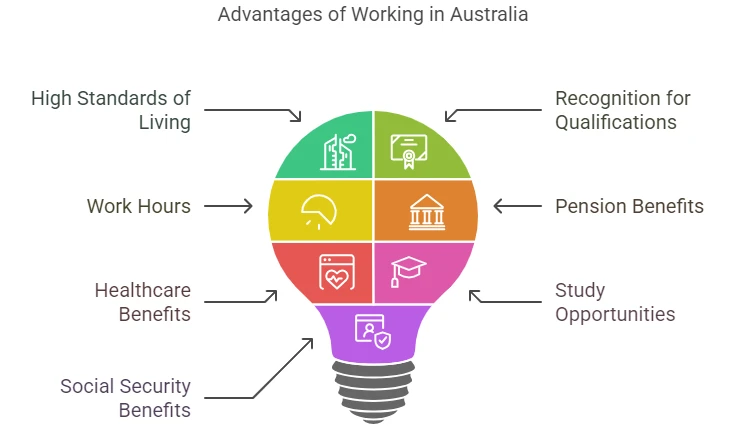
Working in Australia can provide eligible visa holders with:
- Competitive employment opportunities
- High standards of living
- International workplace experience
- Recognition of relevant qualifications and professional skills
- Opportunities for career progression
- Access to eligible healthcare services
- Opportunities to study, subject to visa conditions
- Potential pathways toward permanent residence
Jobs in Australia
Australia has demand for skilled workers across a wide range of industries. Opportunities and salary levels vary depending on occupation, qualifications, experience, location and employer.
Some of the major areas of employment include:
- Information technology
- Healthcare
- Engineering
- Construction
- Finance and accounting
- Education
- Manufacturing
- Hospitality
- Skilled trades
- Professional services
Australia Skills Assessment
A skills assessment is an important part of several Australian skilled migration pathways.
The relevant assessing authority depends on your nominated occupation. Applicants generally need to demonstrate that their qualifications, skills and professional experience meet the requirements established by the relevant assessing body.
| Assessing Authority | Major Occupations Assessed |
|---|---|
| ACS — Australian Computer Society | IT professionals, software developers, data professionals, cybersecurity and related technology occupations |
| TRA — Trade Recognition Australia | Electricians, plumbers, carpenters, welders and other eligible trade occupations |
| VETASSESS | Various professional and technical occupations, including selected business, education and hospitality occupations |
| Engineers Australia | Civil, mechanical, electrical, structural, chemical, mining and other engineering occupations |
| ANMAC | Eligible nursing and midwifery occupations |
| Australian Medical Council — AMC | Medical practitioners and eligible medical occupations |
| CPA Australia | Eligible accounting and related professional occupations |
| CA ANZ | Accounting and related professional occupations |
| AHPRA / Relevant Registration Authority | Registered health professions subject to Australian registration requirements |
A positive skills assessment does not automatically result in a visa grant. Applicants must also satisfy the requirements of the particular visa pathway.
Which Skills Assessment Authority Do I Need?
| If You Are a... | Relevant Authority |
|---|---|
| Software developer, IT professional or data professional | ACS |
| Electrician, plumber, welder or carpenter | TRA |
| Civil, mechanical, electrical or structural engineer | Engineers Australia |
| Registered nurse or midwife | ANMAC |
| Medical doctor or eligible medical practitioner | AMC |
| Accountant or related professional | CPA Australia / CA ANZ |
| Registered health professional | Relevant Australian registration authority |
| Chef, business professional or selected technical occupation | VETASSESS or the relevant assessing authority |
General Skilled Migration Eligibility
Australia's points-tested skilled migration pathways include Subclass 189, 190 and 491.
The points test can consider factors including age, English language ability, skilled employment, qualifications, Australian study, specialist education, community language skills, partner skills and nomination or sponsorship.
| Points Factor | Potential Points |
|---|---|
| Age | Up to 30 |
| English language proficiency | Up to 20 |
| Overseas skilled employment | Up to 15 |
| Australian skilled employment | Up to 20 |
| Educational qualifications | Up to 20 |
| Specialist educational qualification | 10 |
| Australian regional study | 5 |
| Accredited community language | 5 |
| Professional Year in Australia | 5 |
| State/territory nomination — Subclass 190 | 5 |
| Skilled partner | 10 |
| Partner with competent English | 5 |
| Single applicant or eligible Australian citizen/PR partner | 10 |
| Regional nomination/family sponsorship — Subclass 491 | 15 |
The minimum points threshold does not guarantee an invitation. Invitation requirements can vary depending on the visa subclass, occupation, nomination arrangements and invitation round.
Important: The points test applies to points-tested skilled migration visas. The Skills in Demand Visa (Subclass 482) is an employer-sponsored visa and does not use the GSM points test.
Skills in Demand Visa — Subclass 482
The Skills in Demand (SID) Visa Subclass 482 is an employer-sponsored temporary visa for eligible skilled workers.
It replaced the former Temporary Skill Shortage (TSS) visa in December 2024.
Applicants generally need:
- An eligible occupation or qualifying pathway
- An Australian employer willing to sponsor them
- Relevant skills and qualifications
- Relevant work experience
- The required English language ability, where applicable
- Compliance with applicable salary requirements
- Health and character clearance where required
The visa can provide eligible workers with temporary employment in Australia and, depending on the circumstances, may lead to a permanent employer-sponsored pathway.
SID Visa Streams
Core Skills Stream
The Core Skills stream is designed for skilled workers whose nominated occupation meets the applicable occupation-list requirements.
It can cover occupations across areas such as:
- Information technology
- Engineering
- Healthcare
- Construction
- Education
- Skilled trades
- Other professional occupations
Eligibility depends on the occupation, employer, salary, experience and other visa requirements.
Specialist Skills Stream
The Specialist Skills stream is intended for highly paid and specialised workers who meet the applicable salary and other requirements.
It is designed to support Australian employers in accessing highly skilled professionals where the relevant requirements are satisfied.
Labour Agreement Stream
The Labour Agreement stream applies where an employer has an approved labour agreement with the Australian Government.
The occupation, salary, English language, work experience and other requirements depend on the specific agreement.
Australia Work Visa Fees
Australian visa application charges are set by the Department of Home Affairs and can change.
The amount payable depends on the visa subclass, applicant circumstances and application location.
Additional expenses may include:
- Skills assessment fees
- English language testing
- Medical examinations
- Police certificates
- Biometrics, where applicable
- Professional registration
- Translation and document certification
Applicants should check the applicable government charge before submitting an application.
Australia Work Visa Processing Time
Processing times vary depending on the visa subclass and individual application.
Factors that can affect processing include:
- Completeness of the application
- Supporting documentation
- Health examinations
- Character checks
- Skills assessment
- Employer or nomination requirements
- Requests for additional information
- Application volumes
Published processing times are estimates and do not guarantee that an individual application will be finalised within that period.
How to Get a Job in Australia from India
Step 1: Research the Australian Job Market
Start by identifying occupations and industries that match your qualifications and professional experience.
Research Australian employers, job requirements, salary expectations and locations where your occupation is in demand.
Step 2: Prepare an ATS-Friendly Resume
Create an Australian-style resume that clearly presents your:
- Qualifications
- Work experience
- Technical skills
- Professional achievements
- Certifications
- Contact information
Many employers use Applicant Tracking Systems (ATS) to screen applications. A clear, keyword-relevant resume can make it easier for your application to reach the recruitment stage.
Step 3: Apply for Australian Jobs
Apply through Australian job portals, employer websites and legitimate recruitment channels.
Tailor your resume and cover letter to each position rather than sending the same application to every employer.
If the position requires sponsorship, confirm that the employer is able and willing to sponsor overseas workers.
Step 4: Select the Right Australian Work Visa
Receiving a job offer does not automatically determine your visa.
You need to identify the visa pathway that matches your occupation, employer, qualifications, experience and long-term plans.
Depending on your circumstances, this could include:
- Skills in Demand Visa — Subclass 482
- Employer Nomination Scheme — Subclass 186
- Skilled Independent Visa — Subclass 189
- Skilled Nominated Visa — Subclass 190
- Skilled Work Regional Visa — Subclass 491
- Other eligible work or skilled migration pathways
Step 5: Complete the Visa Application
Prepare the required documentation and submit the application through the Australian immigration system.
Depending on the visa, you may need to provide evidence of:
- Identity
- Qualifications
- Employment history
- English language ability
- Skills assessment
- Sponsorship or nomination
- Health
- Character
- Financial circumstances
Step 6: Receive Your Visa Decision
If your application is approved, you receive an electronic visa grant notification rather than a physical visa sticker.
You can check your visa details and conditions through VEVO (Visa Entitlement Verification Online).
Once your visa is granted, make sure you understand its conditions before travelling to Australia and starting employment.
Frequently Asked Questions
For points-tested skilled migration visas such as Subclass 189, 190 and 491, applicants generally need at least 65 points to be eligible to submit an Expression of Interest. However, 65 points does not guarantee an invitation. Actual invitation scores can be higher depending on the occupation, visa subclass and invitation round.
The Temporary Skilled Migration Income Threshold (TSMIT) is a salary threshold used for Australia's employer-sponsored skilled migration framework. For the Skills in Demand Visa, the employer must meet the applicable salary requirements, including the relevant threshold or the market salary rate where applicable.
The Skills in Demand Visa (Subclass 482) has three streams: the Core Skills stream, Specialist Skills stream and Labour Agreement stream. Each stream has different requirements relating to occupations, salary, sponsorship and eligibility.
The Specialist Skills stream has different occupation-list requirements from the Core Skills stream. Eligible highly paid specialists may qualify under this stream without relying on the Core Skills Occupation List. However, they must still satisfy the applicable salary, skills, experience, sponsorship and other visa requirements.
The Subclass 482 visa has a government visa application charge, which depends on the stream and applicant circumstances. Additional expenses may include skills assessments, English language testing, medical examinations, police certificates and other applicable costs. Government visa charges can change, so applicants should check the current fee before applying.
The cost depends on the visa subclass and the number of applicants included in the application. Subclasses 189, 190 and 491 have separate government application charges, with additional costs potentially applying for secondary applicants, skills assessments, English testing and health or character checks.
Processing times can vary significantly depending on the application, employer sponsorship, occupation, documentation and requests for additional information. Published processing times are estimates rather than guarantees, so applicants should avoid relying on a fixed processing period.
Processing times for Subclass 189, 190 and 491 applications vary according to the visa subclass, application volume, documentation, health and character checks and other factors. The processing-time information published by the Australian Government is indicative and does not guarantee a decision within a particular timeframe.
Yes. Eligible Indian passport holders can apply under Australia's Working Holiday arrangements with India, subject to the applicable age, education, English language, health, character and other requirements.
Depending on the specific Working Holiday visa and the applicant's circumstances, further participation may be possible if the relevant requirements are met. Indian applicants should check the conditions applying to their particular Working Holiday pathway before planning a longer stay.
The Core Skills Occupation List (CSOL) identifies occupations relevant to certain Australian skilled employer-sponsored pathways. For the Core Skills stream of the Subclass 482 visa, the nominated occupation generally needs to meet the applicable CSOL requirements.
The assessing authority depends on your nominated occupation. Examples include ACS for many IT occupations, Engineers Australia for engineering occupations, TRA for eligible trade occupations, ANMAC for nursing and midwifery, AMC for medical practitioners and VETASSESS for various professional and technical occupations.
Skills assessment fees vary according to the assessing authority, occupation and type of assessment. ACS, TRA, VETASSESS, Engineers Australia, ANMAC, AMC and other bodies each set their own charges. Applicants should check the applicable authority's current fee before submitting an assessment.
The Skills in Demand Visa can provide an employer-sponsored pathway toward permanent residence for eligible workers. Depending on the circumstances, a worker may later qualify for the Employer Nomination Scheme (Subclass 186). Meeting the requirements of the temporary visa does not automatically guarantee permanent residence.
The Australia–India Economic Cooperation and Trade Agreement includes provisions relating to professional services and recognition of qualifications. However, it does not provide a general fast-track work visa or guarantee faster visa processing for Indian professionals. Applicants must still meet the requirements of the relevant Australian visa and professional registration pathway.
Australian visas are generally issued electronically rather than as physical visa stickers placed in passports. Visa holders can check their visa details and conditions electronically through Australia's Visa Entitlement Verification Online (VEVO) system.
There is no single fastest pathway for every IT professional. Employer-sponsored options such as the Skills in Demand Visa may be suitable for an IT professional with an eligible occupation, qualifying experience and an Australian employer sponsor. Other applicants may be better suited to points-tested skilled migration.
Yes. Eligible Indian engineers may consider points-tested pathways such as the Skilled Independent Visa Subclass 189 or Skilled Nominated Visa Subclass 190. Requirements include the relevant occupation, skills assessment, English ability, points and any applicable invitation or nomination requirements.
Salaries vary considerably according to occupation, experience, location, qualifications and employer. Technology, healthcare, engineering, finance and other specialised professions can offer competitive salaries, while entry-level positions generally pay less. Applicants should compare current salary information for their specific occupation rather than relying on a single average.
WorldVisaHelp can help applicants understand potential Australian work visa pathways, review eligibility factors, identify relevant documentation and guide them through the application process. The appropriate pathway depends on the applicant's occupation, qualifications, experience, employer sponsorship and long-term migration goals.