
Canada Work Visa
Canada offers work permit pathways for foreign nationals who want to work temporarily in the country. Depending on the job, employer, nationality and circumstances, a work permit may require an LMIA, while some categories are LMIA-exempt.
A Canadian work permit can also provide eligible workers with Canadian experience that may later support permanent residence through programs such as Express Entry, the Canadian Experience Class (CEC), or Provincial Nominee Programs (PNPs).
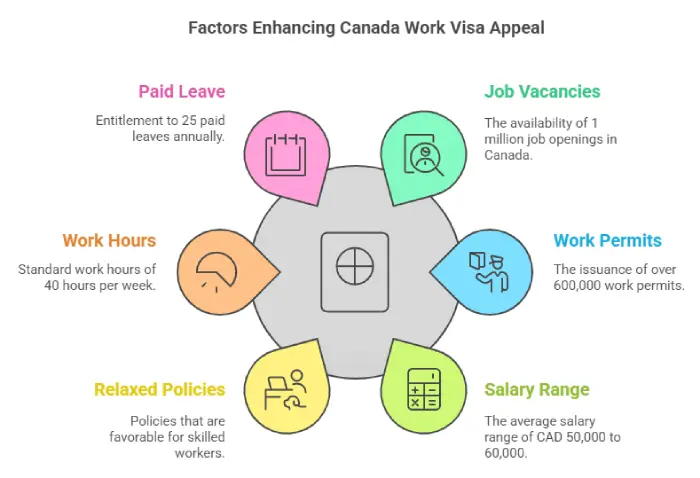
Benefits of Working in Canada
- Employment opportunities across technology, healthcare, construction, finance and skilled trades
- Competitive salaries that vary according to occupation, location and experience
- Canadian work experience that may support future PR eligibility
- Opportunities to develop international skills and experience
- Access to Canada's diverse and multicultural communities
- Potential family immigration options, depending on the worker's permit and family members' eligibility
- Possibility of transitioning to permanent residence through an eligible immigration program
Canada Work Visa for Indians
Indian professionals and skilled workers can apply for Canadian work permits from India if they meet the requirements of an eligible work permit category.
A job offer is required for many employer-specific work permits, but it is not a universal requirement for every Canadian work permit. Certain LMIA-exempt categories, open work permits, post-graduation work permits, international mobility programs, and other special categories have different requirements.
The correct pathway therefore depends on your:
- Occupation
- Work experience
- Education and qualifications
- Canadian job offer
- Employer
- LMIA requirement or exemption
- Current immigration status
- Family circumstances
- Country of citizenship
- Intended duration and type of work
The source specifically identifies a Canadian job offer as a common requirement, while also describing LMIA-required and LMIA-exempt work permit categories.
Canada Work Permit Requirements
There is no single checklist that applies to every Canadian work permit. Requirements depend on the type of permit and the applicant's circumstances.
Common requirements include
1. Valid passport
You need a valid passport or travel document. A copy of the passport information page is generally required with the application.
2. Job offer
For many employer-specific work permits, you need a valid job offer from a Canadian employer.
The employer may also need to complete additional steps before you apply, including obtaining a positive Labour Market Impact Assessment (LMIA) where the position is not exempt from the LMIA requirement.
3. LMIA, where applicable
An LMIA is used to assess whether hiring a foreign worker is justified based on Canada's labour market requirements.
An LMIA is not required for every work permit. Canada has several LMIA-exempt work permit categories under its international mobility framework.
4. Work experience and qualifications
Depending on the position and work permit category, you may need to demonstrate relevant:
- Education
- Professional qualifications
- Employment experience
- Technical skills
- Licensing or certification
- Occupational experience
The source specifically mentions skilled work experience and occupations classified under Canada's NOC/TEER system, but requirements vary by program.
5. Proof of funds
Depending on the application, you may need to demonstrate that you can support yourself and accompanying family members during your stay in Canada.
6. Medical examination
Some applicants may need a medical examination depending on factors such as their intended occupation, duration of stay, travel history, and other immigration requirements.
7. Police or security documentation
Applicants may need police certificates or other documentation to demonstrate admissibility.
8. Biometrics
Applicants who are required to provide biometrics must complete the biometric process after receiving the relevant instruction from Canadian immigration authorities.
9. Additional documents
Additional documents may include:
- Marriage certificate
- Proof of current immigration status
- Employment reference letters
- Educational documents
- Job offer
- LMIA documentation
- Employer compliance information
- Provincial nomination documents
- Proof of previous work
- Other documents requested by immigration authorities
The source lists several forms and supporting documents that can apply depending on the category.
What Is an LMIA?
LMIA stands for Labour Market Impact Assessment.
An LMIA is generally obtained by a Canadian employer when the position requires an assessment of whether hiring a foreign worker will have a positive or neutral impact on the Canadian labour market.
A positive LMIA can support an employer-specific work permit application.
However, LMIA is not required for every foreign worker. Canada has LMIA-exempt work permits under various programs and exemptions.
The LMIA process and the work permit application are separate processes. Where an LMIA is required, the employer generally completes the LMIA process before the worker proceeds with the corresponding work permit application.
Canada Work Permit Eligibility
Eligibility depends on the specific work permit category.
Common considerations include:
- A genuine employment opportunity where required
- Relevant qualifications
- Relevant work experience
- Valid passport
- Ability to perform the proposed work
- Admissibility to Canada
- Medical requirements where applicable
- Biometrics where required
- Compliance with immigration conditions
- LMIA or LMIA-exemption requirements, depending on the program
There is no universal maximum age limit for all Canadian work permits. However, age can affect eligibility or competitiveness under certain immigration programs, including Express Entry and some provincial programs.Canada Work Permit Process
The application process depends on the work permit category, but a typical process involves the following stages.
Step 1: Identify your occupation
Determine the appropriate National Occupational Classification (NOC) code for your occupation.
The NOC helps determine how your occupation is classified and whether your employment experience may meet the requirements of a particular immigration or work permit pathway.
Step 2: Choose the appropriate work permit pathway
Determine whether you qualify for:
- Employer-specific work permit
- LMIA-based work permit
- LMIA-exempt work permit
- Intra-company transfer
- Post-Graduation Work Permit
- International Experience Canada
- Open work permit
- Another specialized work permit category
Canada has multiple work permit pathways, so selecting the correct category is important.
Step 3: Obtain a Canadian job offer if required
If your category requires a job offer, you must secure employment with an eligible Canadian employer.
Where required, the employer must obtain an LMIA before you submit the relevant work permit application.
Step 4: Gather documents
Prepare your:
- Passport
- Photographs
- Job offer
- Employment documents
- Educational qualifications
- Work experience evidence
- LMIA documents, if applicable
- Proof of funds, where required
- Family documents, where applicable
- Medical documents, if required
- Police certificates, if required
Step 5: Submit the work permit application
Complete the applicable forms and submit the application through the appropriate Canadian immigration system.
The source lists IMM 1295 among the forms used for applications made outside Canada, along with other forms that apply depending on the applicant's circumstances.
Step 6: Pay the required fees
Pay the applicable work permit, biometrics, open work permit, or other fees associated with your application.
Step 7: Complete biometrics and medical requirements
If required, complete your biometrics and medical examination according to the instructions provided.
Step 8: Wait for processing
Processing times vary according to:
- Work permit category
- Country of application
- LMIA requirement
- Application completeness
- Background checks
- Medical/security requirements
- Volume of applications
The source itself advises applicants to verify the latest processing time before submitting an application.
Step 9: Receive your decision
If approved, you receive the relevant approval/documentation and work permit arrangements.
You should carefully check:
- Employer
- Occupation
- Location
- Work conditions
- Validity period
- Any restrictions
Step 10: Travel and begin employment
After receiving the required authorization, travel to Canada and comply with the conditions attached to your work permit.
Step 11: Explore permanent residence
If your long-term objective is Canadian PR, review your eligibility for pathways such as:
- Canadian Experience Class
- Express Entry
- Provincial Nominee Programs
- Other applicable economic immigration programs
Canadian work experience can be valuable, but holding a work permit does not guarantee PR.
Canada Work Permit Processing Time
There is no single processing time for all Canadian work permits.
The source provides the following indicative processing times:
| Work Permit Type | Source-Listed Processing Time |
|---|---|
| LMIA-based Work Permit | 9–16 weeks |
| Post-Graduation Open Work Permit | 7–19 weeks |
| IEC | 6–12 weeks |
| CUSMA Professionals | 1–3 weeks |
These figures are not guaranteed processing times. Processing times can change and applicants should verify the current IRCC processing estimate for their specific application before applying.
Canada LMIA Processing Times
The source provides the following 2026 LMIA processing figures:
| LMIA Stream | Source-Listed Average |
|---|---|
| Global Talent Stream | 9 business days |
| Agricultural Stream | 22 business days |
| Seasonal Agricultural Worker Program | 9 business days |
| High-Wage Stream | 79 business days |
| Low-Wage Stream | 71 business days |
| Permanent Residence Stream | 99 business days |
LMIA processing is separate from the work permit application process, and actual processing times can change.
Canada Work Visa Fees
The source lists the following fees:
| Application / Service | Fee |
|---|---|
| Work permit, including extensions | CAD $155 |
| Performing artists group of 3 or more | CAD $465 |
| International Experience Canada | CAD $184.75 |
| Open work permit holder fee | CAD $100 |
| Restoration as a worker + work permit | CAD $401.25 |
| Study permit | CAD $150 |
| Restoration as a student + study permit | CAD $396.25 |
| Temporary Resident Permit | CAD $246.25 |
| Biometrics — individual | CAD $85 |
| Biometrics — family | CAD $170 |
| Biometrics — performing artist group | CAD $255 |
| Employer Compliance Fee, where applicable | CAD $230 |
The source notes that a standard work permit application is CAD $155 and that biometrics may add CAD $85 where required.
Fees can change, so applicants should verify the current fee schedule before payment.
Jobs in Canada for Indians
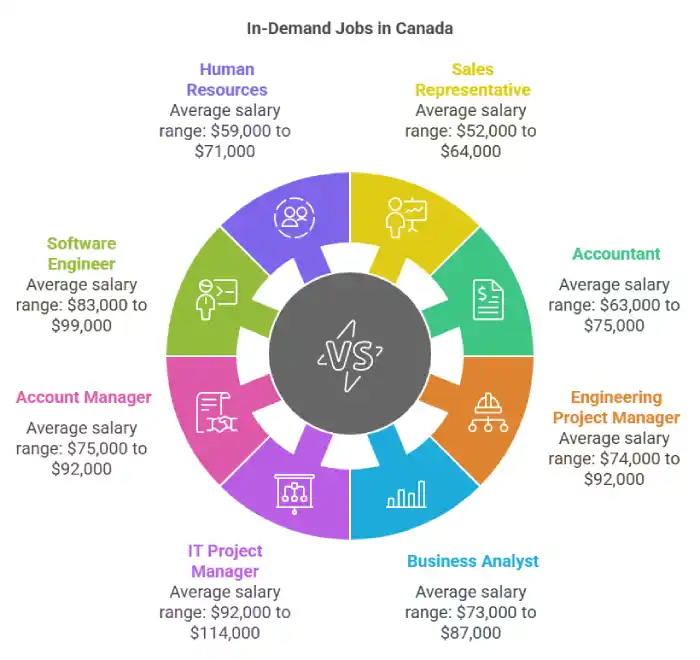
Canada has opportunities across several professional and skilled occupations. The source provides the following indicative salary ranges:
| Job Role | Average Annual Salary |
|---|---|
| Software Developer / Cloud Engineer | CAD $95,000–$130,000 |
| Registered Nurse | CAD $80,000–$110,000 |
| Finance Director | CAD $136,300–$263,000 |
| Financial Analyst | CAD $82,400–$127,400 |
| Pharmacist | CAD $102,300–$142,500 |
| Digital Marketing Manager | CAD $78,000–$135,000 |
| HR Manager | ~CAD $89,000 |
| Construction Project Manager | CAD $90,000–$120,000 |
| Industrial Electrician | CAD $67,000–$99,000 |
| Welder | CAD $49,000–$79,000 |
| Heavy-Duty Equipment Mechanic | ~CAD $82,800 |
| Business Development Manager | ~CAD $84,000 |
| SEO Specialist / Web Developer | CAD $55,000–$85,000 |
| Dental Hygienist | CAD $69,400–$103,200 |
| Warehouse / Logistics Supervisor | CAD $52,000–$75,000 |
These salary ranges are source-provided figures rather than guaranteed salaries. Actual compensation depends on province, employer, experience, occupation, licensing, and market conditions.
Average Salary Levels in Canada
Salary levels vary significantly according to experience and occupation.
The source provides these indicative ranges:
| Experience | Average Annual Salary |
|---|---|
| Entry Level | CAD $45,000–$60,000 |
| Mid Level | CAD $65,000–$90,000 |
| Senior Level | CAD $100,000–$150,000+ |
Specialized professionals in areas such as artificial intelligence, cybersecurity, technology, healthcare, finance, and management may earn substantially more.
In-Demand White-Collar Occupations
The source identifies technology, healthcare, finance, marketing, and HR among areas with demand for skilled professionals.
| Occupation | Annual Salary Range |
|---|---|
| AI / Machine Learning Engineer | CAD $110,000–$160,000 |
| AI Product Manager | CAD $120,000–$170,000 |
| Cloud Architect | CAD $120,000–$170,000 |
| Cybersecurity Analyst | CAD $85,000–$125,000 |
| Data Scientist | CAD $98,000–$130,000 |
| Software Engineer | CAD $100,000–$140,000 |
| Physician / Medical Specialist | CAD $275,000–$340,000 |
| Nurse Practitioner | CAD $90,000–$120,000 |
| Pharmacist | CAD $85,000–$127,000 |
| Finance Manager / Controller | CAD $90,000–$140,000 |
| Marketing Manager | CAD $62,000–$125,000 |
| Sales Manager | CAD $80,000–$130,000 |
| HR Business Partner | CAD $75,000–$110,000 |
These figures should be used as indicative salary information rather than promises of employment or income.
Types of Canada Work Permits
Canada offers several categories of work authorization.
1. Temporary Foreign Worker Program
The Temporary Foreign Worker Program (TFWP) generally involves an LMIA and is intended to allow Canadian employers to hire foreign workers where applicable labour-market requirements are met.
2. International Mobility Program
The International Mobility Program (IMP) contains several LMIA-exempt work permit categories where Canada's immigration rules provide a broader economic, cultural, social, or other benefit.
3. Intra-Company Transfer
Employees of qualifying multinational companies may be eligible to transfer to a related Canadian entity under an applicable LMIA-exempt category.
4. LMIA-Based Work Permit
An employer-specific work permit supported by a positive LMIA, where the position requires an LMIA.
5. LMIA-Exempt Work Permit
Some workers can obtain authorization without an LMIA if they qualify under a specific exemption.
6. Business Visitor
Certain foreign nationals can perform limited business activities in Canada without entering the Canadian labour market as a worker, subject to business visitor rules.
7. International Experience Canada
IEC provides eligible young people from participating countries with opportunities to travel and work in Canada under applicable bilateral arrangements. The source identifies:
- Working Holiday
- Young Professionals
- International Co-op
as the three main IEC categories.
8. Post-Graduation Work Permit
Eligible international graduates may obtain a post-graduation work permit if they meet the applicable requirements.
9. Open Work Permit
An open work permit can allow an eligible foreign national to work for an employer without being restricted to one specific employer, subject to the conditions attached to the permit.
The source identifies several open work permit categories, including spousal open work permits, post-graduation work permits, bridging open work permits, and other applicable categories.
Employer-Specific vs Open Work Permit
Employer-Specific Work Permit
An employer-specific work permit generally restricts the worker to the employer, occupation, location, and other conditions specified on the permit.
Open Work Permit
An open work permit provides broader employment flexibility, subject to the conditions printed on the permit and the eligibility rules of the applicable category.
The exact conditions can include restrictions relating to:
- Type of work
- Location
- Duration
- Employer
- Certain occupations or industries
Applicants should always read the conditions attached to their specific permit.
Canada Open Work Permit
An open work permit is available only to people who meet the requirements of an eligible category.
Examples can include:
- Eligible spouses or partners
- Post-graduation work permit holders
- Bridging open work permit applicants
- Certain temporary residents
- Eligible participants under specific immigration programs
- Other categories established under Canadian immigration rules
An applicant cannot simply choose an open work permit instead of an employer-specific permit. Eligibility must exist under a specific open-work-permit category.
Canada IEC Work Permit
International Experience Canada (IEC) allows eligible participants from countries and territories that have the required youth mobility arrangements with Canada to obtain work authorization.
The source identifies three major IEC categories:
- Working Holiday
- Young Professionals
- International Co-op / Internship
Eligibility, age, participation limits, nationality requirements, and duration depend on the applicable country agreement and category.
Canada Work Permit for Family Members
Depending on the worker's immigration category and the current eligibility rules, certain family members may be able to accompany the principal applicant.
Potential options can include:
- Spousal or partner work authorization
- Study authorization for children
- Visitor status for eligible family members
Family members do not automatically receive the same immigration status as the principal worker. Their eligibility must be assessed separately under the rules applicable to their relationship and the principal applicant's work authorization.
Can a Canada Work Permit Lead to PR?
Yes, in some cases.
A work permit can allow a foreign worker to gain Canadian work experience. That experience may help the worker qualify for economic immigration programs.
Potential pathways include:
Canadian Experience Class
The CEC is an Express Entry pathway for eligible individuals with qualifying Canadian skilled work experience.
Express Entry
Express Entry manages applications under programs including:
- Federal Skilled Worker Program
- Canadian Experience Class
- Federal Skilled Trades Program
Candidates are ranked using the Comprehensive Ranking System (CRS).
Provincial Nominee Programs
Canadian provinces and territories operate immigration programs designed to address their specific labour-market needs.
A qualifying provincial nomination can significantly strengthen an Express Entry candidate's position where the nomination is linked to Express Entry.
Important: A work permit does not guarantee PR. You must independently satisfy the eligibility requirements of the PR program you apply through.
What CRS Score Is Needed for Canada PR?
There is no single CRS score that guarantees an Invitation to Apply (ITA).
The required score changes between Express Entry draws according to:
- Draw type
- Number of invitations issued
- Candidate pool
- Immigration priorities
- Category requirements
- Provincial nominations
- Other selection factors
The source emphasizes that applicants should check the latest Express Entry rounds rather than relying on a fixed CRS cutoff.
Canada Immigration Policy Changes in 2026
The source notes that IRCC conducted a consultation in 2026 concerning possible changes to Express Entry, including the possibility of consolidating the Federal Skilled Worker Program, Canadian Experience Class, and Federal Skilled Trades Program.
These were proposals for consultation, not confirmed changes to the existing system. The source states that the existing Express Entry structure remained unchanged at the time of the source's last update.
Applicants should therefore distinguish between proposed reforms and rules actually in force.
Why Choose WorldVisaHelp for Canada Work Visa?
WorldVisaHelp can assist applicants in understanding the Canadian work permit process and selecting a pathway based on their individual profile.
Our support can include:
- Work permit eligibility assessment
- Identification of suitable work permit categories
- Job and occupation profile assessment
- NOC/TEER classification guidance
- LMIA and LMIA-exempt pathway assessment
- Document checklist preparation
- Application-form guidance
- Work experience assessment
- Family application guidance
- Express Entry and PR pathway assessment
- CRS profile assessment
- Provincial immigration pathway guidance
- Application review and submission support
- Post-approval guidance
Start Your Canada Work Visa Journey
Whether you are a skilled professional, tradesperson, international graduate, business employee, or experienced worker, the appropriate Canadian work permit depends on your individual circumstances.
WorldVisaHelp can help you identify the relevant pathway, understand the requirements, prepare your documentation, and plan a potential transition from temporary work authorization to permanent residence where you qualify.
Frequently Asked Questions About Canada Work Visa
Find answers to common questions about Canada work permits, eligibility, LMIA, job offers, processing times, family members, fees, and pathways to permanent residence.
A Canada Work Visa generally refers to a work permit that allows an eligible foreign national to work legally in Canada for a specified period. Depending on the category, the permit may be employer-specific or open.
An employer-specific work permit generally limits you to the employer, occupation, location, and other conditions specified on the permit. An open work permit can provide greater flexibility, but it is only available to people who meet the eligibility requirements of an applicable open work permit category.
Foreign nationals who meet the requirements of an eligible Canadian work permit category can apply. Eligibility depends on the type of work authorization being requested.
Depending on the program, applicants may need a Canadian job offer, relevant qualifications, work experience, an LMIA or proof of an LMIA exemption, and evidence that they are admissible to Canada. Medical examinations, biometrics, police certificates, and other documents may also be required depending on the circumstances.
A job offer is required for many employer-specific Canadian work permits, but it is not a universal requirement for every work permit category.
Some LMIA-exempt work permits, open work permits, post-graduation work permits, International Experience Canada categories, intra-company transfer categories, and other specialized programs have different requirements.
The correct answer therefore depends on the specific work permit category for which you qualify.
LMIA stands for Labour Market Impact Assessment. It is an assessment used in certain Canadian employment situations to determine whether hiring a foreign worker is justified based on Canada's labour-market requirements.
When an LMIA is required, the Canadian employer normally completes the LMIA process before the foreign worker applies for the corresponding employer-specific work permit.
An LMIA is not required for every Canadian work permit. Several LMIA-exempt categories exist under Canada's immigration framework.
Yes. Some foreign nationals can obtain a Canadian work permit without an LMIA if they qualify under an LMIA-exempt category.
Examples can include certain workers under the International Mobility Program, eligible intra-company transferees, some international graduates, eligible participants under International Experience Canada, and certain other categories.
Being outside the LMIA requirement does not mean that the applicant is automatically eligible. The applicant must satisfy the requirements of the specific LMIA-exempt category.
An employer-specific work permit normally authorizes you to work under the employer and conditions specified on the permit. Restrictions can relate to the employer, occupation, location, and validity period.
An open work permit generally provides greater flexibility because it is not restricted to one specific employer in the same way. However, open work permits are available only to eligible applicants under designated categories and may still contain conditions or restrictions.
Yes. Indian citizens can apply for a Canadian work permit if they qualify under an eligible work permit category.
Depending on the pathway, an Indian applicant may need a Canadian job offer, LMIA, relevant work experience, professional qualifications, or evidence that they qualify for an LMIA-exempt or open work permit.
There is no separate universal Canada Work Visa category exclusively for Indian citizens. The applicant must qualify under the applicable Canadian immigration program.
Documents depend on the work permit category and the applicant's circumstances. Common documents may include:
- Valid passport or travel document
- Passport photographs
- Canadian job offer, where required
- LMIA documentation, where applicable
- Employment reference letters
- Educational qualifications
- Proof of relevant work experience
- Proof of current immigration status, where applicable
- Marriage or family documents, where applicable
- Proof of payment
- Biometrics, where required
- Medical examination documents, where required
- Police certificates or other admissibility documents, where required
Additional documents can be requested depending on the work permit category and the applicant's individual circumstances.
The standard work permit application fee listed in the source is CAD $155 per person. Applicants who are required to provide biometrics may also have to pay a CAD $85 biometrics fee.
Other fees can apply depending on the application, including the open work permit holder fee, IEC participation fee, restoration fees, study permit fees for accompanying applicants, or other applicable charges.
Government fees can change, so applicants should confirm the current fee schedule before submitting payment.
IELTS is not a universal requirement for every Canadian work permit. Language requirements depend on the specific work permit category, immigration program, occupation, employer, and the purpose of the application.
Language testing can become particularly important if you are also planning to qualify for permanent residence through Express Entry or another economic immigration pathway.
There is no single maximum age limit that applies to every Canadian work permit.
However, age can affect eligibility or competitiveness under certain immigration programs, including Express Entry and Provincial Nominee Programs. Some specialized programs, such as youth mobility programs, can also have specific age requirements.
Your age should therefore be assessed together with your occupation, work experience, education, language ability, and intended immigration pathway.
Processing times vary by work permit type, country of application, whether an LMIA is required, application completeness, and background, medical, or security checks.
The source provides indicative figures of approximately 9–16 weeks for LMIA-based work permits, 7–19 weeks for post-graduation work permits, 6–12 weeks for IEC applications, and 1–3 weeks for CUSMA professionals.
These are not guaranteed timelines. Applicants should check the latest official processing estimate applicable to their country and category before applying.
In some circumstances, an eligible spouse or partner of a Canadian work permit holder may qualify for an open work permit.
Eligibility depends on the principal worker's occupation, work permit, duration of authorization, and the immigration rules in effect when the spouse applies.
A spouse does not automatically receive work authorization simply because the principal applicant has a Canadian work permit.
Eligible children of temporary foreign workers may be able to study in Canada, but the exact authorization required depends on the child's age, education level, location, and immigration status.
Parents should determine whether a study permit or another form of authorization is required before the child begins studying.
Family members should be assessed individually rather than assuming that every child automatically receives the same status as the principal work permit holder.
Eligible workers may be able to accompany or be accompanied by qualifying family members, depending on the worker's permit category and the rules applicable to spouses, partners, and dependent children.
Possible family immigration statuses can include work authorization for an eligible spouse or partner, study authorization for children, or visitor status.
Each family member must meet the requirements of their respective immigration category.
Yes. Eligible applicants in India can apply for a Canadian work permit from outside Canada.
The applicant must first identify the appropriate work permit category and meet its requirements. Depending on the pathway, this can involve obtaining a Canadian job offer, completing employer requirements, obtaining an LMIA where required, or demonstrating eligibility for an LMIA-exempt or open work permit.
Applicants should prepare the required forms, supporting documents, fees, biometrics, and medical documentation where applicable.
It depends on the type of work permit you hold.
If you have an employer-specific work permit, you are generally authorized to work under the conditions stated on that permit. You may need to obtain new authorization before starting work for a different employer.
Open work permit holders generally have greater flexibility to change employers, subject to any restrictions printed on their permit.
You should not assume that changing employers is permitted without checking the conditions of your specific work permit.
In eligible circumstances, a Canadian work permit can be extended or a worker may apply for another form of work authorization.
The possibility of extending the permit depends on the underlying work permit category, employment situation, passport validity, employer requirements, LMIA or LMIA-exemption rules, and other immigration requirements.
Workers should review their eligibility and apply within the required timeframe rather than assuming that every work permit can be extended indefinitely.
A Canadian work permit can provide an opportunity to gain Canadian work experience, which may help an eligible worker qualify for permanent residence.
Potential pathways can include the Canadian Experience Class (CEC), Express Entry programs, and Provincial Nominee Programs.
Canadian work experience can strengthen a PR profile, but holding a work permit does not guarantee permanent residence. The applicant must separately meet the eligibility and selection requirements of the PR program.
WorldVisaHelp can help you understand the Canadian work permit options that may be relevant to your profile and guide you through the application process.
Our assistance can include:
- Work permit eligibility assessment
- Selection of a suitable work permit category
- NOC and occupation assessment
- LMIA and LMIA-exempt pathway assessment
- Document checklist and preparation guidance
- Application form guidance
- Family application guidance
- Express Entry and CRS assessment
- PR pathway assessment
- Provincial immigration pathway guidance
The objective is to help you understand your available options, prepare the required documentation, and plan your Canadian immigration pathway based on your individual circumstances.