
Germany Work Visa
Last Updated: 07 August 2026
Why Work in Germany?
Germany is one of Europe's leading destinations for skilled professionals seeking international career opportunities. A strong economy, advanced industries, modern infrastructure and demand for qualified workers make Germany an attractive option for professionals from India and other countries.
Key advantages of working in Germany include:
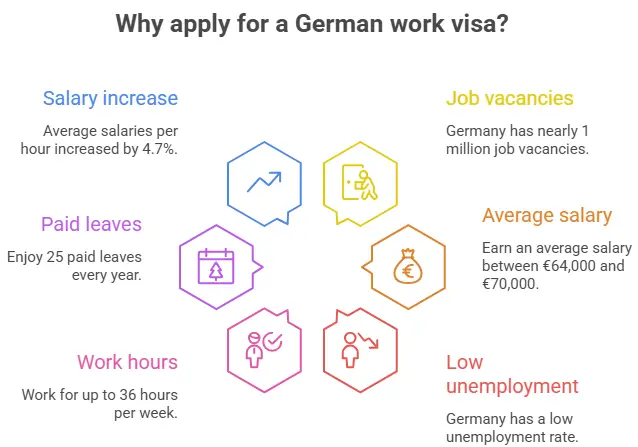
- Around 1 million job vacancies across different sectors
- Competitive salaries for skilled professionals
- Low unemployment levels
- A standard working week of around 36 hours
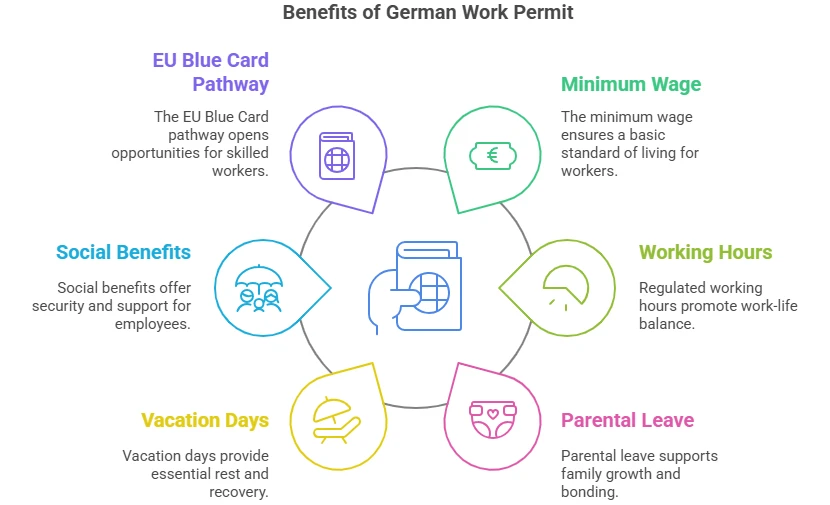
- Paid annual leave and employee protections
- Strong healthcare and social security systems
- Opportunities for long-term residence and permanent settlement
- Growing demand for international professionals in technology, engineering, healthcare and skilled trades
Germany has particularly strong demand for international talent in technology, engineering, healthcare, construction and other specialist occupatio
What is a German Work Visa?
A German employment visa, commonly issued as a National D Visa, allows eligible non-EU/EEA/Swiss nationals to enter Germany for employment.
Depending on the immigration pathway, applicants may need:
- A valid employment offer
- Recognised educational or vocational qualifications
- Relevant professional experience
- Proof of financial stability where required
- Health insurance
- A valid passport
- Additional documentation required for the selected visa category
The National D Visa is generally used to enter Germany for a long-term stay. After arriving in Germany, eligible applicants may need to obtain the appropriate residence permit from the local Foreigners Authority.
For applicants applying from India, the visa application is submitted through the appropriate German visa application channel before travelling to Germany. The entry visa and subsequent residence permit are separate documents.
Germany Work Visa from India
Germany has become an increasingly popular destination for Indian professionals because of its employment opportunities, strong economy and demand for skilled workers.
Professionals with relevant qualifications and experience may find opportunities in sectors such as:
- Mechanical and automotive engineering
- Electrical and electronics
- Information technology and telecommunications
- Construction and infrastructure
- Healthcare and nursing
- Engineering and manufacturing
- Research and STEM-related occupations
Germany has several immigration pathways designed to attract qualified international professionals.
Types of German Work Visa
Germany offers different pathways depending on your qualifications, employment situation and career objectives.
Germany Opportunity Card
The Germany Opportunity Card (Chancenkarte) allows eligible non-EU nationals to enter Germany for the purpose of searching for employment.
A job offer is not necessarily required before applying through this pathway. Eligibility can be based on recognised qualifications or the applicable points system.
Germany Opportunity Card Points System
Applicants may qualify by meeting the applicable points requirements.
| Criteria | Points |
|---|---|
| Recognised university degree or equivalent vocational qualification | 2 |
| German language skills at B2 or higher | 2 |
| German language skills from A1 to B1 | 1 |
| Relevant work experience | 1 |
| IT certification or completed IT vocational training | 1 |
| Age below 35 | 1 |
| Previous legal stay in Germany | 1 |
| Qualified spouse or partner | 1 |
| Maximum possible points | 11 |
A minimum of 6 points is required under the points-based route described in the source material.
Germany Job Seeker Visa
The Germany Job Seeker Visa is designed for qualified professionals who want to travel to Germany and search for employment without already having a job offer.
Key features include:
| Feature | Details |
|---|---|
| Validity | 6 months |
| Purpose | Searching for employment in Germany |
| Degree | Qualification generally needs to meet German recognition requirements |
| Proof of funds | Financial resources may need to be demonstrated |
| Language | German may not be mandatory for every pathway, but language skills can improve employment prospects |
| Conversion | Depending on the applicable rules, a successful job search may allow transition to an appropriate work residence permit |
The exact requirements depend on the applicant's qualification and immigration pathway.
EU Blue Card Germany
The EU Blue Card is a residence permit designed for highly qualified professionals from outside the EU.
It can be particularly relevant to professionals working in areas such as:
- Information technology
- Engineering
- Healthcare
- Mathematics and STEM
- Scientific research
- Other specialised occupations
The permit provides a pathway for qualified professionals to live and work in Germany and may provide a faster route toward permanent residence when the applicable requirements are fulfilled.
Frequently Asked Questions
Find answers to common questions about Germany work visas, the Chancenkarte, skilled worker immigration, eligibility, jobs and relocation from India.
Germany has strong demand for skilled professionals in areas such as information technology, software development, engineering, healthcare, nursing, skilled trades and technical occupations. IT specialists, engineers and qualified healthcare professionals are particularly relevant for international recruitment.
Your prospects depend on your qualifications, professional experience, occupation, German language ability and whether your qualifications are recognised in Germany where recognition is required.
Indian citizens generally need the appropriate German national visa before moving to Germany for long-term employment. The route depends on your circumstances and may include a Skilled Worker Visa, EU Blue Card, or another employment-based residence route.
A typical process involves obtaining a qualifying job offer where required, preparing your qualification and employment documents, completing any required recognition process, submitting the visa application and then applying for the relevant residence permit after arrival in Germany.
Germany continues to attract international skilled workers because of demand in several technical, professional and healthcare occupations. Indian professionals are an important part of Germany's international skilled-worker pipeline.
However, being in a high-demand occupation does not automatically guarantee a visa or employment. Your qualification, experience, salary, language skills and the requirements of the particular immigration route still have to be satisfied.
Not always. Several German immigration routes are employment-based and require a qualifying job offer, but the Chancenkarte (Opportunity Card) is designed to allow eligible skilled professionals to enter Germany for job searching.
Once you secure suitable employment, you may be able to transition to an appropriate employment residence permit, provided you meet the requirements of that route.
There is no single salary figure that applies to every German work visa. Salary requirements depend on the immigration category, your occupation, age in certain cases and the type of employment.
The EU Blue Card, for example, has its own salary threshold that is adjusted periodically. Other skilled-worker routes can operate under different rules. Therefore, the salary should always be assessed against the specific visa category being used.
The Chancenkarte can provide an option for qualified people who want to enter Germany and search for suitable employment. Depending on the route, eligibility can involve recognised qualifications or a foreign qualification meeting the applicable requirements, as well as language ability and other criteria.
The points-based route can award points for factors such as qualifications, professional experience, language skills, age and connections to Germany. Applicants must also meet the basic requirements and demonstrate that they can support themselves during their stay.
| Factor | What it can assess |
|---|---|
| Qualification | Recognised or qualifying foreign professional/academic qualification |
| Experience | Relevant professional experience |
| Language | German and/or English language ability, depending on the route |
| Age | Age can contribute to the points assessment |
| Germany connection | Certain previous study, work or family connections may be relevant |
Yes, eligible Indian IT professionals can potentially use the Chancenkarte route. IT and technology occupations are among the areas where Germany has significant demand for qualified international professionals.
Eligibility still depends on your educational or professional qualification, experience, language skills, financial resources and the applicable points or qualification requirements. An IT job title alone does not guarantee eligibility.
Processing time varies according to the visa category, German mission, document completeness, qualification checks and whether additional approvals are required.
Applications can take several weeks or longer, particularly when authorities need to verify qualifications or employment information. Applicants should therefore avoid making non-refundable travel arrangements until the visa has been issued.
Applications may be refused when the applicant does not meet the requirements of the selected visa category. Common problems can include incomplete documentation, qualification issues, an unsuitable employment contract, insufficient financial evidence or failure to meet applicable salary or professional requirements.
Incorrect information or inconsistencies between documents can also create problems. A refusal should be reviewed carefully before submitting a new application.
German is not universally required for every German work visa. Some employment routes can be available without German language proficiency, particularly for certain qualified international professionals.
However, language requirements can differ by visa route and occupation. German can also substantially improve your employability, especially in healthcare, customer-facing roles and professions where communication with German-speaking colleagues or clients is essential.
Anerkennung refers to the recognition of a foreign professional qualification in Germany. It is particularly important for regulated professions, where you generally need recognition or the appropriate professional licence before practising the profession.
Whether formal recognition is required depends on your occupation and immigration route. Applicants should check the recognition requirements for their specific qualification before applying.
IELTS is not a universal requirement for German work visas. Germany does not use one single English-language test requirement for every employment immigration category.
The relevant visa route may require proof of German or another language level, while some routes may not require a language certificate at all. You should therefore check the language requirement for the exact visa category rather than assuming IELTS is mandatory.
Yes. Employment-based residence can provide a pathway toward permanent residence in Germany when you meet the applicable requirements.
The time required depends on your residence status, employment history, pension contributions, language ability and other conditions. EU Blue Card holders can have different and potentially faster settlement options depending on their circumstances.
Both are routes for qualified professionals, but their eligibility criteria are different. The EU Blue Card is specifically aimed at highly qualified professionals who meet the applicable academic or comparable requirements and salary threshold.
| Feature | EU Blue Card | Skilled Worker Route |
|---|---|---|
| Main focus | Highly qualified employment | Qualified skilled employment |
| Salary | Specific Blue Card salary threshold | Requirements depend on the applicable route |
| Qualification | Usually higher-education or qualifying comparable credentials | Recognised/qualifying vocational or academic qualification |
| Settlement | Can offer specific settlement advantages | Can also lead to permanent residence when requirements are met |
In many cases, eligible workers can be joined by their spouse and dependent children through family reunification provisions. The exact conditions depend on the worker's residence status and the family members involved.
Documentation may include marriage or birth certificates, passports, proof of relationship and residence information. Family members may also receive residence rights and, depending on their status, access to employment.
Germany's job-search immigration options allow certain qualified international professionals to enter Germany without already having a long-term employment contract, so they can look for suitable work.
The Chancenkarte (Opportunity Card) is the current prominent route for eligible skilled workers seeking employment in Germany. It replaced the traditional job-seeker approach for many applicants and uses different eligibility pathways.
The job-search route is primarily intended to allow eligible applicants to look for suitable employment rather than immediately taking up unrestricted full-time employment.
The Chancenkarte can permit limited employment while you search for a qualifying job, subject to its conditions. Once you obtain suitable employment, you can apply for the appropriate residence status for that employment.
The amount of financial proof depends on the visa category and the purpose of your stay. Applicants using a job-search route generally need to demonstrate that they can support themselves while searching for employment.
Evidence can include a blocked account, an appropriate declaration of financial support or other accepted proof, depending on the route. The required amount can change, so the current requirement should be checked before submitting the application.
There is no universally better destination. Germany can be attractive for skilled professionals because of its large industrial base, demand for technical workers, European location and multiple skilled-worker immigration routes.
Canada and Australia have different immigration systems, labour markets, salary structures and permanent-residence pathways. The best option depends on your occupation, age, qualifications, experience, language ability, finances and long-term settlement goals.
| Factor | Germany | Canada | Australia |
|---|---|---|---|
| Skilled migration | Multiple employment-based routes | Points and employer-based pathways | Points and employer/state pathways |
| Language | German often improves opportunities | English/French | English |
| Job-search route | Chancenkarte for eligible applicants | Generally job/immigration-program dependent | Program dependent |
| Best fit | Technical, engineering, IT and skilled professions | Broad skilled migration options | Skilled professionals meeting occupation criteria |
You may be eligible if you have a qualifying academic or vocational qualification, relevant professional experience where required, and meet the conditions of a suitable German immigration route.
Your eligibility can depend on your occupation, qualification recognition, job offer, salary, language ability, age, financial resources and the specific visa category. A proper assessment should consider all of these factors rather than relying only on your job title or degree.
- Qualifying academic or vocational qualification
- Relevant professional experience where applicable
- Suitable employment or eligibility for a job-search route
- Required qualification recognition
- Required salary level
- Language requirements, where applicable
- Valid passport and supporting documents
- Proof of financial resources where required