
Types of Netherlands Work Visa
The Netherlands has different work-related immigration routes based on the duration and nature of employment.
Short-Stay Work Visa
A Schengen Category C visa can be used for eligible short-term business and work-related travel. It generally allows a stay of up to 90 days within a 180-day period.
This route can be relevant for business meetings, conferences, work-related events and certain temporary activities. It is not the standard route for professionals intending to take up long-term employment in the Netherlands.
Single Permit — GVVA
The GVVA combines work authorization and residence permission for eligible employment. It is generally used where the employment does not qualify for one of the more specialised skilled-worker routes.
The employer may need to satisfy labour-market requirements before the permit can be granted.
Seasonal Worker Visa
This route is intended for seasonal employment, particularly in agriculture and related industries. The source states that seasonal employment can be authorised for up to 24 weeks within one year.
Working Holiday Programme
The Working Holiday Programme is available only to nationals of selected partner countries. The source describes eligibility generally for applicants aged 18–30, with the upper age limit reaching 35 for some participating nationalities.
The permit can generally be valid for up to one year.
Entrepreneur / Start-up Visa
The Start-up route is intended for non-EU entrepreneurs developing an innovative business in the Netherlands. Applicants need support from a recognised Dutch facilitator, with the permit generally issued for one year.
Long-Term Netherlands Work Visas
Highly Skilled Migrant Visa
The Highly Skilled Migrant (HSM) route is one of the main options for qualified international professionals.
Applicants generally need employment with an IND-recognised sponsor and must meet the applicable salary requirements. Unlike the standard GVVA route, the HSM route does not require the same labour-market test. The source indicates processing can be considerably faster for applications submitted through recognised sponsors.
EU Blue Card
The EU Blue Card is designed for highly qualified professionals who meet the required education, employment and salary conditions. It can also provide certain mobility advantages within the EU, subject to the rules of the destination country.
Intra-Corporate Transfer Permit
The ICT permit is intended for employees transferred from a company outside the Netherlands to a related Dutch entity. It can apply to managers, specialists and certain trainees.
The source states that employees generally need to have worked for the company for at least three months before the transfer.
HSM vs GVVA
| Factor | Highly Skilled Migrant | Single Permit (GVVA) |
|---|---|---|
| Processing | Around 2–5 weeks in the source | Up to 90 days |
| Labour-market test | Not required | Generally required |
| Employer | IND-recognised sponsor | Standard qualifying employer |
| Salary | Specific HSM threshold | Market-based requirements |
| Validity | Up to 5 years | Depends on employment/permit |
| Suitable for | Highly skilled professionals | Eligible jobs below HSM threshold |
The HSM route is particularly relevant to international professionals working in IT, engineering, finance and other specialised occupations.
30% Tax Ruling in the Netherlands
The Dutch 30% ruling can provide a significant tax advantage to qualifying internationally recruited employees. Under the source's 2026 information, eligible employees may receive up to 30% of their salary tax-free for a qualifying period of up to five years.
The source lists requirements such as being recruited from outside the Netherlands, working for a qualifying Dutch employer, meeting the applicable salary threshold and having specialised expertise. It also states that the application should be made within four months of starting employment.
Example of the 30% Ruling
| Gross Salary | 30% Tax-Free Amount | Estimated Annual Tax Saving |
|---|---|---|
| €60,000 | €18,000 | €5,400–€6,300 |
| €70,000 | €21,000 | €6,300–€7,350 |
| €80,000 | €24,000 | €7,200–€8,400 |
These are illustrative estimates from the supplied source and should not be treated as guaranteed take-home savings.
The source also notes a scheduled change from 30% to 27% from 2027, making the timing of employment relevant for applicants planning their move.
Netherlands Work Visa Eligibility
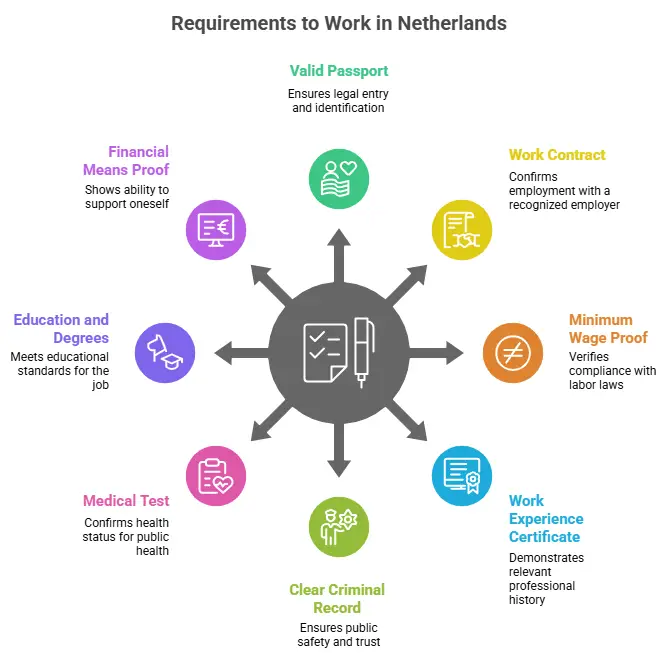
Requirements vary according to the specific permit. For the skilled-worker routes, applicants generally need:
- A qualifying employment offer from a Dutch employer
- Salary meeting the applicable threshold
- Relevant education or professional qualifications
- Skills and experience appropriate for the position
- A valid passport
- Required employment and educational documents
- Proof of financial means where applicable
- Required background and medical documentation
For the 2026 HSM route, the source lists monthly salary thresholds of €5,942 for applicants aged 30 or above, €4,357 for applicants under 30, and €3,122 for eligible graduates/orientation-year applicants.
Netherlands Work Visa Requirements for Indians
The main documents may include:
| Document | Purpose |
|---|---|
| Valid passport | Identity and travel document |
| Employment contract | Evidence of the Dutch job |
| Salary information | Demonstrates compliance with salary requirements |
| Experience certificates | Supports professional experience |
| Educational certificates | Proves qualifications |
| CV | Employment and education history |
| Criminal record documents | Character/background requirements |
| Medical documents | Where applicable |
| Financial evidence | Demonstrates financial capacity where required |
The exact documentation depends on the permit category and individual circumstances.
How to Apply for a Netherlands Work Visa from India
Step 1: Select the Correct Permit
Determine whether your profile fits the HSM, EU Blue Card, GVVA, ICT, seasonal or another applicable route.
Step 2: Secure a Dutch Job Offer
For the HSM and EU Blue Card routes, the employer must meet the relevant sponsor requirements. The source specifically highlights the importance of an IND-recognised sponsor for these routes.
Step 3: Employer Submits the Application
For HSM and EU Blue Card applications, the recognised Dutch employer submits the relevant application to the IND.
For GVVA and other routes, the applicable application process and documentation requirements differ.
Step 4: Pay the Applicable Fee
The supplied source lists €423 for HSM/EU Blue Card and €290 for GVVA under its 2026 fee information.
Step 5: Biometrics
The applicant may need to provide fingerprints and photographs and attend an appointment if required.
Step 6: Receive the Decision
Once the application is approved, the applicant can complete the required entry and residence formalities and travel to the Netherlands to begin employment.
Netherlands Work Visa Processing Time
Processing depends on the permit type, application completeness and workload of the immigration authorities.
| Visa / Permit | Processing Time in Source |
|---|---|
| Short-Stay Schengen Visa | Usually 15 days |
| Seasonal Worker | 3–7 weeks |
| Working Holiday | Up to 90 days |
| Entrepreneur / Start-up | Around 90 days |
| HSM / EU Blue Card | Around 2–5 weeks |
Special cases can take longer than the standard processing period.
Netherlands Work Visa Fees
| Visa / Permit | Fee |
|---|---|
| Short-Stay Schengen Visa | €80 |
| GVVA | €290 |
| Seasonal Worker | €210 |
| Working Holiday | €69 |
| Entrepreneur / Start-up | €350 |
| HSM / EU Blue Card / ICT | €423 |
Additional expenses can arise for document translation, biometrics, courier services and other application-related requirements. The source states these fees were updated from January 1, 2026.
Jobs in Demand in the Netherlands
The Netherlands has demand for skilled workers across technology, healthcare, engineering, high-tech manufacturing, finance, logistics and sustainability.
| Occupation | Average Annual Salary |
|---|---|
| Software Engineer / Developer | €55,000–€95,000 |
| Cybersecurity Analyst | €55,000–€90,000 |
| Data Scientist / AI Engineer | €60,000–€100,000 |
| Medical Practitioner | €80,000–€200,000+ |
| Nurse / Midwife | €35,000–€55,000 |
| Civil / Structural Engineer | €50,000–€85,000 |
| Electrician / HVAC Technician | €38,000–€65,000 |
| Elder / Social Care Worker | €32,000–€50,000 |
| Secondary STEM Teacher | €40,000–€65,000 |
| Primary Teacher | €36,000–€58,000 |
Salary varies according to qualifications, experience, employer, location and occupation.
Salary Growth by Experience
Indicative Annual Salary Range

Entry Level       €35K ━━━━━━━━━ €50K
Mid Level         €55K ━━━━━━━━━━━━━━━ €80K
Senior Level      €90K ━━━━━━━━━━━━━━━━━━━━━━━ €140K+

€0 €50K €100K €150K| Experience | Annual Salary | Indicative INR Range |
|---|---|---|
| Entry Level (0–3 years) | €35,000–€50,000 | ₹32.5–₹46.5 LPA |
| Mid Level (3–7 years) | €55,000–€80,000 | ₹51.1–₹74.4 LPA |
| Senior Level (8+ years) | €90,000–€140,000+ | ₹83.7–₹130+ LPA |
The supplied figures are indicative salary ranges rather than guaranteed offers.
In-Demand Industries for Indian Professionals
Indian professionals may find opportunities across several Dutch industries:
- IT & Software: Software engineering, cloud, DevOps, cybersecurity and AI/ML
- Semiconductors & High-Tech: Chip design, embedded systems and mechatronics
- Finance & FinTech: Risk management, financial analysis and compliance
- Healthcare & Life Sciences: Healthcare, pharmaceuticals and biotechnology
- Research & Academia: Research, data analysis and postdoctoral positions
- Clean Energy: Renewable energy, environmental engineering and sustainability
- Logistics & Supply Chain: Supply chain management and port operations
- Construction & Engineering: Civil engineering, structural engineering and project management
ICT Opportunities for Indian IT Professionals
Professionals working for multinational companies may be able to use the Intra-Corporate Transfer route when transferred to a related Dutch operation.
The supplied source identifies companies including TCS, Infosys, Wipro, HCL Technologies and Tech Mahindra as having Netherlands operations. The ICT route is intended for qualifying internal transfers and can apply to specialists, managers and trainees who meet the applicable conditions.
Future Job Opportunities in the Netherlands
Employment demand is expected to remain strong in areas affected by digitalisation, demographic changes and the transition toward a more sustainable economy.
The source highlights expected growth in ICT, healthcare, green energy, construction, engineering, cybersecurity, data and software development. It also states that the Netherlands could require hundreds of thousands of additional healthcare workers over the coming years.
Netherlands Orientation Year Permit
The Orientation Year residence permit can provide an alternative route for eligible recent graduates and researchers. It allows qualifying foreign nationals to live and work in the Netherlands while looking for suitable employment.
Unlike the standard Skilled Worker route, an eligible applicant can use the orientation year to search for employment without already holding a qualifying job offer.
Tips for a Successful Netherlands Work Visa Application
Apply early: Start the process once you have a qualifying employment offer and understand which permit applies to your profile.
Check your employer: If you are applying through the HSM or EU Blue Card route, verify that the employer meets the relevant IND-recognised sponsor requirements.
Review your documents: Make sure your passport, employment contract, qualifications and experience records are complete and consistent.
Check salary requirements: A job offer alone does not guarantee eligibility. The salary and employment conditions must satisfy the rules applicable to your chosen permit.
Avoid inaccurate information: Errors or inconsistencies in the application can result in delays or refusal.
How WorldVisaHelp Can Help
WorldVisaHelp can assist applicants planning to work in the Netherlands with:
- Netherlands work visa eligibility assessment
- Selection of the appropriate work permit
- Document checklist preparation
- Employment and qualification document review
- Application form guidance
- HSM and EU Blue Card process guidance
- Biometrics and submission guidance
- Application follow-up support
- Guidance for Indian professionals planning their move to the Netherlands
The final decision on a visa or residence permit is made by the competent Dutch immigration authorities. No consultancy can guarantee approval.
Netherlands Work Visa – FAQs
Get answers to common questions about Netherlands work visas, skilled worker permits, eligibility, salary requirements, documents, processing times and long-term residence.
A Netherlands Work Visa or work-based residence permit allows eligible non-EU/EEA nationals to legally live and work in the Netherlands. The appropriate route depends on your job, qualifications, salary, employer and intended duration of stay.
For skilled professionals, common routes include the Highly Skilled Migrant permit, EU Blue Card, Single Permit (GVVA) and Intra-Corporate Transfer permit.
Yes. Indian citizens are non-EU/EEA nationals and generally require the appropriate Dutch residence and work authorisation to take up employment in the Netherlands.
The specific permit depends on the nature of the employment. Highly qualified Indian professionals may be eligible for routes such as the Highly Skilled Migrant or EU Blue Card permit if they meet all applicable requirements.
The Netherlands has several work-related immigration routes. The most relevant option depends on your employment and personal circumstances.
| Permit | Main Purpose | Typical Applicant |
|---|---|---|
| Highly Skilled Migrant | Skilled professional employment | Professionals meeting salary requirements |
| EU Blue Card | Highly qualified employment | Professionals with qualifying higher education |
| GVVA | Combined work and residence | Eligible employees outside specialised routes |
| ICT Permit | Internal company transfer | Managers, specialists and trainees |
| Seasonal Worker | Seasonal employment | Eligible seasonal workers |
| Orientation Year | Job search after qualifying studies/research | Eligible graduates and researchers |
The Highly Skilled Migrant permit is one of the main routes for qualified international professionals working for an eligible Dutch employer.
A key requirement is that the employer must generally be an IND-recognised sponsor. The applicant must also meet the applicable salary threshold and other requirements for the permit. The source describes HSM processing as faster than the standard GVVA route because a labour-market test is not required.
For most employment-based routes, including the standard Highly Skilled Migrant route, you need a qualifying employment offer from a Dutch employer.
An important exception is the Orientation Year residence permit, which can allow eligible graduates and researchers to live and work in the Netherlands while looking for employment. Eligibility for this route is separate from the standard skilled-worker requirements.
Requirements depend on the selected permit. For skilled employment, applicants generally need a qualifying Dutch job, appropriate qualifications and salary that meets the relevant immigration requirements.
- Valid employment offer from a Dutch employer
- Relevant education or professional qualifications
- Salary meeting the applicable threshold
- Professional skills or experience suitable for the position
- Valid passport or travel document
- Required background and supporting documents
The salary threshold depends on factors such as age and whether the applicant qualifies under a graduate or orientation-year category. The source lists the following 2026 figures:
| Category | 2026 Monthly Salary |
|---|---|
| Highly Skilled Migrant, age 30+ | €5,942 gross |
| Highly Skilled Migrant, under 30 | €4,357 gross |
| Eligible graduate / orientation category | €3,122 gross |
Salary requirements are updated periodically, so the applicable threshold should be checked for the year in which the application is submitted.
The required documents depend on the permit type and the applicant's circumstances. Common documents can include:
| Document | Purpose |
|---|---|
| Passport | Identity and travel documentation |
| Employment Contract | Proof of Dutch employment |
| Salary Evidence | Demonstrates compliance with applicable salary rules |
| Educational Certificates | Proof of qualifications |
| Experience Certificates | Evidence of professional experience where applicable |
| CV | Education and employment history |
| Criminal Record Documents | Background requirements where applicable |
| Medical Documents | Where specifically required |
For the Highly Skilled Migrant route, the employer generally needs to be an IND-recognised sponsor. The same sponsor requirement is relevant to the HSM process described in the source.
EU Blue Card and other work routes can have different employer requirements. Therefore, an applicant should confirm the employer's eligibility before relying on a particular permit route.
The application process depends on the permit. For HSM and EU Blue Card applications, the Dutch employer generally submits the application to the IND. Other routes may involve a different application process.
- Identify the appropriate work permit.
- Secure a qualifying job offer from a Dutch employer.
- Confirm whether the employer is an IND-recognised sponsor where required.
- Employer submits the relevant application where applicable.
- Pay the applicable immigration fee.
- Complete biometrics and provide supporting documents when required.
- Wait for the immigration decision.
- After approval, complete the required entry and residence formalities.
Processing time depends on the permit category. The source lists approximately 2–5 weeks for HSM and EU Blue Card applications submitted through an IND-recognised sponsor.
| Permit Type | Indicative Processing Time |
|---|---|
| Short-Stay Schengen | Usually 15 days |
| Seasonal Worker | 3–7 weeks |
| Working Holiday | Up to 90 days |
| Start-up / Entrepreneur | Around 90 days |
| HSM / EU Blue Card | 2–5 weeks |
These are indicative figures. Processing can take longer when applications are incomplete or additional checks are required.
The immigration fee depends on the permit category. The supplied 2026 source lists the following fees:
| Visa / Permit | Fee |
|---|---|
| Short-Stay Schengen Visa | €80 |
| GVVA | €290 |
| Seasonal Worker | €210 |
| Working Holiday | €69 |
| Entrepreneur / Start-up | €350 |
| HSM / EU Blue Card / ICT | €423 |
Additional costs may apply for document translation, biometrics, courier services and other application requirements. Immigration fees can change, so applicants should confirm the current fee before payment.
The supplied source does not identify IELTS as a universal requirement for the Netherlands Skilled Worker or HSM route.
However, individual employers can set their own language requirements. Certain regulated professions may also have separate professional or language requirements. Applicants should therefore distinguish between immigration requirements and requirements imposed by the employer or professional regulator.
The Netherlands has opportunities across technology, high-tech manufacturing, healthcare, finance, engineering, logistics and clean energy.
| Occupation | Indicative Annual Salary |
|---|---|
| Software Engineers & Developers | €55,000–€95,000 |
| Cybersecurity Analysts | €55,000–€90,000 |
| Data Scientists / AI Engineers | €60,000–€100,000 |
| Medical Practitioners | €80,000–€200,000+ |
| Nurses & Midwives | €35,000–€55,000 |
| Civil & Structural Engineers | €50,000–€85,000 |
| Electricians & HVAC Technicians | €38,000–€65,000 |
| STEM Teachers | €40,000–€65,000 |
Yes, qualifying employees of multinational companies may be eligible for an Intra-Corporate Transfer (ICT) permit when transferred to a related Dutch entity.
The source identifies managers, specialists and trainees as potential ICT applicants and states that the employee should generally have worked for the company for at least three months before the transfer.
Indian IT professionals can seek employment in the Netherlands, particularly in areas such as software development, cloud computing, DevOps, cybersecurity, data and artificial intelligence.
The source also identifies major Dutch technology and high-tech hubs such as Amsterdam, Eindhoven and Delft. Eligibility for a work permit still depends on the specific job, employer, salary and immigration route.
Eligible graduates and researchers may be able to use the Orientation Year residence permit. This route can allow qualifying applicants to live and work in the Netherlands while searching for suitable employment.
Once suitable employment is secured, the applicant may be able to transition to an appropriate work-based residence route if all requirements are satisfied.
The Dutch 30% ruling is a tax arrangement that can provide qualifying internationally recruited employees with a tax-free portion of their salary for a limited period.
The supplied source states that eligible professionals recruited from outside the Netherlands may receive up to 30% of their salary tax-free for up to five years, subject to the applicable conditions. The source also notes a scheduled reduction to 27% from 2027.
Working in the Netherlands can contribute toward a long-term residence pathway when the applicant meets the applicable residence and other requirements.
Permanent residence is not automatically granted after receiving a work permit. Applicants must satisfy the relevant rules concerning lawful residence, integration, income and other conditions that apply at the time of application.
WorldVisaHelp can assist applicants in understanding the appropriate Netherlands work route and preparing the documentation required for their application.
- Eligibility assessment
- Work visa and residence permit guidance
- HSM and EU Blue Card route guidance
- Document checklist preparation
- Application form assistance
- Employment and qualification document review
- Biometrics and submission guidance
- Application follow-up support
The final decision is made by the relevant Dutch immigration authorities. Visa approval cannot be guaranteed.