
Italy Work Visa for Indians: Requirements, Types, Fees & Process
Italy offers several work and residence pathways for non-EU professionals, including employer-sponsored work visas, the EU Blue Card, quota-exempt routes, self-employment options and the Digital Nomad Visa.
For Indian professionals, Italy can be particularly relevant in sectors such as IT, healthcare, engineering, construction, manufacturing, renewable energy, hospitality and logistics. The main employer-sponsored route is closely connected to the Decreto Flussi quota system, while certain professional categories can use routes that are not subject to the annual quota.
Italy Work Visa 2026: Latest Update
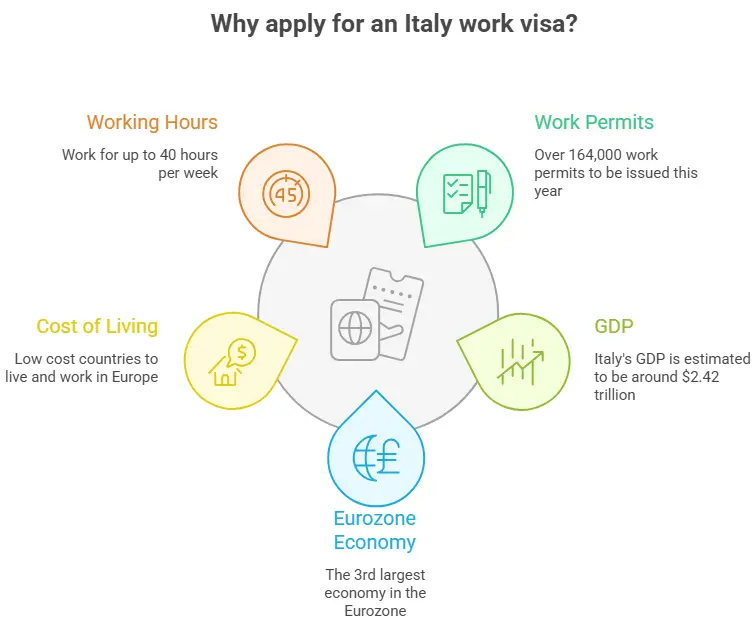
Italy's 2026 Decreto Flussi programme authorised 164,850 work permits for non-EU nationals. According to the supplied source, the 2026 Click Day windows have closed and the available quota has been allocated.
The wider 2026–2028 framework provides 497,550 permits, with India identified as a priority country under the Italy-India Migration and Mobility framework. Professionals planning to use the quota-based route should therefore begin preparing for the next available Click Day rather than waiting until applications open.
Current Pathways for Indian Professionals
| Pathway | Suitable For | Quota Status |
|---|---|---|
| EU Blue Card | Highly qualified professionals | Quota-exempt |
| Quota-Exempt Roles | IT, research and eligible teaching roles | Quota-exempt |
| Digital Nomad Visa | Remote workers with foreign employers/clients | Quota-exempt |
| Decreto Flussi | Eligible employer-sponsored occupations | Annual quota |
| Self-Employment Visa | Entrepreneurs, freelancers and professionals | Category-dependent |
Why Work in Italy?
Italy is one of Europe's major economies and has ongoing demand for foreign workers across several industries. The supplied source highlights opportunities in technology, healthcare, engineering, construction, manufacturing, hospitality and green energy.
Important advantages can include:
- Opportunities in multiple high-demand industries
- Access to Italy's employment market
- Strong collective bargaining protections
- Paid annual leave
- 13th-month salary in applicable employment arrangements
- Access to the Italian public healthcare system subject to registration and eligibility
- Family reunification options for eligible workers
- Potential pathway to EU long-term residence
- Ability to travel within the Schengen Area subject to applicable conditions
Italy's employment system is strongly influenced by sector-specific CCNL collective agreements, which regulate employment conditions such as wages, working hours and overtime.
Italy Work Visa vs Work Permit
The terms "work visa" and "work permit" are often used interchangeably, but they refer to different stages of the immigration process.
The work authorisation (Nulla Osta) is generally obtained before the applicant applies for the relevant long-stay visa. Once the visa is issued and the worker enters Italy, they must complete the required residence-permit procedure.
For employer-sponsored employment under Decreto Flussi, the process is primarily employer-led. The Italian employer initiates the work-authorisation process, while the worker applies for the entry visa after the required authorisation is issued.
Types of Italy Work Visa
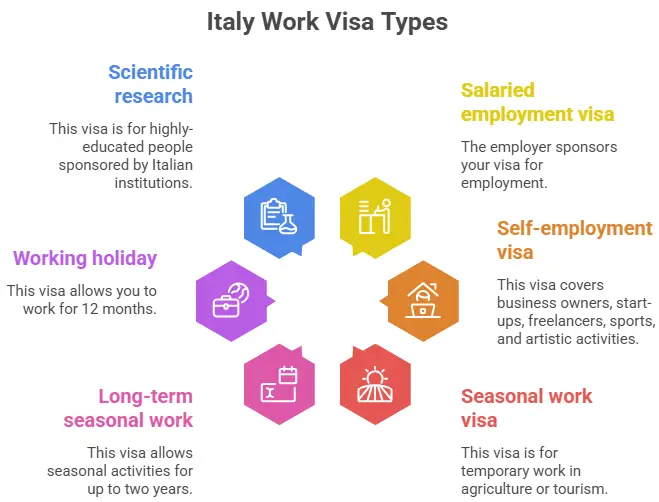
Italy has several National Visa (Type D) routes for people intending to stay and work for more than 90 days.
| Visa Type | Main Purpose |
|---|---|
| Salaried Employment Visa | Employment with an Italian employer |
| Self-Employment Visa | Business owners, freelancers and eligible professionals |
| Seasonal Work Visa | Agriculture and tourism-related seasonal employment |
| Long-Term Seasonal Work | Repeat seasonal employment |
| Working Holiday Visa | Work and travel for eligible young nationals |
| Scientific Research Visa | Researchers sponsored by eligible institutions |
| Digital Nomad Visa | Remote work for foreign employers or clients |
The applicable route depends on the applicant's occupation, employer, qualifications, contract and intended activity
Italy Work Visa – Frequently Asked Questions
Find answers to common questions about Italy work visas, Decreto Flussi, EU Blue Card, Digital Nomad Visa, eligibility, documents, processing, family options and long-term residence.
An Italy Work Visa is a long-stay visa that allows eligible non-EU nationals to enter Italy for employment or other permitted professional activities. For standard salaried employment, the process generally involves an Italian employer, authorization to work (Nulla Osta), a national D visa and, after arrival, a residence permit.
Italy has several work routes, including salaried employment, seasonal work, scientific research, the EU Blue Card and the Digital Nomad Visa. The correct route depends on your job, qualifications, employer and circumstances.
Yes. Indian citizens are non-EU nationals and generally need the appropriate Italian work authorization and visa before beginning employment in Italy.
The requirements depend on the employment category. Standard employer-sponsored positions can be subject to Italy's quota system, while routes such as the EU Blue Card and certain quota-exempt professional categories follow different procedures.
According to the source information for 2026, the Click Day windows for the 2026 Decreto Flussi quotas have already closed. Applicants who are targeting quota-based employment should therefore prepare for the next available quota cycle rather than assuming that a new 2026 application can still be submitted.
Preparation can include finding an eligible employer, confirming the occupation category, preparing documents and completing any required legalization or language steps.
Decreto Flussi is Italy's quota framework for admitting certain non-EU workers. Specific numbers of workers can be admitted in eligible sectors and categories during the relevant period.
Click Day refers to the opening of the online application submission window. Because demand can be significantly higher than available quotas, preparation and timely submission are important for quota-based applications.
The source identifies several routes that can operate outside the ordinary Decreto Flussi quota system. These include the EU Blue Card, certain quota-exempt professional roles such as specified IT, research and university teaching positions, and the Digital Nomad Visa.
| Route | Typical Applicant | Quota |
|---|---|---|
| EU Blue Card | Highly qualified professionals | Quota-exempt |
| Quota-exempt roles | Eligible IT, research and teaching professionals | No Click Day |
| Digital Nomad Visa | Remote workers with foreign employers/clients | Not subject to Decreto Flussi |
The EU Blue Card is a residence and employment route for highly qualified non-EU professionals who have a qualifying job offer in Italy. It is particularly relevant to professionals such as IT specialists, engineers, healthcare professionals and other highly qualified workers.
The source describes the Blue Card as quota-exempt. Salary and qualification requirements apply, and the exact threshold should be checked against the current Italian rules before applying.
Italy's Digital Nomad Visa is designed for qualifying remote workers and freelancers who work for clients or employers outside Italy. The source identifies a minimum income of approximately €28,000 per year, health insurance and either a university qualification or qualifying remote-work experience.
It does not require an Italian employer and is not subject to the Decreto Flussi quota. The source describes the permit as valid for one year and renewable. Applicants whose work involves Italian clients should verify whether this route is appropriate.
The source identifies several sectors with demand for international workers. These include information technology, healthcare, engineering, manufacturing, construction, renewable energy, hospitality, finance, fashion and education or social services.
| Sector | Examples |
|---|---|
| IT | Software developers, technology specialists |
| Healthcare | Doctors, nurses and care professionals |
| Engineering | Mechanical, civil and specialist engineers |
| Construction | Skilled construction and technical workers |
| Hospitality | Hotel, restaurant and tourism workers |
Requirements depend on the specific work route. For standard employer-sponsored employment, applicants generally need a genuine job offer from an Italian employer and the required employment authorization.
Applicants may also need relevant education or professional experience, a valid passport, supporting employment documents, financial evidence where applicable, health insurance and other documents required by the consular authority.
The exact checklist varies according to the visa category and the applicant's circumstances. Common documents can include a valid passport, visa application form, photographs, employment documents, qualification certificates, work experience evidence and the required Italian work authorization.
| Document | Purpose |
|---|---|
| Passport | Identity and international travel document |
| Job/Employment Documents | Evidence of the proposed employment |
| Nulla Osta | Required authorization for applicable routes |
| Qualification Documents | Evidence of education or professional credentials |
| Insurance | Required coverage where applicable |
Italian language proficiency is not universally required for every Italy work visa. The source specifically indicates that standard work routes, the EU Blue Card and Digital Nomad Visa do not have a universal Italian-language requirement at the visa stage.
However, particular professions can have language requirements. Healthcare and certain caregiving roles may require Italian proficiency, while language requirements can also apply later for long-term residence or citizenship.
Nulla Osta is the work authorization issued through the Italian immigration system for applicable employment routes. For employer-sponsored employment, the Italian employer generally plays a central role in initiating the authorization process.
Once the required authorization is issued, the worker can proceed with the relevant visa application at the Italian consular authority. The Nulla Osta is therefore an important part of the employer-sponsored work visa process.
The process depends on the work category. For standard employer-sponsored employment, the Italian employer normally starts the required authorization process. After the authorization is granted, the applicant submits the visa application through the appropriate Italian consular channel in India.
- Determine the appropriate work visa category.
- Secure an eligible Italian job offer where required.
- Complete the required work authorization process.
- Prepare the visa documents and application.
- Submit biometrics and supporting documents.
- Wait for the visa decision.
- Travel to Italy after approval.
- Complete the required residence-permit formalities after arrival.
Processing time varies significantly according to the work category, employer authorization, quota availability, document completeness and consular workload.
The source describes an overall process that can take several months, with employer authorization potentially taking a substantial portion of the timeline. Consular visa processing may take several weeks after the required authorization and documents are available.
Visa fees depend on the category. The source provides different indicative fees for several Italian work routes. Additional costs can arise for document legalization, translation, insurance, residence-permit processing and other required services.
| Visa Category | Source Fee |
|---|---|
| Self-Employment | €116 |
| Seasonal Work | €116 |
| Long-Term Seasonal Work | €100 |
| Working Holiday | €116 |
| Scientific Research | €116 |
Fees can change, so applicants should confirm the amount applicable to their visa category before submission.
The validity of an Italian work visa and residence permit depends on the employment contract and visa category. The source indicates that standard work permits can commonly be issued for a fixed period and renewed when the relevant conditions continue to be met.
Applicants should distinguish between the entry visa and the residence permit. The residence permit is the document that governs lawful residence and employment in Italy after arrival.
Family reunification may be available to eligible foreign workers who meet the applicable immigration, income and accommodation requirements.
The source identifies spouses, unmarried minor children and certain dependent adult children as potential family members. The precise requirements depend on the worker's residence status and the applicable Italian family-reunification rules.
The source indicates that eligible family members joining a worker in Italy can have access to employment rights, subject to their immigration status and the applicable Italian rules.
Family members may also have access to education and healthcare arrangements once the relevant residence status has been obtained. The exact rights should be checked for the particular family reunification route.
Long-term residence may be possible after meeting the required period of lawful residence and other conditions. The source identifies five years of continuous legal residence as an important milestone for an EU long-term residence application.
Citizenship is a separate process and is not granted automatically simply because someone has worked in Italy for five years. Applicants must satisfy the applicable residence, language, income, character and other legal requirements.
WorldVisaHelp can help applicants understand the available Italy work visa routes and organize the application requirements. The support can include eligibility assessment, document preparation, checklist guidance, application review and assistance in understanding the relevant work authorization process.
Because Italy's work immigration system differs between quota-based, quota-exempt and specialist routes, choosing the correct category before preparing an application is particularly important.