

Study in the UK for Indian Students — Universities, Fees, Scholarships & Student Visa
The UK is one of the most popular study destinations for international students, offering globally recognised universities, a wide range of courses, shorter degree durations and opportunities to gain work experience after graduation. In 2024/25, more than 685,000 international students were studying in UK higher education, while 426,471 sponsored study visas were granted in 2025.
Indian students can choose undergraduate, postgraduate and research programmes in areas such as business, engineering, computer science, data science, medicine, finance and law. Eligible students can also work part-time during their studies and may qualify for the Graduate Route after completing an eligible course.
Why Study in the UK?
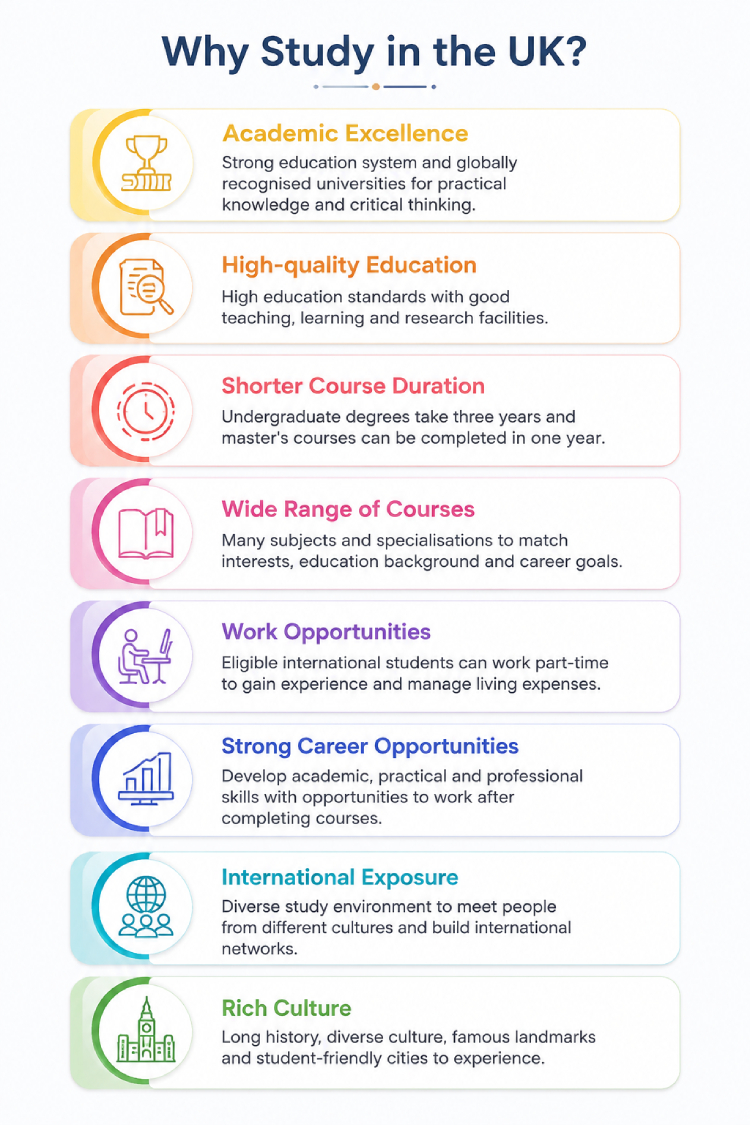
The UK offers several advantages for Indian students:
- Globally recognised education: UK universities are known for academic standards, research and international recognition.
- Shorter courses: Many undergraduate degrees take three years, while numerous master's programmes can be completed in one year.
- Wide course selection: Students can choose from thousands of programmes across different disciplines.
- Part-time work opportunities: Eligible international students can work during their studies subject to Student visa conditions.
- Career opportunities: Students can gain academic and practical skills and may qualify for post-study work options.
- International exposure: UK universities have diverse student populations from around the world.
- Student-friendly cities: London, Manchester, Edinburgh, Birmingham, Leeds and other cities offer established university communities.
- Culture and lifestyle: Students can experience Britain's history, culture, public transport and diverse communities.
Top Universities in the UK for Indian Students
The UK has several highly ranked universities. The source lists the following universities among its leading options:
| University | QS World University Ranking |
|---|---|
| Imperial College London | 2 |
| University of Oxford | 4 |
| University of Cambridge | 6 |
| University College London (UCL) | 9 |
| King's College London | 37 |
| University of Edinburgh | 34 |
| University of Manchester | 40 |
| University of Bristol | 57 |
| London School of Economics and Political Science | 62 |
| University of Warwick | 68 |
| University of Birmingham | 68 |
| University of Leeds | 77 |
| University of Glasgow | 80 |
| University of Sheffield | 82 |
| Durham University | 85 |
| University of Nottingham | 97 |
Rankings can change between editions, so students should check the latest university and subject rankings when making their shortlist.
Popular Courses to Study in the UK
Indian students can choose programmes across technology, business, engineering, medicine, law, finance and social sciences.
| Course Area | Universities Highlighted in the Source |
|---|---|
| Business & Management | Oxford, Cambridge, LSE, Imperial College London |
| Computer Science & IT | Oxford, Imperial, Cambridge, UCL |
| Engineering | Imperial, Cambridge, Oxford, Manchester |
| Medicine | Oxford, Cambridge, Imperial, UCL |
| Law | Oxford, Cambridge, LSE, King's College London |
| Finance & Accounting | LSE, Oxford, Cambridge, Imperial |
| Social Sciences | LSE, Oxford, Cambridge, UCL |
| Media & Communication | Leeds, King's College London, Goldsmiths |
Cost of Studying in the UK
The total cost depends on the university, course, city and lifestyle. Tuition is generally the largest expense, followed by accommodation, food and transportation.
UK Tuition Fees
| Study Level | Estimated Annual Tuition Fee |
|---|---|
| Undergraduate | £11,400–£38,000 |
| Postgraduate / Master's | £9,000–£30,000 |
| PhD / Doctoral | £15,000–£24,000 |
Monthly Living Expenses
| Expense | Estimated Monthly Cost |
|---|---|
| Accommodation | £500–£1,500+ |
| Food & Groceries | £150–£300 |
| Transport | £50–£150 |
| Personal Expenses | £100–£250 |
London generally has higher living costs than many other UK cities.
Indicative Tuition Fee Range
Undergraduate       £11.4K ━━━━━━━━━━━━━━━━━━━━━━━━━━━━━ £38K
Master's             £9K   ━━━━━━━━━━━━━━━━━━━━━━━      £30K
PhD                  £15K  ━━━━━━━━━━━━━━━━━━━          £24K
These are indicative ranges from the supplied source and vary by university and programme.
Scholarships to Study in the UK
Indian students can explore scholarships offered by the UK Government, British Council, universities and other organisations.
| Scholarship | Study Level | Indicative Benefit |
|---|---|---|
| Chevening Scholarship | Master's | £30,000–£35,000+ |
| GREAT Scholarships | Master's | £10,000+ |
| Commonwealth Scholarships | Master's & PhD | £20,000–£30,000+ |
| Scotland's Saltire Scholarships | Master's | Up to £8,000 |
| Charles Wallace India Trust | Master's / Research | Varies |
| University Scholarships | Undergraduate & Postgraduate | £1,000–£10,000+ |
Scholarship eligibility, deadlines and funding amounts differ by programme, so students should check the specific scholarship conditions before applying.
UK University Intakes
UK universities generally have three major intake periods.
| Intake | Typical Months | Availability |
|---|---|---|
| September / Autumn | September–October | Largest selection of universities and courses |
| January / Winter | January–February | Fewer options than September |
| May / Summer | May–June | Limited courses and universities |
The September intake is usually the preferred option for students who want the widest choice of programmes and universities. However, availability depends on the individual course and institution.
Eligibility to Study in the UK
Admission requirements are determined by the university and course. Common requirements include:
- Recognised academic qualifications
- Required marks or GPA
- Relevant subjects for the selected programme
- English-language proficiency
- Work experience for certain postgraduate or professional courses
University admission requirements should not be confused with Student visa requirements.
Documents Required for UK University Admission
Students may need:
- Academic certificates and mark sheets
- Academic transcripts
- Valid passport
- English-language test score
- Statement of Purpose (SOP)
- Letters of Recommendation (LORs), where required
- CV or resume
- Portfolio for design and arts programmes
- Work experience documents where applicable
The exact document list depends on the university and course.
Exams Required to Study in the UK
Depending on the university and programme, international students may need to provide an English-language test score.
Common tests include:
- IELTS
- TOEFL
- PTE
- Duolingo English Test
Some programmes may additionally require exams such as GRE, GMAT, SAT or ACT. Not every UK university requires these tests, so applicants should check the requirements for their chosen programme.
UK Study Application Process
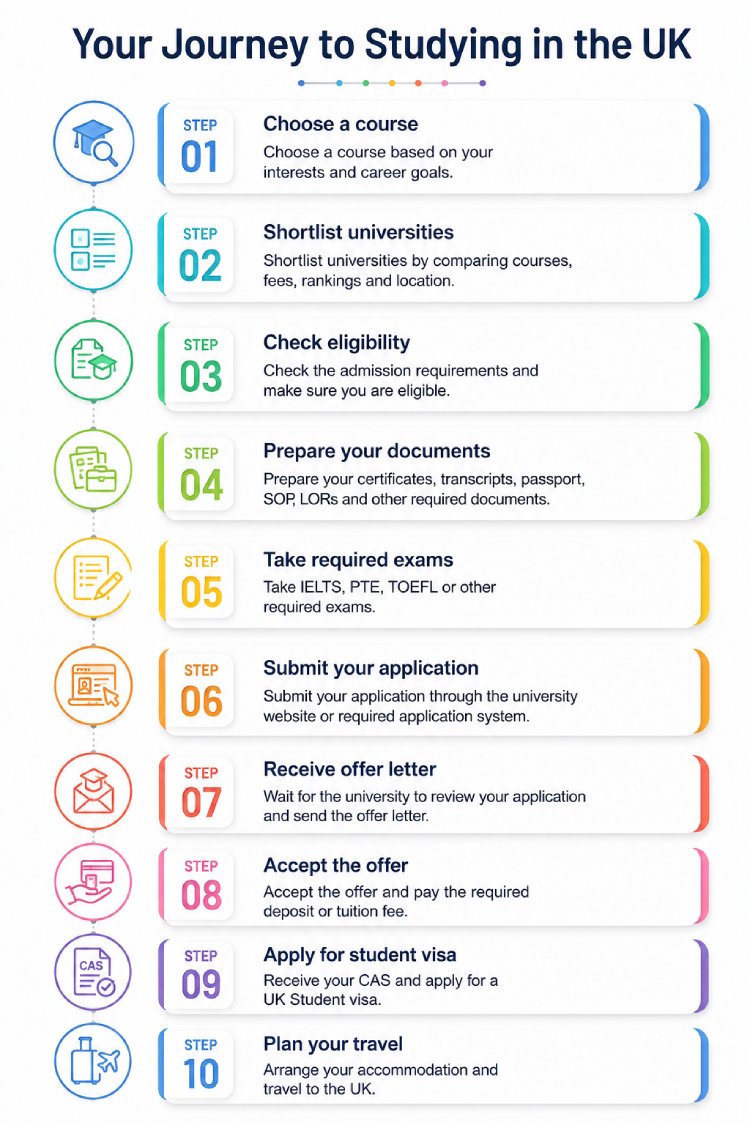
The general process for an Indian student is:
- Select a course according to your academic background and career goals.
- Shortlist universities based on course content, fees, rankings and location.
- Check admission requirements.
- Prepare academic and supporting documents.
- Take any required English-language or entrance exams.
- Submit applications to the selected universities.
- Receive and evaluate your offer.
- Accept the offer and pay the required deposit or tuition amount.
- Receive your Confirmation of Acceptance for Studies (CAS).
- Apply for the UK Student visa.
- Arrange accommodation and travel after visa approval.
Study in the UK FAQs
Find answers to common questions about UK universities, courses, tuition fees, scholarships, Student visas, living costs and post-study work options.
The UK offers globally recognised universities, a wide choice of courses, strong research facilities and opportunities to gain international experience. Many undergraduate degrees take three years and many master's programmes can be completed in one year. Eligible international students can also work part-time during their studies and may qualify for post-study work options after graduation.
The UK has several highly ranked universities, including Imperial College London, Oxford, Cambridge, UCL, King's College London, the University of Edinburgh and the University of Manchester. The best university depends on your course, budget, academic profile and career plans rather than ranking alone.
| University | QS Ranking Listed in Source |
|---|---|
| Imperial College London | 2 |
| University of Oxford | 4 |
| University of Cambridge | 6 |
| University College London | 9 |
| King's College London | 37 |
Popular study areas include business and management, computer science and IT, engineering, medicine, law, finance and accounting, social sciences, and media and communication. Students should select a course based on their previous education, career goals, employability and the curriculum offered by the university.
Tuition fees vary significantly according to the university, course and study level. The supplied source gives undergraduate tuition of approximately £11,400–£38,000 per year, postgraduate tuition of £9,000–£30,000 and PhD tuition of £15,000–£24,000. Living expenses are additional and are generally higher in London.
| Study Level | Estimated Annual Tuition |
|---|---|
| Undergraduate | £11,400–£38,000 |
| Master's | £9,000–£30,000 |
| PhD / Doctoral | £15,000–£24,000 |
Living costs depend on the city, accommodation and lifestyle. London is generally more expensive than cities such as Manchester, Leeds, Birmingham and Nottingham. The supplied source estimates accommodation at £500–£1,500+ per month, food at £150–£300, transport at £50–£150 and personal expenses at £100–£250.
| Expense | Estimated Monthly Cost |
|---|---|
| Accommodation | £500–£1,500+ |
| Food & Groceries | £150–£300 |
| Transport | £50–£150 |
| Personal Expenses | £100–£250 |
Indian students can explore scholarships from the UK Government, British Council, universities and other organisations. Options listed in the supplied source include Chevening, GREAT Scholarships, Commonwealth Scholarships, Scotland's Saltire Scholarships, Charles Wallace India Trust Scholarships and university-specific awards. Funding varies by programme and eligibility.
| Scholarship | Indicative Benefit |
|---|---|
| Chevening | £30,000–£35,000+ |
| GREAT Scholarships | £10,000+ |
| Commonwealth | £20,000–£30,000+ |
| Scotland's Saltire | Up to £8,000 |
| University Scholarships | £1,000–£10,000+ |
The September or Autumn intake is generally the main intake and offers the widest selection of courses and universities. January is another major intake but usually has fewer options, while May or June has limited availability. Students should check the intake dates for their specific course because not every programme is available in every intake.
| Intake | Typical Period | Availability |
|---|---|---|
| September | September–October | Largest selection |
| January | January–February | Fewer courses |
| May | May–June | Limited courses |
Eligibility depends on the university and course. Common requirements include recognised academic qualifications, the required marks or GPA, relevant subjects and proof of English-language ability. Certain postgraduate and professional programmes may also require relevant work experience. Admission requirements are separate from UK Student visa requirements.
Common English-language tests include IELTS, TOEFL, PTE and the Duolingo English Test. The test and minimum score depend on the university, course and individual circumstances. Some programmes may also require other entrance tests such as GRE, GMAT, SAT or ACT.
Students commonly need academic certificates, mark sheets and transcripts, a valid passport, English-language test results, an SOP and LORs where required. Some courses may also ask for a CV, portfolio or work-experience documents. The final document list is determined by the university and programme.
The UK Student visa is the main immigration route for international students who want to study an eligible course in the UK. Students generally need an offer from a licensed student sponsor and a Confirmation of Acceptance for Studies (CAS) before applying. The Student visa replaced the former Tier 4 General student visa in 2020.
Students who need to meet the financial requirement generally need to show their outstanding tuition fees plus the required living-cost amount. The supplied source lists £1,529 per month in London and £1,171 outside London for up to nine months in its proof-of-funds section. It also states that funds generally need to be held for 28 consecutive days.
| Location | Monthly Amount | 9-Month Amount |
|---|---|---|
| London | £1,529 | £13,761 |
| Outside London | £1,171 | £10,539 |
The supplied source lists the UK Student visa application fee as £558. Students may also need to pay the Immigration Health Surcharge (IHS), listed in the source as £776 per year for students. Tuition fees, accommodation, travel and other living expenses are additional costs.
| Cost | Amount |
|---|---|
| Student Visa Application | £558 |
| IHS for Students | £776 per year |
The supplied source states that students applying from outside the UK will usually receive a Student visa decision within approximately three weeks. Processing can take longer in individual cases, so students should submit their application early enough to allow time before the course start date.
Eligible international students can work part-time subject to their Student visa conditions. The supplied source states that eligible degree-level students can generally work up to 20 hours per week during term time and may work full-time during official university holidays. Students must follow the specific work conditions attached to their visa.
Common student jobs include retail assistant, restaurant staff, cashier, receptionist, tutor and university assistant positions. Part-time work can provide additional income and practical experience, but students should not depend on it to cover their complete tuition fees and living expenses.
The Graduate Route allows eligible international students who complete an eligible UK course to remain in the country and work or look for work without needing a job offer when they apply. According to the supplied source, applications made by December 31, 2026 generally receive two years, while applications made from January 1, 2027 generally receive 18 months. PhD and other doctoral graduates can receive three years.
| Application Date / Qualification | Stay Period |
|---|---|
| Application by Dec 31, 2026 | 2 years |
| Application from Jan 1, 2027 | 18 months |
| PhD / Doctoral Qualification | 3 years |
Eligible graduates may use the Graduate Route to remain in the UK and look for employment after completing their course. Popular graduate roles include software engineering, data analysis, cybersecurity, business analysis, accounting, finance, engineering and consulting. The Graduate Route does not guarantee employment or permanent residence.
London offers a large number of universities and career opportunities but has high living costs. Cities such as Manchester, Birmingham, Leeds, Liverpool and Nottingham can offer comparatively lower living costs while still providing established universities and student communities. Edinburgh is another popular option but can have medium-to-high living costs.
| City | General Living Cost |
|---|---|
| London | High |
| Manchester | Medium |
| Edinburgh | Medium–High |
| Birmingham | Medium |
| Leeds | Medium |
| Liverpool | Medium |
WorldVisaHelp can assist with course and university selection, eligibility assessment, university shortlisting, application documentation, SOP and LOR guidance, scholarship planning and Student visa preparation. The process should be planned around your academic profile, preferred course, budget, university requirements and intended career path.