
Canada Tourist Visa for Indians
The Canadian Tourist Visa, officially called a Temporary Resident Visa (TRV), allows eligible travellers to visit Canada temporarily for tourism, leisure, visiting family or friends and other permitted short-term purposes.
Indian passport holders generally require a TRV. A valid visa from another country does not automatically provide Canadian eTA eligibility. However, certain Indian citizens may qualify for the eTA exception if they hold a valid U.S. nonimmigrant visa or have held a Canadian TRV within the previous 10 years and are travelling to Canada by air.
Canada Visitor Visa at a Glance
| Feature | Details |
|---|---|
| Visa | Temporary Resident Visa (TRV) |
| Main Purpose | Tourism, family visits and eligible short-term activities |
| General Stay | Usually up to 6 months per visit |
| Application | Online through IRCC |
| Biometrics | Required for most applicants aged 14–79 |
| Biometrics Fee | CAD 85 per person |
| Visitor Visa Fee | CAD 100 per person |
| Multiple Entry | Available where issued |
| Indian Applicants | Generally require a TRV |
The final period of stay is determined by Canadian authorities and should not automatically be assumed to be six months.
Can Indian Passport Holders Use Canada's eTA?
Indian passport holders are generally not eligible for Canada's eTA and normally need a TRV before travelling to Canada.
There is, however, an important exception. An Indian national may qualify for an eTA when travelling by air if they currently hold a valid U.S. nonimmigrant visa or have held a valid Canadian TRV within the last 10 years. This exception does not apply to land or sea travel.
A common misconception is that a valid UK visa makes an Indian traveller eligible for a Canadian eTA. It does not.
Types of Canada Visitor Visa
Canada has several visitor-related visa options depending on the traveller's purpose and circumstances.
| Visa Type | Main Purpose | General Stay / Validity |
|---|---|---|
| Standard TRV | Tourism, family/friend visits and eligible short-term business activities | Usually up to 6 months per visit |
| Multiple-Entry Visitor Visa | Allows multiple visits during visa validity | Generally up to 6 months per visit |
| Single-Entry Visitor Visa | Intended for one entry into Canada | Based on authorized stay |
| Super Visa | For eligible parents and grandparents of Canadian citizens or permanent residents | Up to 5 years per entry under the stated rules |
The Super Visa has substantially different requirements from a standard visitor visa, including sponsor income requirements, mandatory medical insurance and a medical examination.
Canada Super Visa for Indian Parents and Grandparents
The Canada Super Visa is designed for eligible parents and grandparents of Canadian citizens or permanent residents. It can allow eligible visitors to remain in Canada for up to 5 years per entry, subject to the applicable rules.
The visa can be valid for up to 10 years, making it particularly useful for families who expect parents or grandparents to make extended or repeated visits to Canada.
Super Visa Eligibility
The Canadian host must meet the applicable income requirement based on family size. The source states that from March 2026, sponsors must meet the relevant income threshold for two consecutive tax years. In certain circumstances, the visiting parent's or grandparent's own Canadian-earned income may also be considered.
Applicants should also meet the required medical and insurance conditions.
Super Visa Insurance
Super Visa applicants must obtain medical insurance meeting the applicable requirements. The supplied source specifies:
- Minimum coverage of CAD 100,000
- Policy valid for at least 1 year from the date of entry
- Insurance purchased from a Canadian insurance company
- Indian travel insurance policies are not accepted under the stated requirement
Indicative annual premiums can range from approximately CAD 1,000 to CAD 3,500 or more, depending on factors such as age and pre-existing medical conditions.
Canada Tourist Visa Eligibility
Applicants must demonstrate that they satisfy the requirements for temporary entry to Canada.
Key considerations include:
- Valid passport: A current passport suitable for the proposed travel.
- Genuine temporary purpose: A clear explanation of why you want to visit Canada.
- Financial capacity: Evidence that you can pay for your travel, accommodation and living expenses.
- Strong ties to India: Employment, family, property, business or other commitments supporting your intention to return.
- Immigration history: Previous refusals, overstays or immigration violations should be disclosed accurately.
- Health and character: Applicants must meet applicable health and character requirements.
- Biometrics: Most applicants between 14 and 79 years of age are required to provide fingerprints and a photograph.
There is no single factor that guarantees approval. The overall application should present a consistent and credible picture of the traveller's circumstances.
Documents Required for a Canada Tourist Visa
A strong application should include documents supporting your identity, financial position, travel plans and reasons for returning to India.
| Document | Purpose |
|---|---|
| Valid Passport | Confirms identity and travel document details |
| Application Forms | Provides required personal and travel information |
| Photographs | Must meet applicable Canadian specifications |
| Bank Statements | Demonstrate available funds and financial stability |
| ITRs | Support declared income and financial position |
| Salary Slips | Evidence of employment income |
| Travel Itinerary | Explains planned flights, accommodation and activities |
| Invitation Letter | Required where the visit involves a host or invitation |
| Employment Letter / NOC | Demonstrates employment and ties to India |
| Business Documents | Useful for business owners and self-employed applicants |
| Property Documents | Can support evidence of ties where relevant |
| PCC / Medical | Only where required by IRCC |
The source specifically notes that police certificates and medical examinations are generally required only when requested or when applicable to the applicant's circumstances.
Canada Visa Biometrics from India
Most Canadian visitor visa applicants aged 14–79 must provide biometrics unless their previous biometrics remain valid and an exemption applies.
In India, biometrics are collected through Canada's Visa Application Centre network operated by VFS Global. The source lists centres in New Delhi, Mumbai, Bengaluru, Chennai, Hyderabad, Kolkata, Ahmedabad, Chandigarh, Jalandhar and Pune.
The biometrics fee stated in the source is CAD 85 per person, with a maximum of CAD 170 for families applying together. Biometrics are generally valid for 10 years.
Financial Requirements for Canada Visitor Visa
IRCC does not publish one universal minimum bank balance for every visitor visa applicant. Financial requirements depend on factors such as the length of the trip, accommodation arrangements and whether the traveller is financially independent or being supported by another person.
Applicants can strengthen their financial evidence through:
- 3–6 months of bank statements
- Income Tax Returns
- Recent salary slips
- Fixed deposits, where relevant
- Property ownership documents
- Business ownership and financial records
- Sponsorship or invitation documentation where applicable
The source notes that applicants should explain unusual large deposits rather than leaving unexplained changes in their bank balance.
Canada Tourist Visa Fees for Indians
The source gives the following fee structure for August 2026:
| Fee | Amount |
|---|---|
| Visitor Visa / TRV | CAD 100 |
| Biometrics | CAD 85 |
| Family Visitor Visa Fee — 5 or more applicants | CAD 500 maximum |
| Family Biometrics | CAD 170 maximum |
| Super Visa Application | CAD 100 |
| Super Visa Insurance | Approximately CAD 1,000–3,500+ per year |
The source uses an approximate exchange rate of 1 CAD ≈ INR 68 for August 2026. Government fees can change, so applicants should verify the applicable fee before submitting an application.
Canada Tourist Visa Processing Time from India
The supplied source states that processing can vary and gives a typical range of approximately 2–3 months, with a cited recent estimate of 57–71 days for Indian applicants.
Processing times are not fixed. They can change based on application volume, document verification, biometrics, background checks and other factors. Applicants should check the current IRCC processing-time information before making firm travel plans.
How to Apply for a Canada Tourist Visa from India
The application process can generally be completed through the online immigration system.
Step 1: Check Eligibility
Review the visitor requirements and make sure your purpose of travel is genuine and temporary.
Step 2: Prepare Documents
Collect your passport, financial evidence, itinerary, employment or business documents, invitation documents where applicable and other supporting paperwork.
Step 3: Create an IRCC Account
Create the required online account and begin your visitor visa application.
Step 4: Complete the Application
Enter your personal, travel, financial and background information accurately.
Step 5: Upload Documents
Upload the required forms and supporting documents through the online application system.
Step 6: Pay the Fees
Pay the applicable visa and biometrics fees.
Step 7: Complete Biometrics
After receiving the Biometric Instruction Letter, attend your appointment at an appropriate Visa Application Centre in India.
Step 8: Wait for the Decision
If the application is approved, you may receive instructions to submit your passport for visa issuance.
Step 9: Travel to Canada
Once the visa has been issued, make your travel arrangements and carry relevant supporting documents when travelling.
Common Reasons for Canada Tourist Visa Refusal
A refusal can occur when the application does not sufficiently establish the applicant's eligibility or temporary purpose.
Common concerns include:
- Insufficient or inconsistent financial evidence
- Weak ties to India
- Unclear purpose of travel
- Poorly documented itinerary
- Previous visa refusals or immigration violations
- Missing or incomplete documents
- Medical concerns where a medical examination is required
- Inconsistencies between the application and supporting documents
- Super Visa sponsor income or insurance issues
The source particularly highlights financial inconsistencies, weak home-country ties, unclear travel purpose, previous immigration problems and incomplete documentation as common refusal concerns.
Best Places to Visit in Canada
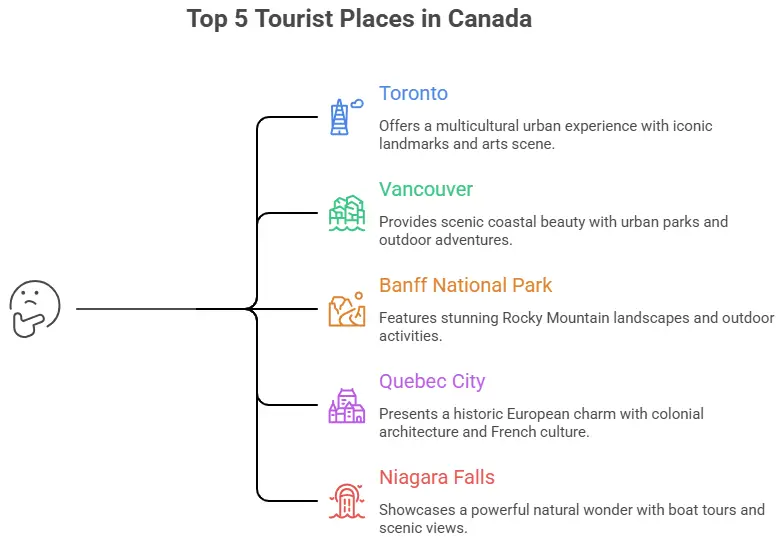
Canada offers destinations ranging from major multicultural cities to dramatic natural landscapes.
Toronto
Toronto is Canada's largest city and a major multicultural destination. Popular attractions include the CN Tower, Distillery District, St. Lawrence Market, Royal Ontario Museum and Art Gallery of Ontario.
Vancouver
Vancouver combines a Pacific coastline with the Coast Mountains. Stanley Park, Granville Island and the Capilano Suspension Bridge are among its popular attractions, while the route toward Whistler provides spectacular mountain scenery.
Banff National Park
Located in Alberta's Canadian Rockies, Banff is known for Lake Louise, the Icefields Parkway, mountain scenery, hiking, skiing and wildlife experiences.
Quebec City
Quebec City offers historic architecture, French-Canadian culture and the UNESCO-recognized Old Quebec area. It provides a distinctly European atmosphere within Canada.
Niagara Falls
Niagara Falls is one of Canada's most recognizable attractions. Visitors can experience the falls from multiple viewpoints and participate in attractions such as boat tours and Journey Behind the Falls.
Canada Visitor Travel Trends
Canada continues to attract international visitors, while India remains an important source market. The supplied source reports that Canada received more than 22 million international visitors in 2024, with Indian arrivals exceeding 370,000 and Indian visitor spending reaching approximately CAD 2.1 billion.
These figures reflect Canada's continued appeal for tourism, family visits, events and other short-term travel.
Why Choose WorldVisaHelp?
Applying for a Canadian visitor visa involves more than simply completing an online form. The supporting documents should establish a clear connection between your travel purpose, financial position, personal circumstances and intention to return.
WorldVisaHelp can assist you with:
- Eligibility assessment
- Document checklist preparation
- Financial-document review
- Application form assistance
- Travel-purpose documentation
- Application package preparation
- Biometrics guidance
- Application updates and follow-up
- Interview preparation where applicable
Whether you are planning a holiday, visiting family in Canada or applying for a Super Visa for your parents or grandparents, WorldVisaHelp can help you organize the application around your individual circumstances.
Canada Tourist Visa FAQs
Find answers to common questions about the Canada Tourist Visa, eligibility, documents, biometrics, fees, processing time and Super Visa.
The Canada Tourist Visa, officially known as a Temporary Resident Visa (TRV), allows eligible foreign nationals to travel to Canada temporarily for tourism, leisure, visiting family or friends and other permitted short-term purposes.
For Indian passport holders, the TRV is generally the primary visitor visa route. Applicants need to demonstrate a genuine temporary purpose, sufficient funds and circumstances that support their intention to leave Canada after their authorized stay.
Yes. Indian passport holders generally need a Canadian Temporary Resident Visa (TRV) to visit Canada. A visa from another country does not automatically provide eligibility for Canada's eTA.
There is a specific exception for certain Indian nationals who hold a valid U.S. nonimmigrant visa or have held a Canadian TRV within the previous 10 years, provided they are travelling to Canada by air.
Indian passport holders are generally not eligible for Canada's eTA. The source identifies a limited exception for Indian nationals who currently hold a valid U.S. nonimmigrant visa or who have held a Canadian TRV within the last 10 years.
The exception applies only when travelling to Canada by air. It does not apply to land or sea entry, so travellers should verify their individual eligibility before relying on an eTA.
No. A valid UK visa by itself does not make an Indian passport holder eligible for Canada's eTA under the exception described in the source.
The relevant exception is based on holding a valid U.S. nonimmigrant visa or having held a Canadian TRV within the previous 10 years, and the traveller must be travelling to Canada by air.
A Canadian visitor can generally be authorized to stay for up to 6 months per visit. However, the source makes clear that six months is a general rule and does not guarantee that every traveller will receive the full six-month period.
The final period of authorized stay depends on the circumstances of the traveller and the decision made by the Canadian authorities at the time of entry.
Applicants must satisfy Canada's requirements for temporary entry and demonstrate that their visit is genuine and temporary. Their application should clearly explain the reason for travel and show that they can financially support themselves during the trip.
| Requirement | What the Applicant Should Demonstrate |
|---|---|
| Valid Passport | A current passport suitable for the intended travel |
| Temporary Intent | A genuine intention to visit Canada temporarily |
| Financial Capacity | Enough funds for travel, accommodation and living expenses |
| Home-Country Ties | Employment, family, property or business commitments |
| Travel Purpose | A clear and credible reason for visiting Canada |
| Health & Character | Compliance with applicable medical and security requirements |
| Biometrics | Fingerprints and photograph where required |
Applicants should prepare documents that support their identity, finances, travel plans and reasons for returning to India. The exact documents can vary according to individual circumstances.
| Document | Purpose |
|---|---|
| Valid Passport | Confirms identity and travel details |
| Application Form | Provides required personal and travel information |
| Photographs | Must meet applicable Canadian specifications |
| Bank Statements | Demonstrate financial capacity |
| ITRs & Salary Slips | Support declared income and financial stability |
| Travel Itinerary | Shows flights, accommodation and planned activities |
| Invitation Letter | Supports a visit involving a host in Canada, where applicable |
| Employment / Business Documents | Demonstrate professional and financial ties to India |
| Property / Family Documents | May support evidence of ties to the home country |
Police certificates and medical examinations are generally required only when applicable or requested by the Canadian immigration authorities.
There is no single fixed minimum bank balance published for every Canadian Temporary Resident Visa applicant. The amount of funds required depends on factors such as the length of the trip, accommodation arrangements and expected expenses.
The source mentions an informal reference of around CAD 2,500–5,000 for a two-week trip, but this should not be treated as an official minimum. More important is that your financial evidence is genuine, consistent and sufficient for your specific travel plans.
The supplied content recommends preparing approximately 3–6 months of consistent bank statements. These statements should show normal financial activity and regular income where applicable.
Applicants should be prepared to explain unusual or substantial deposits. Supporting evidence such as ITRs, salary slips, fixed deposits and property documents can also help establish the overall financial position.
An invitation letter may be useful when the applicant is visiting family, friends or another host in Canada. It should explain the relationship with the visitor, the purpose of the visit and relevant details about the proposed stay.
An invitation letter does not by itself guarantee visa approval. The applicant still needs to demonstrate financial capacity, temporary intent and compliance with the other applicable visitor requirements.
Most applicants between 14 and 79 years of age are required to provide biometrics, subject to applicable exemptions. Biometrics consist of fingerprints and a digital photograph.
The supplied source states that Canadian visa biometrics are generally valid for 10 years. If previous biometrics are still valid, the applicant may not need to enrol again. The Biometric Instruction Letter provides the relevant instructions.
The source identifies Canadian Visa Application Centres operated through VFS Global in 10 Indian cities.
| Biometrics Locations in India | City |
|---|---|
| 1 | New Delhi |
| 2 | Mumbai |
| 3 | Bengaluru |
| 4 | Chennai |
| 5 | Hyderabad |
| 6 | Kolkata |
| 7 | Ahmedabad |
| 8 | Chandigarh |
| 9 | Jalandhar |
| 10 | Pune |
Applicants generally schedule their biometrics appointment after receiving the Biometric Instruction Letter from the immigration authorities.
According to the supplied August 2026 information, the standard visitor visa fee is CAD 100 per person and the biometrics fee is CAD 85 per person.
| Fee Type | CAD | Approx. INR |
|---|---|---|
| Visitor Visa / TRV | CAD 100 | ~INR 6,800 |
| Biometrics | CAD 85 | ~INR 5,780 |
| Family Visa Fee | CAD 500 maximum | ~INR 34,000 |
| Family Biometrics | CAD 170 maximum | ~INR 11,560 |
The INR figures are approximate conversions from the source. Government fees can change, so applicants should confirm the applicable fee before submitting their application.
The supplied source describes processing as typically taking around 2 to 3 months and cites a recent estimate of approximately 57–71 days for Indian applicants.
Processing times can change regularly depending on application volumes, biometrics, background checks and document verification. Applicants should check the latest processing-time information before making non-refundable travel arrangements.
The application process is primarily completed online. Applicants should first determine their eligibility and then prepare the documents supporting their travel purpose, finances and ties to India.
- Check eligibility and establish the purpose of your visit.
- Prepare documents including passport, financial evidence and itinerary.
- Create an IRCC account and begin the online application.
- Complete the application accurately and consistently.
- Upload documents and submit the application.
- Pay the required fees online.
- Complete biometrics after receiving the Biometric Instruction Letter.
- Await the decision and follow passport-submission instructions if approved.
Yes. Tourism and visiting family or friends are among the purposes covered by the standard visitor visa. Applicants should clearly state their intended purpose and provide supporting documents where appropriate.
If you are staying with a family member or friend, an invitation letter and information about the host may help explain the arrangements. Your own financial situation and ties to India remain important parts of the application.
The Canada Super Visa is intended for eligible parents and grandparents of Canadian citizens or permanent residents. It provides a longer-stay option than the standard visitor visa.
According to the supplied source, eligible Super Visa holders can stay for up to 5 years per entry, subject to the applicable rules. The visa can be valid for up to 10 years and has additional requirements that do not apply to an ordinary tourist visa.
The supplied source states that Super Visa applicants must obtain medical insurance with at least CAD 100,000 in coverage and a minimum validity of one year from the date of entry.
The policy must be purchased from a Canadian insurance company. The source also indicates that annual premiums can vary considerably according to the applicant's age and pre-existing medical conditions.
LICO, or Low Income Cut-Off, is the income threshold that the Canadian sponsor must meet for a Super Visa application. The applicable threshold depends on the sponsor's family size.
The supplied source states that from March 2026 sponsors must meet the applicable income threshold for two consecutive tax years. Evidence can include CRA Notices of Assessment, an employment letter and recent pay slips. A spouse or common-law partner may act as a co-signer where permitted.
A visitor visa application may face difficulties when the evidence does not convincingly establish the applicant's temporary purpose, financial position or intention to return home.
- Insufficient or inconsistent financial evidence
- Weak ties to India
- Unclear purpose of travel
- Poorly documented itinerary
- Previous visa violations or undisclosed refusals
- Missing or incomplete documents
- Medical concerns where an examination is required
- Super Visa sponsor income or insurance issues
A strong application should present consistent information across the forms and supporting documents and clearly explain why the applicant intends to visit Canada temporarily.