

Study in Canada: Student Visa, Universities, Costs, Scholarships & Career Opportunities
Canada is a popular destination for international students seeking internationally recognised education, diverse academic programs, research opportunities, and the possibility of gaining Canadian work experience after graduation.
In 2025, Canada had approximately 691,215 study permit holders, while the 2026 study permit allocation was set at approximately 408,000 permits, covering new students and certain extensions. International students can choose from undergraduate, graduate, postgraduate, and doctoral programs offered by Canadian universities, colleges, and other Designated Learning Institutions (DLIs).
The cost of studying in Canada depends heavily on the institution, program, level of study, and province. The source lists average annual international tuition of approximately CAD 41,746 for undergraduate programs and CAD 24,028 for graduate programs. These are averages rather than fixed fees and should not be treated as the cost of every program.
If you are planning to study in Canada, it is important to evaluate the complete cost and immigration pathway before choosing a course. This includes tuition, living expenses, admission requirements, study permit requirements, financial proof, scholarships, work opportunities, PGWP eligibility, and potential PR pathways.
Why Study in Canada?
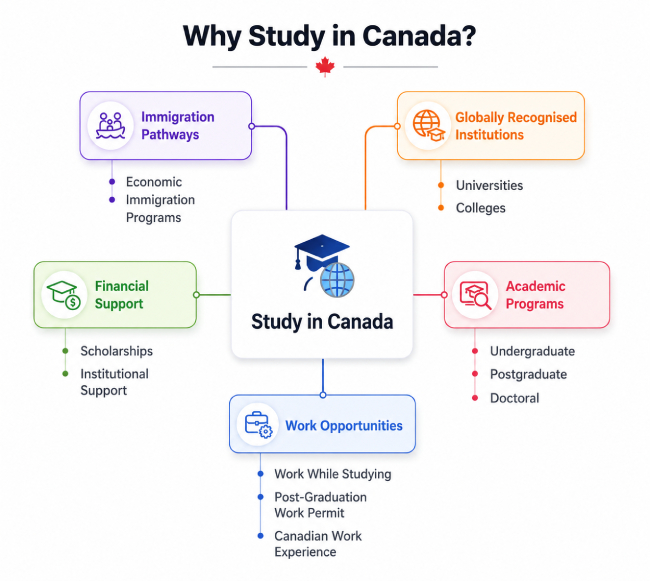
Canada offers a wide range of educational opportunities for international students across technology, engineering, business, healthcare, finance, science, public health, supply chain management, biotechnology, and many other fields.
Major advantages include:
- Recognised universities and colleges offering programs across multiple disciplines.
- Undergraduate, graduate and doctoral programs for students with different academic backgrounds.
- Opportunities to work while studying, provided the student meets the applicable IRCC requirements.
- Post-Graduation Work Permit opportunities for graduates of eligible programs.
- Scholarships and institutional financial assistance for eligible students.
- Canadian work experience that may support future immigration applications.
- Potential PR pathways through programs such as the Canadian Experience Class, Express Entry, and Provincial Nominee Programs.
However, studying in Canada does not automatically result in permanent residence. Similarly, graduating from a Canadian institution does not automatically make every student eligible for a PGWP. Eligibility must be assessed according to the applicable rules.
Canada Study Permit Allocation for 2026
Canada's 2026 study permit allocation is approximately 408,000.
The source divides the allocation into the following categories:
| Category | Allocated Study Permits |
|---|---|
| Applicants requiring PAL/TAL | 180,000 |
| Master's and doctoral students exempt from PAL/TAL | 49,000 |
| Primary and secondary school students | 115,000 |
| Other PAL/TAL-exempt applicants | 64,000 |
| Total | 408,000 |
The applicable attestation requirements depend on the student's program, level of study, province, and exemption category.
Top Universities in Canada for International Students
Canada has several internationally recognised universities offering programs in business, engineering, computer science, healthcare, sciences, social sciences, and other disciplines.
The source lists the following universities based on the QS World University Rankings 2027:
| QS Global Rank | University |
|---|---|
| #32 | University of Toronto |
| #30 | McGill University |
| #45 | University of British Columbia |
| #162 | Université de Montréal |
| #96 | University of Alberta |
| #174 | McMaster University |
| #113 | University of Waterloo |
| #142 | Western University |
| #228 | University of Ottawa |
| #249 | University of Calgary |
| #179 | Queen's University at Kingston |
| #298 | Dalhousie University |
| #312 | Simon Fraser University |
| #370 | University of Victoria |
| #526 | Université Laval |
| #411 | University of Saskatchewan |
| #322 | York University |
| #497 | Concordia University |
| #546 | University of Guelph |
| #560 | University of Manitoba |
| #677 | University of New Brunswick |
| #537 | University of Windsor |
| #721 | Memorial University of Newfoundland |
| #951–1000 | Université de Sherbrooke |
University rankings should be considered alongside program quality, tuition, admission requirements, location, employment opportunities, research facilities, and PGWP eligibility rather than being the only basis for choosing an institution. The source also advises students to verify individual program information directly with the university.
Popular Courses to Study in Canada
Canadian institutions offer programs at different academic levels.
| Program Area | Typical Study Level | Key Considerations |
|---|---|---|
| Computer Science | Bachelor's / Master's | Mathematics, programming and academic prerequisites |
| Data Science / AI | Master's / Graduate | Statistics, mathematics and programming |
| Engineering | Bachelor's / Master's | Academic prerequisites and professional requirements |
| Business / MBA | Master's | Work experience and GMAT/GRE where applicable |
| Nursing | Bachelor's / Master's | Science prerequisites and provincial requirements |
| Public Health | Master's | Relevant bachelor's degree |
| Finance | Bachelor's / Master's | Mathematics, economics and program requirements |
| Engineering Management | Master's | Engineering or technical background |
| Supply Chain Management | Graduate / Undergraduate | Business or related background |
| Biotechnology | Bachelor's / Master's | Biology, chemistry and laboratory prerequisites |
Admission requirements differ between institutions and programs. Students should therefore check the official requirements of the university or college before applying.
Eligibility to Study in Canada
Students generally need to satisfy both academic admission requirements and Canadian immigration requirements.
Common requirements include:
- Admission to a Designated Learning Institution (DLI)
- Meeting the academic prerequisites of the chosen program
- Meeting applicable English or French language requirements
- Demonstrating sufficient funds for tuition and living expenses
- Holding a valid passport or travel document
- Meeting health and character requirements
- Obtaining a study permit where required
Admission to a Canadian institution and approval of a study permit are separate decisions. Receiving an admission offer does not by itself guarantee study permit approval.
Requirements to Study in Canada
A typical study application may require:
- Valid passport
- Academic certificates
- Academic transcripts
- English or French language test results, where required
- Letter of Acceptance (LOA)
- Proof of financial resources
- Statement of Purpose or study plan, where required
- Provincial Attestation Letter (PAL) or Territorial Attestation Letter (TAL), where required
- Quebec Acceptance Certificate (CAQ), where applicable
- Medical examination, where required
- Additional documents requested by the institution or immigration authorities
The exact document checklist depends on the student's nationality, academic program, province, immigration history, and individual circumstances.
Steps to Study in Canada
Step 1: Choose a Course
Select a program that matches your:
- Previous education
- Career objectives
- Academic interests
- Professional experience
- Budget
- Long-term immigration plans
Consider the program's duration, tuition, admission requirements, location, and potential post-graduation opportunities.
Step 2: Select a Canadian Institution
Choose a recognised institution and verify that it is a Designated Learning Institution.
If you intend to work in Canada after graduation, also check whether your specific program meets the applicable PGWP requirements.
Step 3: Check Admission Requirements
Review:
- Academic prerequisites
- Language requirements
- Mathematics or science prerequisites
- Work experience requirements
- GMAT/GRE requirements where applicable
- Portfolio requirements where applicable
- Program-specific conditions
Step 4: Apply to the Institution
Submit the required admission documents and pay the applicable application fee.
Step 5: Receive Your Letter of Acceptance
If the institution approves your application, you receive a Letter of Acceptance (LOA).
The LOA is an important document for the subsequent study permit process.
Step 6: Obtain PAL/TAL or CAQ Where Required
Depending on your program and province, you may need a Provincial Attestation Letter (PAL) or Territorial Attestation Letter (TAL).
Students intending to study in Quebec may need a Quebec Acceptance Certificate (CAQ) where applicable.
Step 7: Prepare Your Finances
You must demonstrate that you have sufficient funds to cover the applicable:
- Tuition
- Living expenses
- Transportation
- Family expenses, where applicable
Step 8: Prepare the Study Permit Application
Prepare your passport, LOA, financial documents, study plan or letter of explanation, attestation documents where required, and other supporting documentation.
Step 9: Submit the Study Permit Application
Submit the application through the appropriate Canadian immigration process and pay the applicable fees.
Step 10: Complete Biometrics and Medical Requirements
Provide biometrics if required and complete a medical examination if requested.
Step 11: Wait for a Decision
IRCC reviews the application and may request additional documents or information.
Step 12: Travel to Canada
If your application is approved, follow the instructions in your approval documents and travel to Canada with the required documentation.
Cost of Studying in Canada
The total cost of studying in Canada consists of considerably more than tuition.
Students should budget for:
- Tuition fees
- Accommodation
- Food
- Transportation
- Health insurance
- Books
- Study materials
- Mobile and internet expenses
- Personal expenses
- Winter clothing
- Initial settlement expenses
The actual amount varies according to the institution, program, province, city, accommodation type, and lifestyle.
Average Tuition Fees in Canada
The source provides the following average annual tuition figures for international students:
| Study Level | Average Annual Tuition |
|---|---|
| International Undergraduate | CAD 41,746 |
| International Graduate | CAD 24,028 |
These are average figures rather than fixed tuition fees. Individual programs can be significantly more or less expensive.
Tuition Fees by Province
Tuition can vary considerably between provinces.
For 2025/26, the source lists the following average international undergraduate tuition figures:
| Province | Average International Undergraduate Tuition |
|---|---|
| Newfoundland and Labrador | CAD 18,867 |
| Ontario | CAD 49,802 |
Students should check the exact tuition charged by their institution and program rather than relying solely on provincial averages.
Tuition Fees by Field of Study
The program you choose can have a major effect on the total cost of education.
Professional and specialised programs such as:
- Medicine
- Dentistry
- Engineering
- Business
- Technology
- Healthcare
may have substantially different tuition costs from general undergraduate or graduate programs.
Always check the university's official fee schedule for the exact intake and program.
Canada Student Visa for Indian Students
Indian students planning to study in Canada generally need to complete both an institutional admission process and an immigration process.
The typical sequence is:
Choose a DLI → Apply for admission → Receive LOA → Obtain PAL/TAL or CAQ where required → Prepare financial documents → Apply for study permit → Biometrics/medical if required → Receive decision → Travel to Canada.
Students should check the current IRCC requirements before submitting their application because financial requirements, attestation requirements, and other policies can change.
Canada Study Permit Requirements for Indian Students
Common requirements include:
- Letter of Acceptance from a DLI
- PAL/TAL unless exempt
- CAQ for Quebec, where required
- Proof of sufficient funds
- Valid passport
- Biometrics where required
- Medical examination where required
- Police certificate where requested
- Letter of explanation or study plan
- Evidence demonstrating that you satisfy Canada's temporary-residence requirements
IRCC can request additional documents depending on the applicant's circumstances.
Do You Need IELTS for a Canada Student Visa?
There is no single IELTS score prescribed by IRCC for every Canadian study permit applicant.
Language requirements can come from the university or college, rather than being a universal study permit requirement.
Depending on the institution and program, students may be able to demonstrate English or French proficiency through different accepted tests or methods.
Possible tests accepted by institutions can include:
- IELTS
- TOEFL
- PTE
- CAEL
- Duolingo English Test
The accepted test and required score depend on the institution and program. Students should therefore check the specific admission requirements before taking a language test.
What Is a Designated Learning Institution?
A Designated Learning Institution (DLI) is a Canadian educational institution approved by a provincial or territorial government to host international students.
For post-secondary study, students generally need an LOA from a DLI when applying for a study permit.
However, being a DLI does not automatically mean that every program offered by that institution is eligible for a Post-Graduation Work Permit.
Students planning to work in Canada after graduation should verify the PGWP eligibility of their specific program, not simply the institution's DLI status.
How to Choose the Right DLI
Before accepting an admission offer, evaluate:
- DLI status
- Specific program's PGWP eligibility
- Tuition fees
- Program duration
- Admission requirements
- Location
- Cost of living
- Co-op or internship opportunities
- Graduate employment opportunities
- Scholarships
- Industry connections
Choosing an institution only because it is listed as a DLI is not sufficient. The program itself should be examined carefully.
Proof of Funds for Canada Study Permit
Students must demonstrate that they have enough money to support their studies and stay in Canada.
Funds may need to cover:
- Tuition fees
- Living expenses
- Transportation to Canada and back
- Living expenses of accompanying family members, where applicable
Financial requirements are updated periodically, so students should verify the latest IRCC amount before submitting an application.
Acceptable Proof of Funds
Depending on the circumstances, financial evidence can include:
- Bank statements
- Proof of tuition payment
- Proof of accommodation payment
- Canadian bank account
- Guaranteed Investment Certificate (GIC), where applicable
- Student or education loan
- Bank draft
- Scholarship or financial support letter
- Documents showing financial support from another person or institution
The source also identifies bank statements covering the previous four months as one possible form of evidence. The appropriate financial documents can vary depending on the applicant's situation.
Canada Study Permit Fees
The source lists the following study permit fees:
| Fee | Amount |
|---|---|
| Study Permit Application | CAD $150 |
| Biometrics — Individual | CAD $85 |
| Study Permit + Biometrics | CAD $235 |
Additional expenses can include:
- Medical examination
- Police certificate
- Language testing
- Translation
- Visa Application Centre services
- Travel
- Document preparation
These costs are separate from the study permit fee.
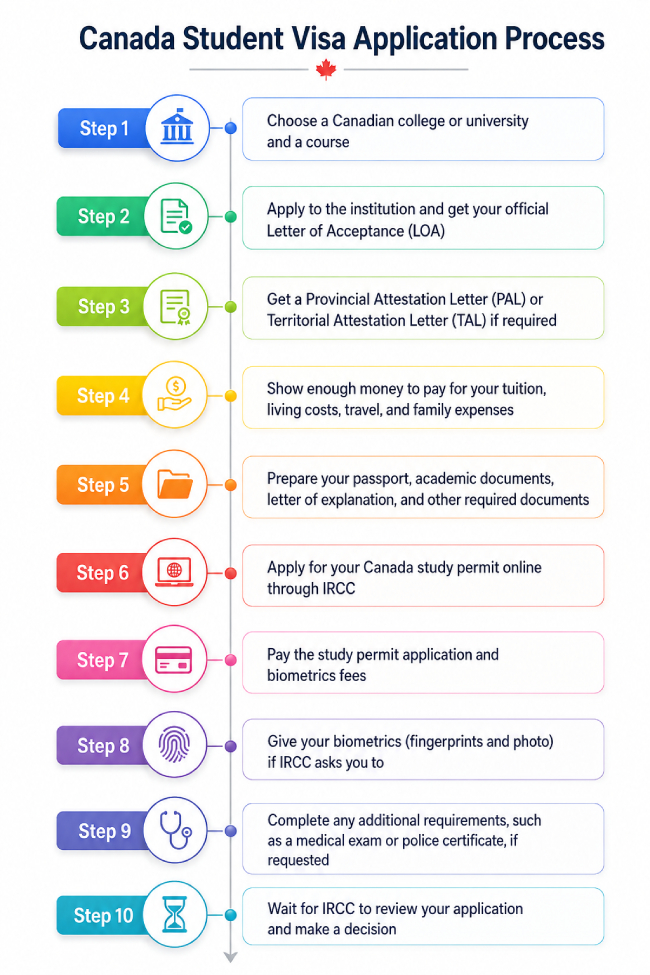
Canada Student Visa Application Process
The application can be divided into the following stages:
1. Select your institution and program
Choose a DLI and an appropriate course based on your academic and career objectives.
2. Apply for admission
Submit academic records, language scores, identification, recommendation letters, CV, portfolio, or other documents required by the institution.
3. Receive the LOA
Once admitted, obtain the official Letter of Acceptance.
4. Obtain PAL/TAL or CAQ
Complete the applicable provincial or territorial attestation process, or determine whether you qualify for an exemption.
5. Arrange finances
Prepare sufficient evidence for tuition, living expenses, transportation, and applicable family expenses.
6. Prepare the immigration application
Prepare the study plan/letter of explanation and all required supporting documents.
7. Apply for the study permit
Submit the application through IRCC and pay the applicable fees.
8. Complete biometrics
Complete biometrics if IRCC requires them.
9. Complete additional requirements
Complete medical examinations, police certificates, or additional documentation if requested.
10. Wait for the decision
IRCC reviews the application and makes a decision.
11. Travel to Canada
If approved, follow the instructions provided and carry the necessary documentation when travelling to Canada.
Canada Study Permit Processing Time
There is no single fixed processing time for every Canadian study permit application.
Processing can depend on:
- Country of application
- Type of application
- Completeness of documentation
- Biometrics
- Background checks
- Medical examination
- Additional document requests
- IRCC workload
Students should check the current IRCC processing-time tool before applying instead of relying on a fixed number of weeks or months.
Cost of Living in Canada for Students
Living expenses depend heavily on the city and lifestyle.
Major expenses include:
- Accommodation
- Food and groceries
- Transportation
- Mobile phone
- Internet
- Health insurance
- Books
- Study materials
- Personal expenses
- Winter clothing
- Initial settlement expenses
Housing costs can vary considerably between cities. Large metropolitan areas such as Toronto and Vancouver can have significantly higher accommodation costs than many smaller Canadian cities.
Students should create a monthly budget before travelling rather than assuming that the minimum proof-of-funds amount represents their complete cost of living.
Accommodation Options for International Students
Students can consider:
University or College Residence
On-campus accommodation can be convenient, particularly for students arriving in Canada for the first time.
Shared Rental
Sharing an apartment or house can reduce accommodation costs.
Private Rental
Students can rent an apartment independently, although they may need to provide deposits, references, identification, or proof of income depending on the landlord.
Homestay
Homestays allow students to live with a Canadian host family and can provide a structured living environment.
Temporary Accommodation
Students may use hotels, short-term rentals, or other temporary accommodation while searching for longer-term housing after arrival.
Scholarships to Study in Canada
International students can explore scholarships and financial assistance offered by:
- Canadian universities
- Colleges
- Provincial governments
- Private organisations
- Foundations
- International organisations
- Other scholarship providers
Scholarship amounts and eligibility vary considerably.
Some scholarships may be based on:
- Academic performance
- Leadership
- Research
- Extracurricular achievements
- Community involvement
- Program of study
- Financial need
- Specific nationality or demographic criteria
Students should check the official scholarship provider's eligibility rules and deadlines.
How to Apply for a Canada Scholarship
Step 1: Search for scholarships
Look at university scholarships, government programs, private organisations, foundations, and other funding sources.
Step 2: Check eligibility
Review:
- Academic requirements
- Language requirements
- Study level
- Program requirements
- Citizenship requirements
- Financial conditions
- Application deadlines
Step 3: Prepare documents
Common documents can include:
- Academic transcripts
- CV
- Recommendation letters
- Personal statement
- Research proposal, where applicable
- Proof of achievements
- Other scholarship-specific documents
Step 4: Submit before the deadline
Scholarship deadlines can be significantly earlier than university admission or study permit deadlines.
Step 5: Highlight your achievements
Include relevant:
- Academic achievements
- Leadership
- Research
- Volunteering
- Extracurricular activities
- Professional experience
Step 6: Follow the provider's application procedure
Some scholarships require direct applications, while others are considered automatically through the institution's admission process.
Can International Students Work While Studying in Canada?
Eligible international students may be permitted to work while studying without obtaining a separate work permit, provided they meet the applicable IRCC conditions.
For eligible students, off-campus work can generally be:
- Up to 24 hours per week during regular academic periods
- Unlimited during scheduled breaks, subject to the applicable requirements
Students must continue meeting the conditions of their study permit.
Who Can Work Off Campus?
Students generally need to:
- Hold a valid study permit
- Study full-time at a DLI
- Be enrolled in an eligible program
- Be studying in a qualifying program of at least six months that leads to an eligible credential
- Continue meeting the conditions of their study permit
Students generally cannot begin working before their study program starts.
Can Students Work On Campus?
Eligible international students may also work on campus without a fixed weekly hour limit during regular study periods and scheduled breaks, provided they continue to meet the applicable requirements.
Students should verify their specific eligibility and study permit conditions before beginning employment.
Popular Part-Time Jobs for Students
International students may find part-time employment in areas such as:
- Retail
- Hotels
- Hospitality
- Restaurants
- Customer service
- Administration
- Tutoring
- Campus services
- Research assistance
- Library services
The availability and salary of part-time employment depend on the city, employer, student's skills, and previous experience.
Students should not rely on part-time employment as their primary source of funds for tuition and living expenses. They must demonstrate sufficient financial resources for their study permit application.
Post-Graduation Work Permit (PGWP)
The Post-Graduation Work Permit (PGWP) allows eligible graduates to gain Canadian work experience after completing an eligible study program.
However, two important points should be understood:
- Graduating from a DLI does not automatically make you eligible for a PGWP.
- The specific program and other eligibility requirements must be satisfied.
Students who intend to work in Canada after graduation should therefore check PGWP eligibility before selecting their program.
PGWP Duration
For eligible programs other than master's programs, the source provides the following framework:
| Program Duration | Possible PGWP Duration |
|---|---|
| At least 8 months but less than 2 years | Up to the same length as the program |
| 2 years or longer | Up to 3 years |
Eligible master's degree graduates may qualify for a 3-year PGWP even where the master's program is less than two years, provided the program is at least eight months and all other requirements are met.
Passport expiry can also limit the length of the PGWP.
PGWP Field-of-Study Requirements
The source states that bachelor's, master's, and doctoral graduates do not have a field-of-study requirement for PGWP eligibility.
For certain other university, college, polytechnic, and non-university programs, an eligible field of study may be required where the applicable study permit application was submitted on or after November 1, 2024.
The source also states that the eligible field-of-study list was frozen for 2026.
Students should verify the exact program, CIP code, and current PGWP rules before selecting a course because PGWP eligibility is an important consideration for students planning to work in Canada after graduation.
Can You Get PR After Studying in Canada?
Yes, international graduates may be able to apply for permanent residence if they qualify for an eligible immigration program.
However, studying in Canada does not guarantee PR.
A common progression can be:
Study in Canada → Graduate from an eligible program → Obtain PGWP if eligible → Gain qualifying Canadian work experience → Apply through an eligible PR pathway.
The exact pathway depends on the graduate's occupation, work experience, language ability, CRS score, province, and other factors.
Popular PR Pathways for International Graduates
Canadian Experience Class
The Canadian Experience Class (CEC) is an Express Entry pathway for eligible skilled workers with qualifying Canadian work experience.
Express Entry
Eligible graduates can create an Express Entry profile and compete for an Invitation to Apply based on their CRS score and the type of Express Entry selection taking place.
Provincial Nominee Programs
Canadian provinces and territories operate their own immigration programs, some of which provide pathways for eligible international graduates and skilled workers.
The appropriate pathway depends on the graduate's individual profile and the immigration rules in effect at the time of application.
Canada Study Permit Validity
A Canadian study permit is generally issued for the duration of the student's authorised study period.
The source states that a study permit generally becomes invalid 90 days after completion of studies, although other circumstances can also affect its validity.
Students should always check:
- Study permit expiry date
- Conditions printed on the permit
- Institution listed on the permit
- Requirements for changing institutions
- Whether an extension is required
If additional time is required to continue studying, the student should determine whether an extension is necessary before the existing authorization expires.
Study in Canada with WorldVisaHelp
WorldVisaHelp can assist students throughout the Canadian education and immigration planning process.
Our support can include:
- Course and university selection guidance
- DLI and program assessment
- Admission application guidance
- Academic profile evaluation
- Language-test guidance
- Scholarship search guidance
- Financial documentation guidance
- Study plan and statement preparation
- PAL/TAL and CAQ guidance where applicable
- Canada study permit documentation
- Study permit application assistance
- Biometrics and medical guidance
- Family application guidance
- PGWP eligibility assessment
- Post-study career planning
- Express Entry and PR pathway assessment
Plan Your Canada Education Pathway
Choosing a Canadian course should not be based only on tuition fees or university rankings. Students should evaluate the program, DLI status, PGWP eligibility, total cost, location, career prospects, and potential immigration options before making a decision.
WorldVisaHelp can help you evaluate these factors and plan your study journey from admission through study permit and, where eligible, post-graduation work and permanent residence pathways.
Frequently Asked Questions About Studying in Canada
Get detailed answers about studying in Canada, study permits, admission, tuition fees, scholarships, part-time work, PGWP and permanent residence.
Canada offers a wide range of undergraduate, graduate and doctoral programs through universities, colleges and other Designated Learning Institutions (DLIs). International students can access programs in areas such as technology, engineering, business, healthcare, finance, science and management.
Eligible students may also work while studying and, after completing an eligible program, may qualify for a Post-Graduation Work Permit (PGWP). Canadian work experience can potentially support a later permanent residence application if the graduate meets the requirements of an eligible immigration program.
Studying in Canada does not automatically guarantee a PGWP or permanent residence. Both must be assessed separately.
The cost of studying in Canada depends on the institution, program, level of study and province. In addition to tuition, students need to budget for accommodation, food, transportation, health insurance, books, personal expenses and initial settlement costs.
The source lists average annual international tuition of approximately CAD $41,746 for undergraduate programs and CAD $24,028 for graduate programs. These are national averages and should not be treated as the exact tuition fee for a particular university or course.
Students should always check the official fee schedule of their selected institution before preparing their financial plan.
Students must demonstrate that they have sufficient funds for the applicable tuition, living expenses and transportation costs. If eligible family members accompany the student, additional funds may also be required.
Proof of funds can include bank statements, tuition or housing payment records, a Canadian bank account, an eligible GIC, an education loan, a bank draft, scholarship documentation or evidence of financial support.
Financial requirements can change, so students should verify the current IRCC requirements before submitting a study permit application.
Students generally need admission to a Designated Learning Institution, must satisfy the academic requirements of their chosen program and must meet the applicable Canadian immigration requirements.
Depending on the application, requirements can include:
- Admission to an eligible Canadian institution
- Academic qualifications and transcripts
- English or French language proficiency where required
- Sufficient financial resources
- A valid passport or travel document
- Medical examination where required
- Police certificate or other admissibility documents where required
- PAL/TAL or another applicable document where required
A Designated Learning Institution (DLI) is a Canadian educational institution approved by a provincial or territorial government to host international students.
Students applying for a post-secondary study permit generally need a Letter of Acceptance from a DLI.
However, being enrolled at a DLI does not automatically make every program eligible for a Post-Graduation Work Permit. Students who intend to work in Canada after graduation should verify the PGWP eligibility of their specific program before accepting an offer.
Choosing an institution should involve more than comparing university rankings. Students should consider whether the institution and specific program match their academic and career objectives.
Important factors include:
- DLI status
- PGWP eligibility of the specific program
- Tuition fees
- Program duration
- Admission requirements
- Location and cost of living
- Co-op and internship opportunities
- Graduate employment opportunities
- Scholarship availability
Students should verify current program information directly with the institution before making a final decision.
Popular study areas include Computer Science, Data Science and AI, Engineering, Business and MBA programs, Nursing, Public Health, Finance, Engineering Management, Supply Chain Management and Biotechnology.
The right course depends on your previous education, academic qualifications, career objectives, budget and the admission requirements of the institution.
Students should also evaluate the program's duration, career prospects and PGWP eligibility if working in Canada after graduation is part of their long-term plan.
There is no single IELTS score that applies to every Canadian study permit applicant. Language requirements are often determined by the university or college and the specific program.
Depending on the institution, students may be able to use IELTS, TOEFL, PTE, CAEL, Duolingo or another accepted form of language evidence.
Students should check the exact English or French language requirements of their chosen DLI and program before booking a test.
The exact document checklist depends on the student's circumstances, program and place of application. Common documents can include:
- Valid passport
- Letter of Acceptance from a DLI
- Academic certificates and transcripts
- Language test results where required
- Proof of sufficient funds
- PAL/TAL where required
- CAQ for Quebec where required
- Statement of Purpose or study plan where required
- Biometrics where required
- Medical examination where required
- Police certificate where requested
- Additional documents requested by IRCC
A Provincial Attestation Letter (PAL) or Territorial Attestation Letter (TAL) is required for certain international students as part of Canada's study permit system.
Not every student needs a PAL or TAL. Certain categories, including some master's and doctoral students and other exempt applicants, may be exempt depending on the applicable rules.
Students should determine whether their specific program and situation require an attestation letter before submitting their study permit application.
Students planning to study in Quebec may need a Quebec Acceptance Certificate (CAQ), depending on their program and circumstances.
The CAQ is part of the Quebec-specific process and is separate from the federal study permit application.
Students should determine the current Quebec requirements before applying for their Canadian study permit.
The study permit application fee listed in the source is CAD $150.
If biometrics are required, the individual biometrics fee listed is CAD $85, making the combined study permit and individual biometrics amount CAD $235.
Other expenses, such as medical examinations, police certificates, language tests, translations and Visa Application Centre services, are separate from the study permit fee.
There is no fixed processing time that applies to every Canadian study permit application.
Processing can vary depending on the country from which you apply, application type, completeness of documentation, biometrics, background checks, additional document requests and IRCC workload.
Students should check the latest official IRCC processing-time estimate before submitting their application rather than relying on a fixed number of weeks or months.
Eligible international students may work while studying in Canada without obtaining a separate work permit, provided they meet the applicable IRCC conditions.
Eligible students can generally work up to 24 hours per week during regular study periods and can work unlimited hours during scheduled academic breaks, subject to the applicable rules.
Students must continue to meet the conditions of their study permit. They should also ensure that they are eligible to work before beginning employment.
Eligible international students may work on campus without a fixed weekly hour limit during regular study periods and scheduled breaks, provided they continue to satisfy the applicable requirements.
Students should verify their eligibility and study permit conditions before beginning on-campus employment.
The Post-Graduation Work Permit (PGWP) allows eligible graduates to gain Canadian work experience after completing an eligible study program.
Graduating from a Designated Learning Institution does not automatically make a student eligible for a PGWP. The specific institution, program and other eligibility conditions must satisfy the applicable requirements.
Students who intend to work in Canada after graduation should verify PGWP eligibility before selecting their program.
PGWP duration depends on the length and type of the eligible study program and the applicable immigration rules.
For eligible programs other than master's programs, the source provides the following general framework:
- Programs of at least 8 months but less than 2 years may qualify for a PGWP of up to the same length as the program.
- Programs of 2 years or longer may qualify for a PGWP of up to 3 years.
Eligible master's graduates may qualify for a 3-year PGWP even when the master's program is less than two years, provided the applicable requirements are satisfied. Passport validity can also affect the length of the permit.
No. Graduation from a Canadian DLI does not automatically guarantee PGWP eligibility.
PGWP eligibility can depend on the institution, specific program, program length, credential, the applicable field-of-study rules and other requirements.
Students planning to use Canadian education as a route toward post-graduation work should verify the PGWP eligibility of the exact program before enrolling.
International graduates may qualify for permanent residence if they satisfy the requirements of an eligible Canadian immigration program.
A common progression can be:
Study in Canada → Graduate → Obtain a PGWP if eligible → Gain qualifying Canadian work experience → Apply for an eligible PR pathway.
Potential pathways include the Canadian Experience Class (CEC), Express Entry and Provincial Nominee Programs. Studying in Canada itself does not guarantee permanent residence.
WorldVisaHelp can assist students in planning their Canadian education pathway from course selection through study permit preparation and post-graduation planning.
Support can include:
- Academic profile assessment
- Course and university selection
- DLI and program assessment
- Admission application guidance
- Language-test guidance
- Scholarship guidance
- Financial-document preparation guidance
- Study plan and statement guidance
- PAL/TAL and CAQ guidance where applicable
- Canada study permit application assistance
- Biometrics and medical guidance
- PGWP eligibility assessment
- Post-study work planning
- Express Entry and PR pathway assessment
The objective is to help students choose a suitable program, understand the immigration requirements, prepare their documentation, and plan their education and post-study pathway in Canada.